SPCC Closure Rules and New Jersey Underground Tank Closure Steps for Facility Owners
When a tank at your facility reaches the end of its life, or you stop using it for good, the question is what you have to do to be finished with it. There are two sets of rules, and people tend to mix them up. The federal oil spill plan rule, called SPCC for Spill Prevention, Control, and Countermeasure, has a specific definition of what makes a container "permanently closed." If your tank is buried, New Jersey's underground storage tank (UST) rules add a separate closure process run through NJDEP.
This article covers both. We'll explain what permanent closure means under the SPCC rule, how it takes a container out of your oil storage count, what New Jersey requires for regulated underground tanks, and what to check before you start. If your closure raises questions about your oil spill plan, you can reach out to RMA and we'll help you work through the plan side.
Table of Contents
TL;DR
Under the federal SPCC rule, a tank is permanently closed only when it's emptied, its piping is disconnected and blanked off, its valves are closed and locked, and it carries a dated sign saying it's permanently closed. A tank that meets that test stops counting toward your 1,320 gallon aboveground total. If the tank is a regulated underground tank in New Jersey, closure is a separate process that needs an NJDEP certified closure contractor, a notice to NJDEP at least 14 days ahead, and a site investigation for contamination. Closing a tank also means updating your oil spill plan.
What Does "Permanently Closed" Mean for an Oil Tank Under SPCC?
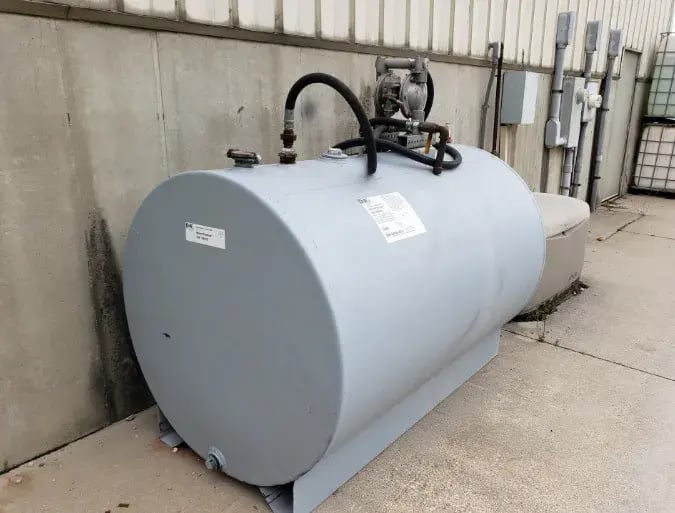
The SPCC rule is the federal oil spill prevention rule found in 40 CFR Part 112. It defines "permanently closed" in 40 CFR 112.2, and the definition is a checklist, not a judgment call. A tank that's sitting empty in the corner of your yard isn't necessarily permanently closed under the rule. It has to meet all four conditions below, and if any one is missing, the tank still counts as an oil container at your facility.
| What the rule requires |
What it looks like on site |
| All liquid and sludge removed from the container and its connecting lines |
The tank and the piping running to it are pumped out and cleaned, with the removed oil and sludge handled and documented as waste |
| Connecting lines and piping disconnected from the container and blanked off |
Fill lines, supply lines, and vent connections are physically separated and capped, not just valved shut |
| All valves, except ventilation valves, closed and locked |
Every remaining valve has a lock on it, and the locks stay on |
| Conspicuous signs posted on each container stating that it's permanently closed, with the date |
A visible sign on the tank that anyone walking by can read |
The practical trap is the half-closed tank. A tank that's been drained but still has an open valve, a fill line attached, or no sign hasn't met the definition. It still counts toward your storage total, and it still belongs in your plan, your inspections, and your containment calculations. We recommend taking dated photos of the sign, the blanked connections, and the locks, and keeping the waste records with your plan, so you can show an inspector exactly what you did and when.
How Does Closing a Tank Remove It From Your SPCC Oil Storage Count?
The SPCC rule applies to facilities that store more than 1,320 gallons of oil aboveground, counting only containers of 55 gallons or larger. Under 40 CFR 112.1(d)(2)(ii), capacity from a permanently closed container is excluded from that total. The same exclusion applies to the buried storage calculation. So closing a tank properly can lower your count, and for some facilities it can lower it enough to change whether the federal rule applies at all.
The count works on capacity, not on what's in the tank today. A 1,000 gallon tank that's half full counts as 1,000 gallons, and one that's empty but not yet permanently closed still counts as 1,000 gallons. A simple example shows how the math shifts.
| Container |
Capacity |
Counted before closure |
Counted after closure |
| Aboveground diesel tank (in use) |
1,000 gallons |
1,000 |
1,000 |
| Old used oil tank (permanently closed) |
600 gallons |
600 |
0 |
| Hydraulic oil tank (permanently closed) |
500 gallons |
500 |
0 |
| Total |
|
2,100 |
1,000 |
In this example, the facility goes from above the 1,320 gallon threshold to below it. Your own numbers will differ, because every container of 55 gallons or more counts, including drums, totes, and oil-filled equipment, and one permanently closed tank may not be enough to change the answer. If your total does drop below the threshold, confirm that with a full recount before you set the plan aside, because the state's discharge reporting and cleanup liability don't depend on the 1,320 gallon number. Our guide on inventorying oil tanks, drums, and equipment shows how to do the recount without missing hidden oil.
If you stay above the threshold, the closed tank still needs to come out of the plan's active inventory. The plan should list it as permanently closed, show it that way on the facility diagram, and drop it from the containment and inspection sections. How you handle that revision depends on what else changed, and our article on replacing an old tank and SPCC amendments covers when a change calls for a Professional Engineer's review and approval.
What Are the Steps to Permanently Close an Aboveground Oil Tank?
For an aboveground tank, permanent closure is mostly a matter of doing the four things in the definition in the right order and writing down that you did them. Start by arranging for the oil and sludge to be removed and handled properly. What you do with the removed material depends on what it is, since used oil and waste oil follow their own rules, and the hauler or contractor you hire should give you paperwork you can keep. Then have every line to the tank disconnected and capped, close and lock the valves, and post the sign with the date. Photograph all of it.
Whether you leave the tank in place or take it away is a separate decision. A permanently closed tank can stay on site and stay out of your count, as long as it stays closed. If anyone reconnects it and puts oil back in, it counts again. Removing the tank entirely is cleaner, and it takes the question off your inspection list, but removal can bring its own local permit and fire code requirements, and your local fire official or contractor can tell you what applies. We cover the broader decision between keeping, closing, and removing in going idle or closing a New Jersey facility.
Is Your Underground Oil Tank Regulated by New Jersey's UST Rules?
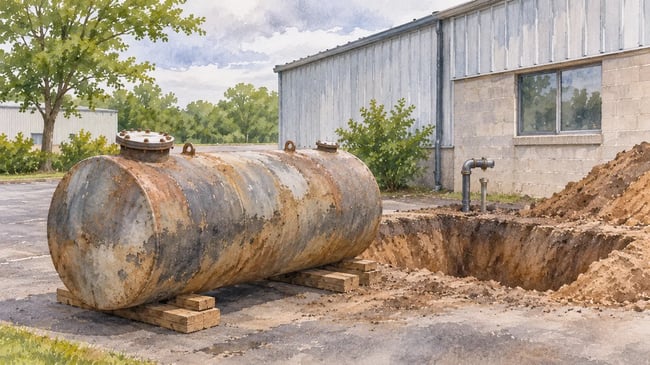
A completely buried tank is a different animal from an aboveground one. Buried tanks that are subject to federal UST technical requirements are generally outside the SPCC rule, though they still belong on your facility diagram. The state has its own program, the Underground Storage Tank rules at N.J.A.C. 7:14B, and whether a given tank is regulated under it depends on what the tank holds and how big it is.
Heating oil is where most of the confusion comes from. NJDEP treats heating oil tanks used to heat a residential building, and heating oil tanks of 2,000 gallons or less at nonresidential buildings, as unregulated. Heating oil tanks above 2,000 gallons at a nonresidential building are regulated by the state, and so are tanks holding motor fuels for nonresidential use or sale, hazardous substances, and heating oil for sale or distribution. Small farm and residential motor fuel tanks (1,100 gallons or less in aggregate) are exempt. If you're not sure which category your tank falls into, ask a certified UST firm or check N.J.A.C. 7:14B-1.4 against your own tank details.
"Unregulated" doesn't mean there are no rules. Only NJDEP certified individuals and firms can perform services on unregulated heating oil tanks, and the Heating Oil Tank System Remediation Rules at N.J.A.C. 7:26F cover closing those tanks and cleaning up discharges from them. Our article on heating oil tanks at New Jersey businesses explains how those tanks interact with the federal spill rules.
What Are New Jersey's UST Closure Steps for Certified Contractors, NJDEP Notice, and Site Assessment?
For a regulated UST, N.J.A.C. 7:14B-9.2 sets the closure process. Whether you remove the tank or abandon it in place, the work has to be done by a contractor certified for UST closure under N.J.A.C. 7:14B. The order of events below follows the rule and NJDEP's guidance, and your closure contractor and licensed site remediation professional (LSRP) will walk you through the details for your site.
- Make sure the facility is registered. You can't close a tank at a facility that isn't registered with NJDEP, so if it's not, registering comes first.
- Hire a certified closure firm and an LSRP. The notice of intent to close identifies the certified business firm doing the closure work and the LSRP handling remediation. NJDEP publishes a list of certified UST firms, and the rules call for a written contract with the certified firm.
- File the notice of intent to close with NJDEP. It's filed through NJDEP Online at least 14 calendar days before the planned closure date, and it includes the facility registration number, whether the tank is being removed or abandoned in place, the closure date, and the firm and LSRP information. NJDEP generates an approval automatically when you submit.
- Send the approval to local authorities. Give a copy to the municipal and county health departments at least 14 calendar days before closure, and to the local authority along with your application for a local demolition permit. Closures also have to comply with the Uniform Construction Code.
- Follow the closure plan. For tanks holding hazardous substances that aren't hazardous waste, the plan includes a site investigation and a tank decommissioning plan, and it has to be kept at the facility. Closure follows API Recommended Practice 1604, and the tank is inspected for holes.
- Report any discharge. If the contractor finds holes or a discharge, it has to be reported to the NJDEP hotline unless it was already reported. NJDEP's website has the current hotline number.
- Remove the tank, or abandon it in place only if the rule allows. Abandonment in place is allowed only where removal isn't feasible or no contamination above standards is found, and it requires a New Jersey licensed Professional Engineer's statement, thorough cleaning, filling the tank with inert material, and removing fill pipes to at least a foot below grade.
- Assess the soil and groundwater. The site assessment checks for contamination around the tank. If contamination above a remediation standard turns up, cleanup proceeds under N.J.A.C. 7:26C, typically with an LSRP overseeing it. The rules set deadlines for the site investigation report, so ask your closure firm and LSRP for the dates that apply to your tank.
A tank that's out of service for more than 12 months generally has to be closed under these rules, with limited exceptions, so letting a regulated tank sit unused isn't a way to avoid the process. Closure costs vary a lot with tank size, access, and whether contamination turns up. We don't price tank closures, so get quotes from certified firms and compare what each one includes.
What Else Should You Check Before Closing an Oil Tank in New Jersey?
A few other New Jersey programs can sit behind a tank closure. If contamination turns up, the Spill Act's liability provisions come into play, and Spill Act liability can be broad, so talking with an environmental attorney before you commit to a plan is reasonable. If the closure is tied to selling, leasing, or shutting down an operation, the Industrial Site Recovery Act (ISRA) may apply to the transaction, and we cover the sale side in buying or selling a facility with oil tanks. If your facility is a "major facility" under N.J.A.C. 7:1E, which depends on how much it stores and what it stores, you may have state discharge prevention and cleanup plans to revise too, and our comparison of SPCC and DPCC plans explains how the two relate.
We also want to be clear about where we fit. We don't perform tank removals or UST closures, we don't prepare the construction-phase or demolition permits that can come with them, and we don't oversee cleanups. Those jobs belong to your certified closure contractor, your contractor or engineer, and an LSRP. What we do is the operational side: making sure your oil spill plan, inventory, containment calculations, inspections, and training reflect the tank's closure once it's done.
Finally, don't let the paperwork lag the field work. The plan should be revised soon after the closure, and the five-year review is a good time to catch anything that got missed, as we explain in the five-year review rule. A plan that still describes a tank that's gone, or omits a tank that's still there, is one of the easier things for an inspector to find.
How Can RMA Help With the SPCC Side of an Oil Tank Closure?
If you're closing tanks and want your oil spill plan to match what's on the ground, we can help. That usually means recounting your oil storage, confirming whether the closure changes your federal requirements, documenting the closed containers the way the rule expects, and rebuilding or revising the plan so it holds up. When a change needs a Professional Engineer's review and approval, we build that step into the schedule. If you'd like a second set of eyes on whether a tank counts as closed, we're happy to look.
There's no obligation in a conversation. You can call us at 888-RMA-0230, email us, or fill out the form on our website, and you can contact RMA with a short description of the tank and what you're planning. If you're still sorting out what your plan should cover, our guide to what goes into an SPCC plan for a New Jersey facility is a good place to start.