The 5G3 Covers Construction Activity, Industrial Permits Cover Ongoing Operations, and Some Facilities Need Both
New Jersey facility owners often hear "stormwater permit" and assume it's one permit with one set of rules. It's not. NJDEP runs two separate tracks, and they're tied to two different moments in a property's life. One covers the period when you're clearing, grading, and building. The other covers the years when a business is up and running and rain is hitting its yard, its piles, and its loading areas.
This article walks through the 5G3 construction stormwater general permit, the industrial stormwater permits NJDEP issues for operating facilities, and how Soil Conservation District certification fits in. We'll also cover the situations where a single site needs both, like an expansion at a plant that's already permitted. If you're not sure which one applies to your project, you can always reach out to RMA and we'll help you sort it out.
Table of Contents
TL;DR
The 5G3 is New Jersey's general permit for stormwater from construction activity. It's tied to a soil erosion and sediment control plan certified by your local Soil Conservation District, and it lasts for the project. Industrial stormwater permits, like the 5G2 and the industry-specific permits, cover a facility's ongoing operations for as long as it runs. They're separate permits for separate activities. A facility needs both when it builds or expands on a site that disturbs enough land while it operates, or when a brand new facility has to get through construction first and then start operating.
What Does the 5G3 Construction Stormwater Permit Cover?
The 5G3 is a NJPDES general permit for stormwater discharges from construction activity. NJPDES is the New Jersey Pollutant Discharge Elimination System, the state's program for permitting discharges to surface water and groundwater, and it's run by NJDEP. The 5G3 deals with the muddy, sediment-heavy runoff that leaves a site while the ground is torn up: clearing, grading, excavating, stockpiling soil, and everything else that exposes bare earth to rain.
The trigger is the amount of land you disturb. NJDEP and the Soil Conservation Districts have long described the threshold as clearing, grading, or excavating that disturbs one acre or more, or less than one acre when the work is part of a larger plan of development or sale. A developer can't dodge the permit by splitting a big project into small lots. If you're close to the line, ask your Soil Conservation District before you assume you're under it.
The permit has to be in hand before soil is disturbed. NJDEP takes applications for it through its online e-permitting system, which replaced paper Request for Authorization forms back in 2009, and the current 5G3 final permit took effect on March 1, 2022. The permit also comes with construction-side duties of its own, including controls for things like concrete washout, chemical storage, waste handling, and spill response on the job site. The permit document spells out the plan, inspection, and reporting requirements, and whoever is running the construction should work from the current version.
What Do New Jersey Industrial Stormwater Permits Cover?
Industrial stormwater permits cover something different: rain that touches a working facility. If trucks are fueled outside, scrap is stacked in the yard, aggregate sits in open piles, or materials and equipment are exposed to the weather, runoff from those areas can carry pollutants off the property. NJDEP regulates that runoff through permits tied to the type of operation, not the construction of the building. If you want the full plain-English version of who needs one, our guide on how to determine whether your facility needs an industrial stormwater permit walks through it.
New Jersey doesn't use a single industrial permit. Most facilities with covered industrial activity land in the Basic Industrial Stormwater General Permit, the 5G2, which we explain in our plain-English guide to the 5G2. Certain industries get their own general permits instead, including concrete products manufacturing (CPM), hot mix asphalt (R4), mining and quarrying (R13), sand and gravel (RSG), scrap metal (SM and SM2), vehicle recycling (RVR), and wood waste recycling and leaf composting (WRC). A few facilities need an individual permit, and facilities with no exposure to rain can qualify for an exclusion instead of a permit. Our post on which permit fits a concrete, asphalt, or quarry operation shows how that sorting works in practice.
What these permits share is the timeline. They aren't tied to a project. They apply for as long as the facility operates with covered activity and exposed areas, and they bring a stormwater pollution prevention plan (SWPPP, which some people call an SPPP, an SP3, or just a stormwater plan), best management practices, inspections, and annual reporting. Some categories also involve sampling and monitoring, and others don't, so what you owe depends on the permit you're under. If you want to understand the plan itself, start with what a SWPPP is and what goes in it.
5G3 vs. Industrial Stormwater Permits: Side-by-Side Comparison
Here's how the two tracks compare on the points that most often cause confusion. Details vary by project and by which industrial permit applies, so treat this as a map and check the current permit document before you act on any one row.
| Question |
5G3 Construction Permit |
Industrial Stormwater Permits |
| What does it cover? |
Stormwater from clearing, grading, excavating, and other construction activity |
Stormwater from the ongoing operations of an industrial facility |
| What triggers it? |
Disturbing one acre or more of land, or less than an acre as part of a larger plan of development |
Covered industrial activity with materials or operations exposed to stormwater |
| Which permits are there? |
One statewide general permit (5G3) |
5G2, industry-specific general permits (CPM, R4, R13, RSG, SM/SM2, RVR, WRC), individual permits, or a no exposure exclusion |
| Who reviews the site plan? |
Your local Soil Conservation District certifies the soil erosion and sediment control plan |
NJDEP administers the permit, with no Soil Conservation District certification step |
| How do you apply? |
Online through NJDEP's e-permitting system, alongside the certified plan |
A Request for Authorization to NJDEP, with the process depending on the permit category |
| What plan is required? |
A soil erosion and sediment control plan plus construction site controls |
An industrial SWPPP with best management practices for the facility's exposed areas |
| How long does it last? |
The life of the construction project |
As long as the facility operates with covered activity |
| Who usually handles it? |
The project engineer, contractor, or a soil erosion specialist |
The facility's environmental, safety, or operations staff, often with a consultant |
The pattern across the table is that the 5G3 is about a project and the industrial permits are about a facility. When the project ends, the 5G3 has done its job. When the facility opens, the industrial permit takes over, and it keeps going for as long as the doors stay open.
How Does Soil Conservation District Certification Work With the 5G3?
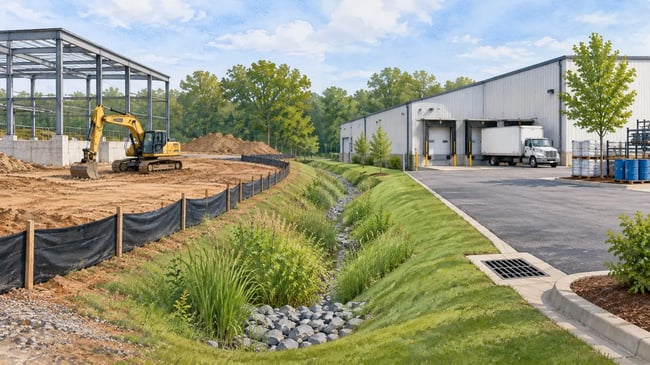
New Jersey has 15 Soil Conservation Districts, and they review soil erosion and sediment control plans under the state's Soil Erosion and Sediment Control Act. The district certifies the plan, which shows how you'll keep soil on the site during construction with things like silt fencing, stabilized construction entrances, inlet protection, and temporary seeding. That certification is a separate approval from the 5G3 itself, and the two are meant to travel together. The districts' own guidance says the 5G3 must be obtained in addition to the plan certification, and that it has to be in place before the first soil is disturbed.
Districts take this seriously. A district can issue a stop-construction order if land disturbance starts before the plan is certified, and it can do the same if a certified plan expires and work continues. Because 5G3 authorization is tied to the certified plan, a lapse in certification can put your permit coverage at risk too. If your project runs long, keep an eye on the certification's expiration and ask your district about renewal well ahead of time.
The district's reach can also start well before the one-acre mark. Soil Conservation District rules can apply to land disturbance that's smaller than what triggers the 5G3, so a small expansion at an operating plant can still need a certified plan even when it doesn't need the permit. Call the district early, before the excavator is scheduled.
When Does a New Jersey Facility Need Both a 5G3 and an Industrial Stormwater Permit?
The two permits cover different activities, so coverage under one doesn't stand in for the other. That's the whole reason some sites carry both. Here are the situations we see most often.
An Operating Facility Builds or Expands
Say a concrete plant already holds its CPM coverage and wants to add a new batch plant and a larger paved yard. The operation keeps its industrial permit the whole time. If the expansion disturbs an acre or more, or is part of a larger plan that does, the construction needs 5G3 coverage and a certified soil erosion and sediment control plan on top of it. Once the new area is built and stabilized, the industrial permit and its SWPPP have to reflect the new layout, new drainage, and any new exposed areas. Big enough changes can even move a facility to a different permit category, which we cover in when changes move you to a different New Jersey permit.
A New Facility Goes From Construction to Operations
A new plant, warehouse with outdoor operations, or recycling yard usually runs through the two permits in order. The 5G3 and the certified plan come first, and they last through site work and building. Then the facility starts operating, and the industrial permit (or a no exposure exclusion, if the site qualifies) becomes the one that matters. Many owners treat the industrial permit as an afterthought during construction, and then find out a few weeks before opening that it takes time to put in place. We cover the timing in how long it takes to get a New Jersey stormwater permit.
A Site in a Redevelopment Area
Redevelopment sites get this question a lot. Rebuilding on an old industrial property doesn't erase the stormwater rules, and a redevelopment project can touch both permits, the construction-phase permit during demolition and rebuild and an industrial one once the new tenant is operating. Our post on stormwater rules in New Jersey redevelopment areas goes into that.
When You Might Need Only One
Plenty of sites need only one of these. A building project for something like an office, a warehouse with no outdoor operations, or a data center may need the 5G3 during construction and never need an industrial stormwater permit afterward, because there's no exposure to speak of once it's running. On the other side, an existing facility with no construction planned only needs its industrial permit. We tell people when they don't need a permit, so ask us if you suspect that's you. Our guide on checking a facility for permanent no exposure is a good place to start.
Who Handles What When You Build or Expand a New Jersey Facility?
RMA doesn't prepare construction-phase permits or approvals. That includes the 5G3, Soil Conservation District soil erosion and sediment control certification, post-construction stormwater management design for larger projects under N.J.A.C. 7:8, and municipal site plan stormwater approvals. For those, most owners work with their project engineer, their contractor, or a soil erosion specialist, and the people designing the site usually carry the plan through the Soil Conservation District.
What we help with is everything on the operational side once the facility is running: figuring out which industrial permit fits, setting up the SWPPP, getting the Request for Authorization filed, training your team, and keeping up with inspections and annual reporting. We can also help you work out what your construction phase is going to need and point you to the right construction professionals, so the two sides don't surprise each other. The cleanest approach is to line up the industrial permit while the building is still going up, so the plan and the permit are ready when the doors open. If you're comfortable doing parts of it yourself, our guides on applying for a New Jersey industrial stormwater permit yourself and writing your own industrial SWPPP are free, and our online environmental training library can bring your team up to speed.
How Does RMA Help With Industrial Stormwater Permits?
If you're building, expanding, or taking over a New Jersey facility, we'll help you figure out which industrial permit applies, whether you qualify for no exposure, and what you'll need in place before operations start. Senior staff do the work, we explain what's going on in plain language, and we'll tell you straight if a simpler route makes more sense or if the construction side is better handled by your engineer. After you're permitted, we offer ongoing support with reminders, inspection prep, annual reporting, and questions as they come up, and we train your team to do the sampling and day-to-day tasks themselves.
There's no pressure and no obligation. You can call us, email us, or fill out the form on our website, and we'll talk through your project. When you're ready, contact RMA and tell us what you're planning.