Missing Plans, Failing Containment, Skipped Inspections, and Thin Paperwork: What Trips Up Delaware Industrial Facilities
A lot of industrial facilities in Delaware assume stormwater compliance is either simple or something DNREC only enforces after a major spill. That's rarely how it goes. Most of the problems we see aren't disasters. They're small things that pile up: a missed inspection, a SWPPP that still describes the yard the way it looked ten years ago, a containment area that cracked a little more each winter until an inspector finally noticed. Most facilities don't realize they're out of compliance until a Notice of Violation lands on the desk and somebody starts hunting for records that may not exist.
We see these problems at manufacturing plants, marine terminals, warehouses, concrete operations, scrap yards, recycling facilities, and transportation companies all over the state. Nearly all of them are preventable, and none of them take a heroic effort to fix. This article walks through the seven violations we run into most often, what each one looks like in the field, and what keeps it from happening. If you're not sure where your facility stands, you can reach out to RMA before a regulator forces the question, or try our pricing calculators to see what support would realistically cost.
Table of Contents
TL;DR
The industrial stormwater violations we see most in Delaware are missing or outdated SWPPPs, poor housekeeping, deteriorated containment, missed inspections, sampling and benchmark mistakes, thin documentation, and untrained employees. Most of them start as small lapses that nobody owns, and they get expensive once a pattern shows up in the records. Keeping the plan current, assigning inspections to a named person, and writing down everything you do prevents the large majority of them.
What Are the Most Common Industrial Stormwater Violations in Delaware?
DNREC inspectors look at the paperwork and the yard together, and violations tend to show up wherever the two disagree. The plan says one thing, the site says another, and the inspection logs say nothing at all. The table below sums up the seven problems we see most, what an inspector tends to find, and what usually prevents it.
| Violation |
What an Inspector Tends to Find |
What Usually Prevents It |
| Missing or outdated SWPPP |
A plan that doesn't match the site, or no plan at all |
Reviewing the plan whenever operations change |
| Poor housekeeping |
Debris, stained pavement, uncovered waste, leaking dumpsters |
A regular walk-through with a checklist |
| Failing containment |
Cracked berms, stuck drain valves, containers outside protected areas |
Periodic containment reviews |
| Missed inspections |
Logs that stop months ago |
One named owner and a backup |
| Sampling and benchmark problems |
Missed windows, repeated exceedances with no investigation |
A sampling calendar and a written response to every exceedance |
| Weak documentation |
Work that was done but can't be proven |
Records kept in one organized place |
| Untrained employees |
Staff who can't explain what they're supposed to do |
Documented, site-specific training that repeats |
None of these are exotic. They're what happens when stormwater becomes one more task handed to someone with a full plate. If you're still deciding whether your site needs coverage in the first place, our post on whether you need an industrial stormwater permit in Delaware is the place to start.
How Do a Missing or Outdated SWPPP Cause Delaware Stormwater Violations?
The most common violation we see is also the simplest. The facility either has no Stormwater Pollution Prevention Plan or has one so old it's no use to anyone. A company buys a property, ownership changes, operations expand, materials move around the yard, new equipment goes in, drainage shifts, and employees leave. Years go by, and the SWPPP in the binder still describes the site as it was in 2014.
DNREC treats the SWPPP as the operating manual for your stormwater program, so a plan that doesn't match the site makes an inspector doubt everything else. We've seen plans where whole process areas were missing from the site map, outfalls were mislabeled, and containment areas had been gone for years. We've seen plans where the drainage description no longer matched where the water went, and plans that didn't identify the facility's industrial activities correctly anymore. If you want the basics of what belongs in the plan, we walk through what a SWPPP is and why Delaware requires one.
What Does an Outdated SWPPP Look Like During an Inspection?
Picture a manufacturer that adds outdoor material storage along the back fence. Nobody updates the plan. When DNREC walks the site, the new storage area isn't in the SWPPP, has no BMPs written down, and has no inspections tied to it. That one expansion can turn into a plan deficiency, a BMP deficiency, an inspection gap, and a possible discharge concern all at once, and the only cause was that operations moved faster than the paperwork.
Facilities often assume that having a plan means being compliant. An old plan can hurt you, because it shows in black and white that nobody has kept the program up. Chemical inventories, contact lists, permit references, and BMP descriptions all go stale the same way. A missing or outdated SWPPP is rarely the only gap on a site, either. When an inspector sees one, they tend to look harder for the rest. The fix is to review the plan whenever the site changes and at least once a year. We've also written about whether you can write your own SWPPP, and we'll tell you straight when you don't need us.
How Does Poor Housekeeping Lead to Industrial Stormwater Violations?
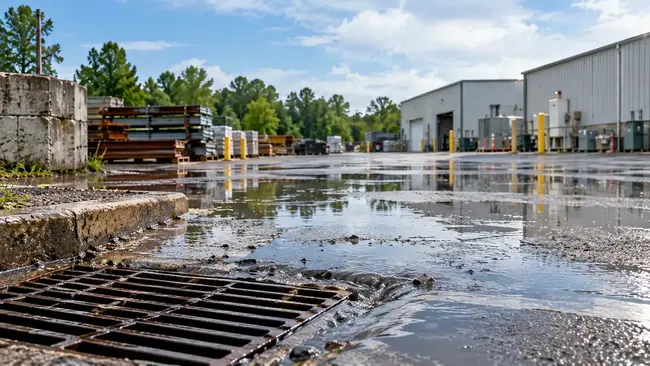
Housekeeping sounds minor until you see how many Delaware violations start there. If a pollutant can touch stormwater, DNREC can treat it as a compliance problem, whether or not it looks harmless to the people who walk past it every day. Rain doesn't care what looks harmless. It carries whatever is on the ground toward the nearest drain, swale, or outfall.
The usual suspects are leaking dumpsters, debris piling up outdoors, uncovered waste, oil-stained pavement, dust and sediment that nobody sweeps, material tracked across paved areas, drums and containers stored in the wrong place, and trash around industrial activity areas. None of it looks like much on a given day.
Here's a scenario we run into often. A facility stores scrap metal outdoors. Over months, small pieces of debris, rust, oil, and trash collect around the pile. Nobody notices because it happens slowly. Then a heavy rain pushes all of it toward a swale that connects to a discharge point. Now the facility has a housekeeping problem, a possible discharge violation, a documentation problem, and corrective action obligations, and the cause was a condition employees had stopped seeing.
This is the part of stormwater compliance that has the least to do with paperwork. It's daily site management. It's also an area where you often don't need a consultant at all. A walk-through with a checklist, done on a schedule by someone who knows the yard, catches most of it. Our post on how to do a stormwater visual inspection the right way is a good starting point for building that routine, and stormwater BMPs cover the controls that keep the problem from coming back.
Why Do Stormwater Containment Systems Fail Over Time?
Containment is the other area we see cited across Delaware industrial sites, especially around fuel, oil, chemical containers, waste drums, totes, and liquid raw materials. Facilities rarely ignore containment on purpose. What happens is that the system wears out. Concrete cracks. Drain valves stick or get left open. Rainwater management becomes inconsistent. Containers drift outside the protected area. Employees start using containment pallets the wrong way. Eventually the system no longer does the job it was built for.
The belief we hear most is "if nothing has spilled, we're okay." Regulators don't see it that way. Containment exists because spills eventually happen, and an inspector is judging whether the system would hold when one does. We worked with a facility that figured its old berms were fine because it hadn't had a problem in years. During a site review we found serious deterioration, and the containment volume no longer matched what the site was storing after years of operational changes. Everyone on site genuinely thought they were in good shape, because they saw the same berms every day and nobody had measured anything.
That's the argument for a periodic outside look. Problems become invisible when you see the same conditions daily. If you store oil above ground, your containment may also fall under an SPCC plan, and the two programs overlap in ways that confuse people, so it helps to read the difference between an SPCC plan and a SWPPP.
What Happens When a Facility Misses Required Stormwater Inspections?
This is one of the easiest violations to avoid, and it still happens constantly. Industrial stormwater permits generally require some mix of routine inspections, quarterly inspections, visual assessments, and benchmark reviews, depending on the permit and the site. Facilities miss them all the time, and almost never on purpose.
The reasons are boring. Nobody clearly owns the process. Staff turned over. The calendar reminder disappeared with the person who set it up. The environmental person left, and each manager assumed someone else had it. Then DNREC asks for the inspection records, and the facility finds out the logs stopped six months ago.
We see this most at facilities where compliance became "part of someone's job" instead of a managed program. That works fine until it doesn't. One missed inspection may not sound like a big deal. A string of them creates a paper trail of systemic failure, and once a regulator spots a pattern, the enforcement conversation escalates quickly. The cheapest prevention is also the dullest: name one person responsible, name a backup, put the inspection dates on a shared calendar, and keep the completed forms where anyone can find them. Our guide to what happens during a DNREC stormwater inspection shows what an inspector will ask to see.
Where Do Stormwater Sampling and Benchmark Exceedances Go Wrong?
Sampling makes industrial facilities in Delaware nervous, and the nerves are earned. The requirements have a lot of moving parts, and sampling mistakes are a steady source of DNREC violations. The problems we see most often are:
Plenty of facilities also misread what a benchmark exceedance means. An exceedance doesn't automatically mean a fine. It does usually trigger more work, such as evaluating the cause and taking corrective action. We explain the difference in benchmark values versus effluent limits, and the next step after a bad result is covered in what to do if your stormwater sampling results are high.
How Does One Ignored Exceedance Become a Larger Problem?
Here's a hypothetical we see play out in different forms. A facility gets elevated zinc results. Nobody investigates, because someone assumes it's probably coming off the building roof. Six months later there's another exceedance, and still nobody digs in. Eventually DNREC reviews the records and finds that the facility never looked at potential pollutant sources and never wrote down a single corrective action. A manageable benchmark issue is now a failure to respond, which is a much bigger conversation. Trouble starts when facilities ignore exceedances, skip the investigation, leave corrective actions undocumented, or keep generating the same exceedance with no real response. A written investigation after every exceedance, even a short one, keeps that from happening.
Why Does Weak Stormwater Documentation Make Every Violation Worse?
Thin documentation is what turns a small gap into a violation. The records we find missing most often are inspection logs, training records, corrective action documentation, maintenance records, sampling paperwork, SWPPP updates, employee sign-in sheets, rainfall records, and spill response write-ups.
The sentence we hear most is "we did it, we just didn't document it." From a regulatory standpoint, work that isn't documented is usually treated as work that wasn't done. We've watched companies do solid operational work and still struggle through an inspection because their records couldn't show it. Rainfall data is a good example, since a sampling or inspection record means little without it, and our post on where to get rainfall data for your stormwater permit report points to sources you can use.
To be fair, the volume of records can feel overwhelming if nothing is organized. A shared folder with a consistent naming scheme, a calendar, and a one-page checklist for each recurring task will carry most facilities a long way. That's also why we've built structured compliance systems, tracking tools, and simplified workflows for our clients, so requirements get handled ahead of time instead of in a scramble.
How Does a Lack of Stormwater Training Create Violations?
Employees are the front line of stormwater compliance. They handle materials, manage waste, run equipment, perform inspections, respond to spills, move containers, and keep the yard clean. If they don't understand the requirements, violations become close to inevitable.
Management often believes the team is trained because "we talked about it once." One conversation isn't enough. Useful stormwater training is documented, specific to what happens at your site, repeated on a schedule, and practical enough that a forklift operator can use it the next morning. A generic slideshow doesn't do that.
Stormwater compliance is also an operations issue, not just an environmental department issue. If forklift operators, maintenance crews, shipping staff, and supervisors don't see how their daily work affects compliance, even a good SWPPP won't keep the same problems from coming back. Our posts on whether stormwater training is required and why you need it cover the basics, and our online training library is available if you'd rather not build courses from scratch.
What Does a Stormwater Violation Cost Compared to Fixing the Program First?
A lot of facilities treat stormwater violations as environmental paperwork until enforcement starts. Then the conversation changes fast. Federal Clean Water Act penalties can reach $68,445 per day per violation under the January 2025 inflation adjustments in 40 CFR Part 19. DNREC has its own state enforcement authority, and those penalties depend on the violation, so we won't put a number on them here.
Fines are only part of it. Facilities in enforcement also deal with corrective action deadlines, extra sampling, closer regulatory attention on later visits, legal costs, and a lot of staff time spent on a problem instead of on production. Once regulators have found weaknesses at a site, they tend to look at it more closely afterward.
In our experience, fixing the program ahead of time costs less than responding to a violation. Compliance spending feels high until the day noncompliance costs more. You can see ballpark pricing in our post on how much a stormwater permit costs, and the calculator below shows what RMA's help with your NPDES and stormwater program would run, so you can set it beside the cost of waiting.
How Can RMA Help With Delaware Industrial Stormwater Compliance?
If you're not fully confident in your stormwater program, the best time to look at it is before an inspection, before exceedances stack up, and before documentation gaps get too old to fix. We help Delaware facilities sort out complicated stormwater requirements, find gaps before a regulator does, and build programs that are practical to run and easy to defend. Senior staff do the work, and we'll tell you if a simple fix is something your own team can handle.
There's no pressure and no obligation. You can call us at 888-RMA-0230, send us a note, or fill out the form on our website, and we'll talk through where you stand. To start the conversation, contact RMA. The facilities that avoid major stormwater violations usually aren't the perfect ones. They're the ones that find their own problems before DNREC does.

