What a Stormwater Pollution Prevention Plan Actually Is, and Why It Has to Match Your Site, Not Just a Binder
If someone told you your facility needs a SWPPP and you had no idea what that actually meant, you're not alone. Most people searching for this term aren't trying to become stormwater experts. Somebody just told them "you need one of these," and suddenly they're staring down an acronym and a stack of regulations that don't explain themselves.
A SWPPP is a written plan describing how your site prevents rainwater from carrying pollutants off the property. Below we'll cover what one actually contains, why Delaware requires it, and what tends to go wrong when facilities treat it as a document you write once and forget about. If you'd rather just get a straight answer about your own site, you can reach out to RMA directly.
Table of Contents
TL;DR
A SWPPP, or Stormwater Pollution Prevention Plan, is a written plan describing how your site keeps pollutants out of rainwater runoff before it leaves the property. Delaware requires one because regulators want pollution prevented before it reaches storm drains, streams, or groundwater, not addressed after the fact. A SWPPP is supposed to reflect what's actually happening on site right now, not just what was true the day it was written. In Delaware, the plan also has to accompany your Notice of Intent rather than follow it, which is a detail that catches people used to other states' timelines.
What Is a SWPPP?
SWPPP stands for Stormwater Pollution Prevention Plan. That's really it, no hidden meaning. It's just a written plan explaining how a site prevents pollution from being carried away by rainwater.
Picture a heavy rainstorm hitting a construction site, a parking lot, an industrial yard, or a loading dock. That water doesn't just disappear into the ground. As it moves across the surface, it can pick up sediment, oil, chemicals, trash, fuel, or whatever else happens to be sitting exposed, and eventually that runoff can reach a storm drain, a stream, a wetland, or groundwater. A SWPPP is the plan for making sure that doesn't happen, or at least making sure it's controlled and documented when it does. For a broader explanation of the concept outside Delaware specifics, our general SWPPP explainer is a good companion to this one.
Why Delaware Requires a SWPPP
Delaware requires SWPPPs because, like the federal Clean Water Act framework it operates under, the state wants pollution prevented before it leaves the property, not cleaned up after it's already in a stream. Instead of only reacting to discharges after the fact, the permitting program is built around facilities identifying their own pollutant sources and controlling them proactively.
Nobody sets out to become a stormwater expert on purpose. A facility gets a letter, a lease requirement, or a phone call saying a SWPPP is needed, and suddenly someone's trying to make sense of acronyms and cross-referenced regulations with zero context for why any of it applies to them. In plain terms: if your site has industrial activity exposed to rain, Delaware wants a documented plan for keeping that activity from contaminating runoff, and the SWPPP is that document. What counts as stormwater associated with industrial activity is worth reading if you're still not sure whether your site qualifies in the first place.
Quick note before we go further: construction sites disturbing an acre or more of ground fall under a separate stormwater permit with their own version of a plan, different from the industrial stormwater program this article is about. If you're a contractor rather than an ongoing industrial operation, the concept of a SWPPP is the same, but the specific permit and requirements you're under aren't. This article is written from the industrial facility side.
Why a SWPPP Isn't Just Paperwork You File Away
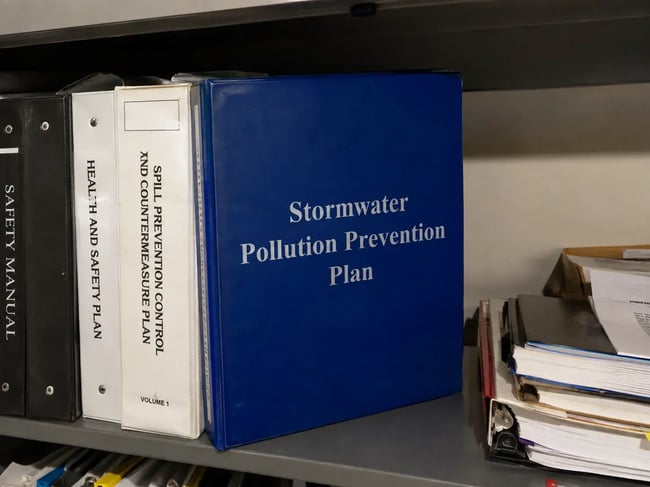
One of the most common misunderstandings is treating a SWPPP as something you write once, print, and put in a binder for good. Regulators don't see it that way. Your SWPPP is supposed to reflect what's happening on site right now, not what was true the day it was drafted.
A plan is a living description of your site's drainage patterns, storage areas, drains, spill risks, inspection procedures, and training, and every one of those things can change without anyone deciding to update the paperwork that describes them. A facility that hasn't touched its SWPPP in three years almost certainly has a document describing a site that no longer exists.
What's Actually Inside a SWPPP
A complete SWPPP generally covers a consistent set of pieces:
- Site drainage patterns and a map of where stormwater actually flows
- Material storage areas and what's stored in each one
- Storm drains, outfalls, and other discharge points
- Identified spill and pollutant source risks
- Inspection procedures and how findings get documented
- Employee training requirements tied to the plan
- Sampling procedures where your permit requires them
- The physical and procedural controls used to reduce pollution
Some SWPPPs are fairly straightforward. Others get genuinely technical and site-specific, especially at facilities with multiple outfalls, several categories of exposed material, or a drainage system that's been modified more than once since the plan was first written.
The Site Map
One of the most important pieces of a SWPPP is the site map, and it's often where people first realize the process is more detailed than they expected.
What It Should Show
A proper map identifies buildings, drainage flow directions, storm drains, outfalls, material storage areas, loading docks, spill risk areas, BMP locations, vehicle maintenance areas, waste storage, sampling locations, and nearby surface waters. Its job is to let both regulators and your own staff understand how stormwater actually moves across the property, not just where the buildings happen to sit.
Why It Matters During an Inspection
Stormwater problems tend to be very site-specific: a dumpster draining directly to a catch basin, chemical storage exposed to rainfall, sediment washing off disturbed soil, a vehicle leak near a storm drain, an improperly stored drum. These are exactly the kinds of things a good map flags before an inspector finds them. A poor or outdated map hides them instead, and a confusing site map creates confusion fast during an inspection, which is rarely your friend in that moment.
Best Management Practices, Explained
The physical and procedural controls a SWPPP describes are called Best Management Practices, or BMPs. These can be as involved as silt fences, covered storage structures, or engineered erosion controls, or as simple as consistent housekeeping procedures and inlet protection around a storm drain. What stormwater BMPs actually are covers the full range in more depth.
The part that trips facilities up isn't usually choosing the right BMPs on paper. It's making sure they're actually in place and functioning, not just described in a document nobody's checked against reality in a while. A spill kit that's expired, a silt fence that's fallen over, or a covered storage area that's since had material moved outside it are all examples of a BMP that exists on paper but not in practice, and that gap is exactly what an inspector is trained to notice.
Where a SWPPP and Reality Tend to Drift Apart
This is where a lot of facilities run into real trouble. The SWPPP says one thing, and the site looks like something else. Maybe the drainage map was never updated after an expansion. Maybe inspections are happening but aren't being documented. Maybe a piece of equipment listed in the plan was removed two years ago and nobody ever went back and edited the page describing it.
A mismatch between the plan and the site tells an inspector something more specific than any single deficiency would: that the plan isn't actually being used as a working document. That's why inspectors tend to check the map against the yard before they check almost anything else. Doing a stormwater visual inspection correctly is one of the more effective ways to catch this kind of drift before an inspector does.
Most SWPPP problems, in our experience, trace back to one of a few familiar patterns:
- The plan was never updated after operations, drainage, storage areas, or outfalls changed, so it describes a site that no longer exists
- Inspections aren't done correctly, whether skipped, rushed, or documented with nothing more than "everything looked good"
- BMPs aren't maintained, so the plan says controls exist while the silt fence is down or the spill kit is gone
- Employees were never actually trained on what the plan expects of them, even though a SWPPP technically exists
- Someone downloaded a generic template instead of building a plan around the actual site, and regulators can tell the difference
None of that requires bad intentions. It just requires nobody treating the plan as a living document.
Inspections, Sampling, and Training
Depending on your specific permit, a SWPPP can come attached to routine inspections, documented findings, required employee training, and sometimes stormwater sampling on a set schedule. None of that is optional add-on work. It's the operational half of the plan, and it's usually the half that actually determines whether an inspection goes well.
Inspections are supposed to say something, not just confirm a visit happened. "Everything looked good" doesn't tell a regulator what was actually inspected, what issues turned up, or whether anything was done about them. That's part of why some facilities bring in a consultant for this piece specifically, not because they can't understand a SWPPP, but because staying consistent with inspection documentation, quarter after quarter, becomes its own workload on top of everything else the facility already has going on.
Sampling adds another layer of technical detail, and it's often where people realize this is more involved than they expected. Depending on your permit, requirements can include benchmark monitoring, effluent monitoring, visual assessments, or analytical laboratory testing, with samples collected during qualifying rain events and results reported on a defined schedule. Mistakes here are common: wrong sampling timing, missed windows, improper collection technique, incomplete chain-of-custody forms, and missed reporting deadlines all show up regularly. Benchmarks versus limits is worth reading before your first sampling event.
Employee training gets overlooked just as often, since it's easy to assume the plan speaks for itself. It doesn't, if the people responsible for inspections, material handling, or spill response were never actually walked through what the plan expects of them. Handing someone a binder once and never revisiting it doesn't count as an effective training program, and one spill or one improperly stored container is usually all it takes to expose that gap. Why stormwater training matters covers what that responsibility looks like in practice, and if you're weighing writing the plan internally versus bringing in help, developing your own SWPPP is a fair, honest look at what that actually takes.
Delaware's Wrinkle: The SWPPP Has to Come With the NOI
Here's a detail that catches people coming from other states' stormwater programs. In Delaware, new facilities, facilities moving off an individual permit, and existing facilities without NPDES coverage all have to prepare and implement a Storm Water Plan before submitting their Notice of Intent, and that plan has to be submitted along with the NOI itself. You don't apply for coverage first and write the plan afterward. The plan is part of the application.
That sequencing is a big part of why Delaware SWPPP timelines run longer than facility managers sometimes expect. Rushing this step tends to produce a plan that looks complete on paper but doesn't hold up to a site walkthrough, which brings us right back to the drift problem covered above. If you're not sure whether your facility needs coverage in the first place, the general SWPPP overview and a conversation with your permitting authority are both worth doing before you start drafting.
How RMA Helps With Delaware SWPPPs
We don't just write SWPPPs and hand them over. We help facilities develop site-specific plans that actually match what's on the ground, perform the inspections a plan requires, assist with stormwater sampling, update plans as conditions change, and stay current with permit requirements so you're prepared whenever an inspector actually shows up, not just on the day the plan was signed.
If your facility needs a SWPPP, or you already have one that hasn't been looked at since it was written, call us, email us, or fill out the form on our contact page. There's no pressure and no obligation. We'll help you figure out where you stand, and you can decide what to do from there.

