How to Compare Firms on DEP Experience, Industry Knowledge, Pricing, Training, and Site Visits, and Where RMA Fits
There isn't one best industrial stormwater consultant in Pennsylvania, and any list that claims otherwise is probably selling something. The right firm depends on your industry, how many outfalls you have, whether you need a one-time permit or ongoing help, and how much of the work you want to keep in-house. What you can do is compare firms on the same handful of criteria and know which kind of firm suits your facility.
This guide walks through those criteria, describes the types of firms in the market and what each does well, and explains how to read a proposal. We're RMA, and we compete for this work, so we've kept our own firm to one section near the end, with specific facts about what we do and who we're a good fit for. If you'd rather talk through your situation with someone, you can reach out to RMA at any point.
Table of Contents
TL;DR
No single firm is the best stormwater consultant for every Pennsylvania facility. Compare firms on recent PAG-03 and DEP experience, familiarity with your industry, responsiveness, pricing transparency, how they handle training, and whether they visit your site before writing anything. Large engineering firms, regional compliance firms, small specialists, independents, labs, and online or AI-assisted services each fit different facilities. RMA is one option, best suited to facilities that want senior staff, published pricing, and a facility-specific plan, and less suited to anyone shopping purely on price or able to handle a simple permit alone.
What Makes an Industrial Stormwater Consultant the Best Fit in Pennsylvania?
A good consultant helps you work out which stormwater path applies to your facility before recommending anything. In Pennsylvania that means choosing among PAG-03 coverage, an individual NPDES permit, and a No Exposure Certification, and plenty of facilities that call a consultant turn out to qualify for the last one. A firm that jumps straight to PAG-03 without asking what's stored outside is skipping the step that can save you the most money. Our comparison of No Exposure versus PAG-03 shows how that decision gets made.
Past that first step, the six criteria below are the ones that separate firms in practice. None of them requires you to know the regulations yourself. They're questions you can ask on a first call and judge by the answers.
What Does Real Experience With DEP and PAG-03 Look Like?
Almost every environmental consultant will tell you they do industrial stormwater. The useful question is how many Pennsylvania PAG-03 applications they've prepared recently and for what kinds of facilities. Ask what happened when DEP came back with questions, because the review is where inexperience shows. A firm that has handled those follow-ups can describe how, and one that hasn't will stay vague.
Vocabulary is a quick tell. Pennsylvania uses a PPC Plan, short for Preparedness, Prevention and Contingency plan, rather than the SWPPP used in many other states. A consultant who keeps saying SWPPP may be applying another state's template to your site. Our post on what a PPC plan is explains the difference. Be wary of anyone who promises DEP approval or a firm timeline, since review is DEP's call and no firm controls it. Our overview of how long PAG-03 coverage takes explains what drives the timeline.
Does Industry Familiarity Count When Hiring a Pennsylvania Stormwater Consultant?
It does, because PAG-03 is organized by industry. DEP assigns each facility to a sector appendix based on its SIC code, and the pollutants, sampling, and problem areas differ a lot between, say, a ready-mix plant with high-pH wash water and a metal fabricator with outdoor steel and coolant drums. A consultant who has worked in your sector already knows where your site is likely to draw questions. One who hasn't will learn on your budget.
Ask for examples close to your own operation. If you run a concrete plant, we've written about ready-mix concrete plants, and for a salvage operation, scrap yards. Whoever you hire should be able to talk about your industry at that level of detail, and our post on PAG-03 appendices helps you check what the firm tells you.
How Responsive Should a Pennsylvania Stormwater Consultant Be?
Responsiveness is easy to test before you sign anything. Notice how long the first reply takes, whether a person who knows the subject answers, and whether the firm will name who would visit your site, write your plan, and be your contact afterward. Vague answers to the last question usually mean the work gets assigned after the sale. Reviews and references help, and a reference from a facility in your industry and region helps most.
Responsiveness counts most after the permit is issued. Sampling windows depend on the weather, DEP can send questions at any time, and reporting deadlines don't move. A firm that's quick during the sales process and slow once the contract is signed is a common complaint, so ask a reference how the firm behaved in month six, not just in week one.
How Transparent Is Pricing for Pennsylvania Stormwater Consultants?
Firms price this work three common ways: a one-time package, hourly billing, or an ongoing annual arrangement. Any of them can be fair. What you want is a proposal that spells out what's included, so you can compare two quotes line by line instead of comparing totals. A proposal that says only "PAG-03 permitting services" can't be compared to anything.
We publish our own ranges, so here they are. For a relatively straightforward facility, we charge roughly $5,000 to $10,000 one time for the PAG-03 application package, which covers the activity review, drainage tracing, outfall identification, maps, PPC plan, Notice of Intent, site visits, sampling coordination, and responses to DEP questions. A standalone PPC plan runs roughly $2,000 to $5,000, and ongoing PAG-03 support runs roughly $3,000 to $6,000 per year. DEP's fees and lab costs are separate, and our post on what RMA charges for PAG-03 and PPC plan services has the details. Our broader look at the full cost of a PAG-03 permit covers the costs beyond DEP's fees.
Price drivers are the number of outfalls, the number of drainage areas, how many operations you run, the condition of your records, and deadline pressure. A quote far below the going range isn't automatically a bad deal, but ask what's missing, since site visits and facility-specific plan writing are the usual things dropped. You can get a rough estimate of our consulting cost with the pricing calculator below, and it works the same whether or not you ever contact us.
What Training Approach Should a PAG-03 Consultant Offer?
PAG-03 expects the people at your facility who handle materials, housekeeping, and spill response to know what the plan says. A consultant who delivers a binder and leaves hasn't solved that. Ask whether training is built around your site or is a generic slideshow, how it gets documented, and whether it's repeated when staff turn over or the plan changes.
Firms differ on this. Some include training in an ongoing support arrangement, some sell it separately, and some leave it to you. We offer an online training library and custom training development, and our ongoing PAG-03 support includes employee training. Our post on PAG-03 employee training lists what the training should cover whichever route you take.
Does a Stormwater Consultant Need to Visit Your Pennsylvania Site?
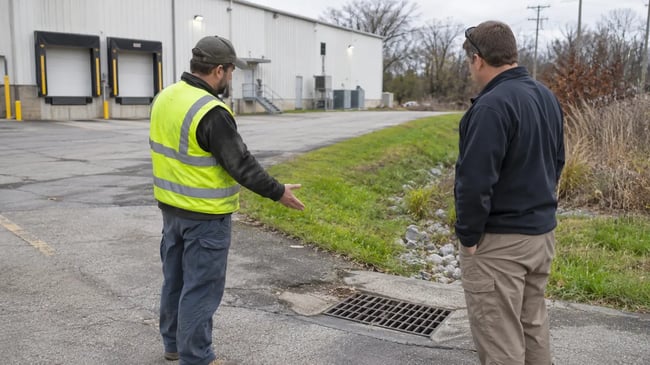
For most industrial facilities, yes. A real site visit produces a drainage map, notes on what's exposed to rain, and a list of outfalls, and a plan built from those is a plan about your facility. A firm that builds the application from a questionnaire and satellite images can miss a floor drain, a loading area, or a pile that wasn't there when the photo was taken. The exceptions are small sites that qualify for No Exposure, where a remote review can sometimes do the job.
Ask any firm how site visits work, who would attend, and how soon one could happen. We work with Pennsylvania facilities from offices outside the state, so a visit involves travel, and site visits are part of our PAG-03 package and usually part of a standalone PPC plan. If you want a firm with a Pennsylvania office a short drive from your site, that's a reasonable thing to prefer, and we'd rather you know that going in.
What Types of Stormwater Consulting Firms Work in Pennsylvania?
The market falls into a few types, and each has excellent firms and poor ones. The table describes the general tendencies, not any specific company. We haven't named individual firms because a list would go out of date and couldn't be fair to everyone, but referrals from your trade association and from other facilities in your industry are good places to find names.
| Type of firm |
Where it tends to be strong |
What to check |
| Large engineering and consulting firms |
Broad staff, engineering design, and stormwater tied to a larger project such as site development |
Industrial permit work can be a small part of the business, and rates tend to reflect overhead |
| Regional environmental compliance firms |
Stormwater alongside related programs such as SPCC, Tier II, and waste, under one roof |
Quality varies, so ask for recent Pennsylvania PAG-03 work |
| Small stormwater specialists |
Deep permit knowledge and quick, direct communication |
Limited capacity for long engagements or for programs outside stormwater |
| Independent consultants |
Personal attention and often lower rates |
One person is the whole team, so illness, vacation, or a heavy workload can stall your permit |
| Labs and sampling companies |
Sampling quality and clean data for monitoring reports |
Plan writing and DEP follow-up may be a side service |
| Template, online, and AI-assisted services |
Low upfront cost and speed, useful for simple sites |
A PPC plan has to describe your actual site, and generic drafts can fall short |
Doing it yourself is also a legitimate option. Pennsylvania's rules don't require a consultant, and small sites with one or two outfalls, or ones that qualify for No Exposure, are reasonable candidates. Our guide to getting a PAG-03 permit yourself lays out what the work involves so you can judge. If you're weighing AI tools specifically, our post on whether AI can write your PPC plan explains where they fall short.
Where Does RMA Fit Among Pennsylvania Stormwater Consultants?
RMA is a family-run environmental consulting firm founded in 1992, and stormwater is one of several services alongside SPCC plans, Tier II and TRI reporting, hazardous waste, and environmental audits. We work with Pennsylvania facilities all the time. Here's what we do and don't do, in plain terms.
| Who does the work |
Senior staff, and we tell you who up front. Our people stay with a client from the first conversation through completion. |
| What we prepare |
We identify the right permit path, walk the site, map drainage and outfalls, write a facility-specific PPC plan, assemble the application, and answer DEP's questions. |
| Published pricing |
About $5,000 to $10,000 for a straightforward PAG-03 package, $2,000 to $5,000 for a standalone PPC plan, and $3,000 to $6,000 per year for ongoing support. |
| Artificial intelligence |
We don't use AI to produce client deliverables. |
| What we don't do |
We don't prepare construction-phase permits such as construction stormwater coverage or erosion and sediment control plans. We don't guarantee DEP approval or a timeline. We generally don't make minor edits to a PPC plan written by someone else, and recommend a new plan instead. |
| Location |
Our offices are outside Pennsylvania, so site visits involve travel. |
We're a good fit for facilities that want a PPC plan built from a real site visit, have several outfalls or complicated drainage, don't have anyone in-house who can own the permit long term, or are recovering from a difficult DEP review or a bad sampling result. Manufacturing, concrete and aggregates, recycling, food and beverage, and fleet operations are among the industries we work with most. We're also a reasonable choice if you'd like one firm for stormwater and for related programs like SPCC or Tier II.
We're not the right choice if the lowest price is your main criterion, since we're not the cheapest and don't try to be. We're probably not what you need if you run a small site with one or two outfalls and someone with time to learn the permit, or if you qualify for No Exposure and can handle that filing on your own. In those cases we'll say so. We're also not the firm for construction-phase approvals, and an environmental attorney is the right call for enforcement or legal-exposure questions.
How Do You Compare Pennsylvania Stormwater Consultants Side by Side?
Put each firm through the same questions and write down the answers. A scorecard like the one below keeps a smooth sales pitch from standing in for substance. For a longer walkthrough of red flags and proposal scope, our post on how to choose a PAG-03 consultant goes into more detail.
| Criterion |
A good sign |
A warning sign |
| DEP and PAG-03 experience |
Recent Pennsylvania work, and examples of handling DEP's questions |
Talks about SWPPPs, or promises approval or a timeline |
| Industry familiarity |
Discusses your sector's specific problem areas |
Generic answers that fit any facility |
| Responsiveness |
Prompt replies and named people for each task |
Can't say who will do the work |
| Pricing transparency |
Itemized scope, with fees and lab costs separated out |
One line reading "permitting services" |
| Training |
Site-specific, documented, repeated as needed |
A generic slideshow or nothing at all |
| Site visit |
Visit produces a drainage map, exposure notes, and an outfall list |
Plan built from a questionnaire and satellite images |
How Can RMA Help You Evaluate Your Pennsylvania Stormwater Options?
If you're comparing firms and want a second opinion on a proposal, or you want to know whether your facility needs a consultant at all, we're glad to talk it through. We'll tell you if the simpler route makes sense, whether that's No Exposure, handling the permit yourself, or a firm other than us. You can call, email, or fill out the form on our website, and there's no pressure and no obligation. Whenever you're ready, contact RMA and we'll start with your site and your questions.