Buying a New Jersey Property With Oil Tanks: How a Phase I Treats Current and Former Tanks, Staining, Registrations, and Spill History
You found a property you like, the seller mentions an old diesel tank behind the shop, and your lender wants a Phase I Environmental Site Assessment (Phase I ESA) before closing. Most buyers treat that report as paperwork to get through. When oil tanks are involved, it's the document that tells you what you might be inheriting: tanks nobody registered, stained soil, a spill that never got cleaned up, or a facility that needed an oil spill plan for years and never had one.
A Phase I reads the records and walks the site. It looks for current and former tanks, staining, registration paperwork, and spill history, and it flags anything that looks like a possible release. It doesn't sample soil or test a tank, and it doesn't check whether the facility has the oil spill plan (called an SPCC Plan, short for Spill Prevention, Control, and Countermeasure) that federal rules may require. This article covers what buyers typically find, why a missing plan or an unregistered tank matters in a New Jersey deal, and what to do next. If you're already holding a report with tank findings, you can reach out to RMA and we'll help you sort out which items need action.
Table of Contents
TL;DR
A Phase I ESA reads the records and walks the site to find current and former tanks, staining, registrations, and spill history, then flags anything that looks like a possible release. It doesn't sample soil, test tanks, or audit compliance, so a missing oil spill plan or an unregistered tank shows up as a question, not a verdict. The owner after closing takes on the plan obligation and can inherit cleanup liability. The usual next steps are to get the tank paperwork from the seller, decide whether a soil investigation is needed, and bring the results into the price negotiation before your due diligence deadline.
What Does a Phase I ESA Look for When a New Jersey Property Has Oil Tanks?
A Phase I follows ASTM E1527-21, a standard practice EPA recognizes as meeting the federal "all appropriate inquiries" requirement for buyers under the Superfund law (CERCLA). A qualified environmental professional reviews records, visits the site, and interviews people who know the property. Nothing gets dug up or tested.
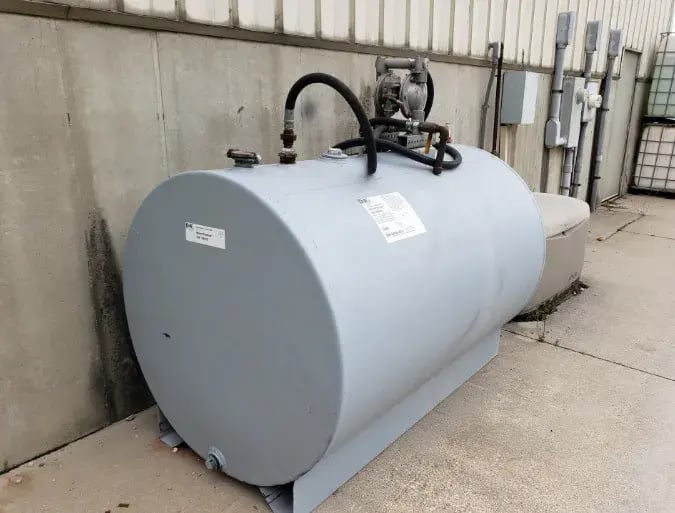
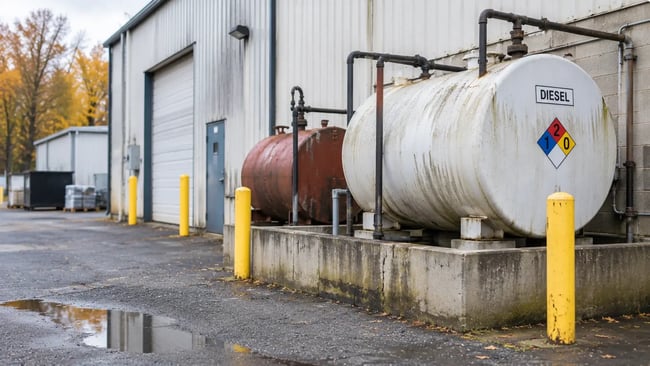
On tanks, the records review pulls federal, state, and local government records, which in New Jersey includes NJDEP tank registrations, spill and release reports, and its list of known contaminated sites. Old aerial photos, fire insurance maps, and city directories can show that a gas station or fuel yard stood on the property decades ago. During the site visit, the professional looks for aboveground tanks, drums, fill and vent pipes, fuel dispensers, floor drains, sumps, stained concrete or soil, stressed vegetation, and heating oil lines running into a basement. Interviews with current and past owners often surface the tank that was "taken out years ago."
Then comes the judgment call. If the professional finds evidence of a release or a likely release, the report labels it a Recognized Environmental Condition, or REC. A past release that was cleaned up but left restrictions in place is a Controlled REC, and one cleaned up with no strings attached is a Historical REC. Our article on what RECs are in Phase I ESAs explains how those labels get applied.
What Do Buyers Typically Find About Oil Tanks in a Phase I ESA?
The table below shows the tank findings we see most often and what each usually means for a buyer.
| What the Phase I finds |
How the report usually treats it |
What it means for you |
| A tank on site with no paperwork |
Notes its apparent age and condition and the missing records, often as a data gap or a REC |
You can't tell whether it's registered, tested, or leaking until someone produces records |
| A fill or vent pipe with no tank in sight |
Suggests a buried tank, and a REC if there's no removal record |
Possible abandoned underground tank that has to be located and checked |
| Staining or stressed vegetation near a tank or fuel dispenser |
A REC in many cases, though minor drips are sometimes noted as a lesser condition |
Could be a few drips or a long-term leak, and the spill history helps tell which |
| A tank removed years ago |
A Historical REC if cleanup and closure are documented, a REC if they aren't |
Ask for the closure report and any NJDEP No Further Action letter |
The answer usually turns on paperwork. A tank removed with a closure report and a No Further Action letter in hand reads very differently from the same tank with no documents. When records are missing, the report calls it a data gap, and the buyer carries that uncertainty unless someone finds the documents. That's why the first request to a seller after a Phase I should be for tank paperwork.
What Can't a Phase I ESA Tell You About Oil Tanks?
A Phase I tells you what the records and the walk-through suggest. It can't tell you what's in the ground. It doesn't include soil or groundwater sampling, tank tightness testing, or geophysical work such as ground penetrating radar scans. Those belong to a Phase II investigation, and our Phase I and Phase II comparison covers how the two differ. Our article on Phase I ESAs and underground storage tanks explains why scans aren't built into the standard report.
It also isn't a compliance review. A standard Phase I doesn't check whether a tank has the right containment, whether inspections are happening, or whether the facility has the oil spill plan it needs, which we explain in does a Phase I ESA include a compliance audit. A report with no tank-related RECs means no evidence of a release turned up. It doesn't mean the tanks are in good shape or in compliance, and those are two separate questions.
Why Does a Missing SPCC Plan Matter When Buying a New Jersey Property?
Federal oil spill rules in 40 CFR Part 112 require a written SPCC Plan at a facility that stores more than 1,320 gallons of oil in aboveground containers and could reasonably be expected to discharge to navigable waters or adjoining shorelines. Only containers of 55 gallons or more count, capacity matters rather than what's inside today, and oil-filled equipment counts too. The discharge test looks at geography and drainage, not manmade barriers. Our guide on how to determine whether your New Jersey facility needs an SPCC Plan walks through both tests.
The Phase I documents the tanks, drums, generators, and oil-filled equipment it sees, so you can add up their capacity. If the total clears 1,320 gallons and the seller can't produce a plan, or produces one for a different set of tanks, you've found a compliance problem that becomes yours at closing. The duty sits with the owner or operator, and EPA Region 2 enforces it in New Jersey (see who enforces SPCC Plans). EPA's penalties, adjusted for inflation under 40 CFR Part 19, currently run up to $23,647 per day of violation in an administrative case, capped at $295,564, and up to $59,114 per day in federal court. Our article on top SPCC plan violations and fines covers what inspectors cite most.
New Jersey adds a second layer for larger sites. A facility with 200,000 gallons or more of hazardous substances including petroleum, or 20,000 gallons or more of non-petroleum hazardous substances, is a major facility under N.J.A.C. 7:1E and needs Discharge Prevention, Containment and Countermeasure (DPCC) and Discharge Cleanup and Removal (DCR) plans approved by NJDEP. Our article on whether you need both an SPCC Plan and a DPCC Plan compares the two, and buying or selling a facility with oil tanks covers how plans and registrations change hands at a sale.
A plan that doesn't match the site causes trouble too. One written for last decade's tank layout, or one past its five-year review, tells an inspector that nobody has been minding it.
Why Do Unregistered or Unknown Tanks Matter in a New Jersey Property Deal?
New Jersey regulates underground tanks through its Underground Storage Tank rules at N.J.A.C. 7:14B, and what applies to a given tank depends on what it holds and what it serves. The table below shows the main situations a Phase I tends to turn up.
| Tank situation |
How New Jersey treats it |
What to ask the seller for |
| A heating oil tank serving a residential building, or up to 2,000 gallons combined at a non-residential property |
Called an unregulated heating oil tank. NJDEP doesn't regulate how it's operated, but it oversees cleanup when a discharge is found |
Removal or abandonment paperwork and any No Further Action letter |
| An underground tank holding gasoline, diesel, or other regulated substances, or a larger non-residential heating oil tank |
Falls under N.J.A.C. 7:14B, which includes registration, release detection, and closure requirements |
Registration certificate, release detection records, and closure documents for any tank taken out |
| Aboveground tanks, drums, and oil-filled equipment |
Count toward the federal SPCC threshold and the major facility thresholds on large sites, and fall under the Uniform Fire Code enforced by local fire officials |
The SPCC Plan, inspection records, containment details, and any DPCC and DCR plans |
A tank that should be registered and isn't is a compliance problem, and it says something about how the property has been run. An unknown or abandoned tank is a cost problem, because someone has to locate it and close it properly. Underground tank closure has to be done by an NJDEP-certified closure firm. A discharge has to be reported right away through the NJDEP hotline, 1-877-WARNDEP, and cleanup usually involves a Licensed Site Remediation Professional (LSRP), or a certified subsurface evaluator in smaller heating oil tank cases. A buyer needs to find all this out early enough to price it, because New Jersey's Spill Act can put cleanup costs on the current owner even when a previous owner caused the problem.
How Do the Spill Act, CERCLA, and Phase I Timing Protect a Buyer?
The Spill Act makes liability strict, joint and several, and it reaches beyond oil to other hazardous substances. The current owner of a contaminated property can be pulled into a cleanup it didn't cause unless it qualifies for the innocent purchaser defense, which depends on appropriate inquiry before buying. New Jersey sets its own standard for what counts, so a Phase I is a strong start but shouldn't be treated as automatically meeting it. That's a question for an environmental attorney.
On the federal side, a Phase I done to E1527-21 satisfies EPA's all appropriate inquiries rule at 40 CFR Part 312, which supports the buyer protections under CERCLA. The inquiry has to happen within one year before closing, and five pieces of it (interviews, lien searches, the government records review, the site visit, and the professional's declaration) must be done or updated within 180 days before closing, so a report can go stale if the deal drags on. Our articles on how long a Phase I stays good, whether you can use an old Phase I, and what protection a Phase I provides go deeper.
If the property is an industrial establishment covered by New Jersey's Industrial Site Recovery Act (ISRA), the sale itself can trigger ISRA, and a Phase I doesn't replace its Preliminary Assessment. We cover that in do Phase I ESAs in New Jersey take the place of ISRA. If you suspect a discharge has already happened or you've received an enforcement notice, talk to an environmental attorney first.
What Should You Do Next When a Phase I Flags Oil Tank Problems?
Start by reading the REC list and the data gaps with the environmental professional who wrote the report, and ask which findings would go away if a specific document turned up. Then ask the seller for that paperwork: tank registrations, installation and removal records, closure reports, No Further Action letters, the SPCC Plan, and inspection records. Put a deadline on the request that falls well inside your due diligence period.
If a REC survives the paperwork, a targeted Phase II is how you find out whether there's contamination, and it gives you something concrete to negotiate with. Findings usually end up in the price, an escrow or holdback, a requirement that the seller finish a cleanup before closing, or a decision to walk away. Your attorney should drive that conversation while you can still leave the deal.
Plan for the day after closing too. Count every container of 55 gallons or more using our guide to inventorying oil tanks, drums, and equipment. If you're buying to build or expand, keep the construction side separate. Soil erosion and sediment control, construction stormwater coverage, building and fire permits, and tank installation by NJDEP-certified contractors go through your engineer and contractors, and we don't prepare them. Once the facility is running, it will almost always need an SPCC Plan or an amendment, DPCC and DCR plans if it's a major facility, spill reporting procedures, inspections, and training. That's the part we help with, and our post on expanding a New Jersey facility covers how new oil storage changes the plan.
How Much Do a Phase I ESA and an SPCC Plan Cost for a Property Purchase?
A Phase I ESA typically runs about $4,000 to $6,500, and our New Jersey Phase I cost article explains what moves the number. An SPCC Plan runs about $2,500 to $15,000, depending mostly on total storage capacity, the number and type of containers, whether secondary containment needs evaluating, and whether a Professional Engineer has to review and certify the plan. A plan the seller had written by someone else and left to age is usually rebuilt rather than patched, so budget for a new plan. Our SPCC cost breakdown has more detail. Costs for DPCC and DCR plans, tank closures, and cleanups swing too widely to quote. The pricing calculator below gives you a ballpark for the plan side of the purchase.
How Can RMA Help With a Property Purchase That Has Oil Tanks?
If you're holding a Phase I with tank findings, or you're about to order one, we're glad to look at it with you. We're a family-run firm based in New Jersey, so NJDEP's rules and EPA Region 2's SPCC enforcement are familiar ground. We can read the tank findings alongside the seller's plan, tell you whether a plan is required and what a new one would involve, and help you figure out which other professionals you need, whether that's a Phase II firm, a certified tank contractor, an LSRP, or an attorney.
We'll also tell you when you don't need us. If the property stays under 1,320 gallons of aboveground oil, there's no federal plan to write, and if the seller's plan already matches the tanks and only needs new names, you may be fine without a consultant. There's no pressure and no obligation. You can call, email, or fill out the form on our website, or just contact us with your findings and closing timeline.