New Jersey Warehouses and Distribution Centers: When a Generator, Fire Pump Tank, or Truck Fueling Triggers an Oil Spill Plan
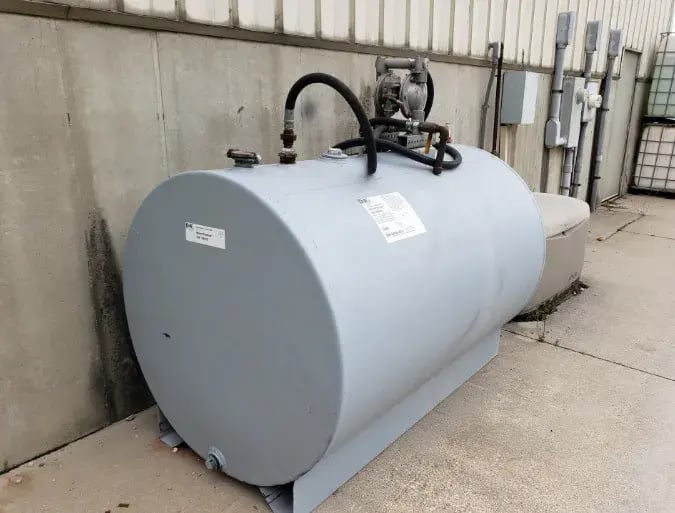
Most warehouses and distribution centers store very little oil, so most of them don't need an oil spill plan. A few drums of hydraulic oil, a forklift fleet running on propane, and a loading dock full of pallets won't get you anywhere near the line. The trouble comes from a short list of equipment that holds a lot of diesel or oil in one place: a standby generator, a diesel fire pump, a bulk fuel tank for yard trucks, or a used oil tote in the maintenance corner.
The federal oil spill plan rule is called SPCC, short for Spill Prevention, Control, and Countermeasure, and it kicks in when a facility stores more than 1,320 gallons of oil aboveground. This article explains how to add up your own numbers, which warehouse equipment counts and which doesn't, and what New Jersey adds on top. If you add it up and land near or over the line, you can reach out to RMA and we'll look at it with you, and if you're clearly under, we'll tell you that too.
Table of Contents
TL;DR
A New Jersey warehouse needs a federal oil spill plan only if its oil containers of 55 gallons or more add up to more than 1,320 gallons, counted by what they can hold, not what's in them. Many warehouses are well under that. A diesel generator, a diesel fire pump tank, a bulk fuel tank for trucks, or a used oil tote can push a site over, while forklift fuel tanks, propane cylinders, and small containers don't count. Even a warehouse that doesn't need the plan still has to report spills to the state.
What Makes a Warehouse Need an SPCC Oil Spill Plan?
SPCC is the federal oil spill prevention rule in 40 CFR Part 112, and EPA Region 2 enforces it in New Jersey. A facility needs a plan when it passes three tests at the same time. It has to be a non-transportation-related facility, which describes a warehouse or distribution center. It has to store more than 1,320 gallons of oil aboveground, counting only containers that hold 55 gallons or more. And a discharge from the site has to be reasonably expected to reach navigable waters or adjoining shorelines.
That third test rarely rescues a New Jersey site. Between storm drains, ditches, streams, and wetlands, a spill in a loading yard can almost always find its way to water, and EPA's guidance says you can't count on manmade features like curbs, dikes, or berms to argue that it couldn't. So in practice the 1,320-gallon number decides it. The number is the total shell capacity of every qualifying container, which means the size of the tank or drum, not how much is in it today. An empty 500-gallon tank counts as 500 gallons.
Oil also covers more than diesel. Motor oil, hydraulic oil, used oil, lubricants, and vegetable oils and animal fats all count, along with the oil inside large equipment. Our guide on how to determine whether your New Jersey facility needs an SPCC plan covers the general test. This article applies it to the equipment you'll find in a warehouse.
Which Warehouse Equipment Counts Toward the 1,320-Gallon SPCC Threshold?
Here's how the usual warehouse and distribution center equipment lines up. Every item that holds 55 gallons or more is counted by its capacity, and anything under 55 gallons is left out of the math.
| Equipment at a warehouse |
Counts toward 1,320 gallons? |
What to know |
| Standby generator fuel tank |
Yes |
Full tank capacity, including sub-base and day tanks of 55 gallons or more |
| Diesel fire pump fuel tank |
Yes |
Size varies with the pump and its required run time |
| Bulk diesel tank for yard trucks or a fleet |
Yes |
Usually the biggest single number at a warehouse that fuels on site |
| Used oil or waste oil tote or tank |
Yes |
A single 275-gallon tote is roughly a fifth of the threshold |
| 55-gallon drums of motor, hydraulic, or gear oil |
Yes, each drum |
Counted by capacity, whether full or empty |
| Vegetable oil totes (food distribution) |
Yes |
Vegetable oils are covered, not just petroleum |
| Oil-filled transformer or large hydraulic power unit |
Yes, if the container holds 55 gallons or more |
Small hydraulic units, like many dock levelers, fall under 55 gallons |
| Pails, quart bottles, aerosol cans, small totes under 55 gallons |
No |
Not counted, no matter how many you stock |
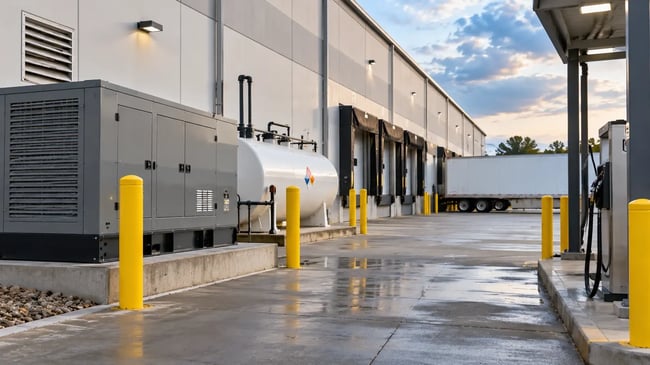
The generator is the item we see most. EPA treats the fuel tank on a generator set as a bulk storage container, not as oil-filled operational equipment, so there's no shortcut around counting it. If you're planning to install one, adding a backup generator walks through recounting before it goes in. Air permitting for the same generator is a separate question, covered in our post on environmental permits for emergency backup generators.
The diesel fire pump is the item that gets missed. Nothing in the SPCC rule exempts fire protection equipment, so a diesel fire pump's fuel tank counts like any other container of oil. Fire pumps are usually specified and installed by the sprinkler and fire protection side of a project, which means the tank can slip past the environmental count entirely. If your pump is electric, it doesn't add anything. If it's diesel-driven, find out the tank size and put it on your list.
What Doesn't Count for a Warehouse, and What About Forklifts and Truck Fueling?
The rule exempts what it calls motive power containers, which are onboard tanks used mainly to power the movement of a vehicle or its onboard oil-filled equipment. A forklift's own diesel tank, a yard tractor's fuel tank, and a delivery truck's saddle tanks are all in that group. They don't count toward the 1,320 gallons. Propane cylinders on forklifts don't count either, because propane isn't oil, and our post on propane and other fuels that aren't oil explains the details. Electric forklift batteries hold acid electrolyte, not oil, so they stay out of the SPCC count as well.
Truck fueling is where warehouses get caught. The vehicle's tank is exempt, but the tank you fuel it from isn't. If you keep an aboveground diesel tank on the property to fuel yard trucks or a delivery fleet, that tank counts at full capacity, and a 1,000-gallon fuel tank leaves little room for anything else. The rule also says that transferring fuel into an exempt vehicle at an otherwise regulated facility isn't exempt, so once the site is over the threshold, the fueling area becomes part of the plan. A mobile refueler you keep on site is treated as a bulk storage container too, not as a motive power container. Fuel delivered by a supplier's tanker truck belongs to the supplier, though the unloading area still needs attention, which we cover in fuel delivery areas and SPCC unloading requirements.
Underground tanks follow different rules. A buried fleet fueling tank that's fully covered by New Jersey's underground storage tank rules, N.J.A.C. 7:14B, doesn't count toward the aboveground total, but it carries its own registration and certified-contractor requirements. For the full list of what the federal rule leaves out, see SPCC exemptions for New Jersey containers and facilities.
How Do You Add Up Warehouse Oil Storage to Check SPCC Applicability?
Walk the whole site, inside and out, and write down every container that holds 55 gallons or more: tanks, drums, totes, the generator and fire pump tanks, and any oil-filled equipment of that size. Record the capacity printed on the nameplate or the tank, not the current level. Include containers that are idle, seasonal, or standby, because those still count unless they've been permanently closed under the rule's definition. Then total the numbers and compare them to 1,320. Our guide on how to inventory oil tanks, drums, and equipment goes deeper on the walkthrough.
A realistic example shows how fast it moves. A distribution center with a 750-gallon generator tank and a 400-gallon diesel fire pump tank totals 1,150 gallons, which is under the line. Then maintenance adds a 275-gallon used oil tote and two 55-gallon drums of hydraulic oil, and the site is at 1,535 gallons. Nothing dramatic happened, and the facility now needs a plan. That's why we suggest recounting any time a generator, a tank, or a new tenant's equipment shows up.
If your total comes in comfortably under 1,320 gallons, you don't need an SPCC plan, and you don't need us. Keep a dated copy of your count so you can show how you reached the number, and redo it when the site changes. If you're close, treat it as over until you've checked every container, because a miscount is the usual way a site ends up without a plan it needed.
What New Jersey Rules Apply to a Warehouse Even Without an SPCC Plan?
Skipping the federal plan doesn't take a warehouse out of New Jersey's rules. The Spill Compensation and Control Act, usually called the Spill Act, applies to a discharge from any facility, large or small. It requires you to report a discharge to NJDEP right away through its hotline, and the number is on NJDEP's website. Liability under the Spill Act is strict and can be joint and several, which in general terms means the party responsible for a release can be on the hook for cleanup costs. If a spill does happen, put safety and emergency calls first, and consider talking to an environmental attorney about your specific situation. Our post on when you have to report an oil spill covers the reporting side.
The Spill Act also covers hazardous substances beyond oil, and this is where some warehouses are surprised. NJDEP's DPCC and DCR plans, which stand for discharge prevention, containment and countermeasure, and discharge cleanup and removal, apply to "major facilities" under N.J.A.C. 7:1E. A major facility is one with 20,000 gallons or more of hazardous substances other than petroleum, or 200,000 gallons or more of all hazardous substances including petroleum. NJDEP counts storage differently than EPA does, including full or empty containers over five gallons. A warehouse holding drums of chemicals for customers can cross that line without owning a single oil tank. The details are in our comparison of SPCC and DPCC plans, and because the thresholds and the substance list can change, check the current rule against your own inventory. A warehouse that stores chemicals may also have Community Right to Know reporting.
The Uniform Fire Code adds its own tank requirements, enforced by your local fire officials, and a diesel generator or fire pump tank can draw their attention whether or not you need an SPCC plan. If you're building or expanding a warehouse, the construction side, including construction stormwater coverage, soil erosion approvals, and the permits for installing tanks, is work for your engineer and contractors, and it's not something RMA prepares. Where we help is the operational side once the building is running, and we can help you work out what the construction phase needs and point you toward the right people.
What Does an SPCC Plan Cost for a New Jersey Warehouse?
When a warehouse does need a plan, the path depends on size. A facility with 10,000 gallons or less of total aboveground oil storage and no single container over 5,000 gallons can often self-certify using EPA's template, provided it meets the other qualified facility conditions, including its spill history. Above those limits, a licensed Professional Engineer has to review and certify the plan. Whether you can self-certify is worth settling early, since it changes the cost.
RMA's published range for a new SPCC plan runs from about $2,500 to $15,000. Where a warehouse falls in that range depends on total storage capacity, how many containers and what types, whether a PE certification is needed, and whether the secondary containment needs to be evaluated or fixed. For a closer look at the numbers, read SPCC plan costs explained and what a Tier I plan costs in New Jersey. Our SPCC pricing calculator below gives you an estimate for RMA's help with your own facility.
How Can RMA Help With a Warehouse Oil Spill Plan?
RMA is based in New Jersey and works with NJDEP's rules and EPA Region 2 every day. For a warehouse, we start by counting what's on site, and we'll tell you plainly if you're under the line and don't need a plan. If you're over, we help you build a plan that fits how your facility operates, and we'll explain any containment, inspection, and training requirements that come with it. There's no pressure and no obligation. You can call us, email, or fill out the form on our website, and if you'd like a second set of eyes on your oil count, just reach out to RMA.