How NPDES, Industrial Stormwater, General, and Individual Permits Fit Together, and Why Everyone Uses the Terms Differently
Ask three people at a facility what permit they have and you might hear "our NPDES permit," "our stormwater permit," and "our industrial stormwater general permit," all describing the same piece of paper. Your state agency, your consultant, and your insurance auditor may each use those words a little differently too, which makes it hard to tell whether everyone is talking about the same thing at all.
In this article we'll show how NPDES, stormwater, industrial stormwater, general, and individual permits fit together, what each term means in practice, and how the names change from state to state. If you'd rather talk through your own facility, you can reach out to RMA any time, but the goal here is to give you enough to follow the conversation on your own.
Table of Contents
TL;DR
NPDES is the federal permitting program under the Clean Water Act, and nearly every other term in this area sits underneath it. Stormwater permits are one branch, and industrial stormwater permits are a subset of that branch for facilities where rain touches industrial activity. A general permit is a standardized permit that covers many similar facilities, while an individual permit is written for one facility, which is the usual route for wastewater and process water. When someone says "NPDES permit," you still need to know which branch they mean.
What Is an NPDES Permit and Why Does It Cover So Much?
NPDES stands for National Pollutant Discharge Elimination System. It's the federal permitting program set up under the Clean Water Act, and it covers discharges of pollutants from a defined point, like a pipe, ditch, or outfall, into waters of the United States. In most states, the state environmental agency runs the program under authority delegated by EPA, which is a big reason the paperwork looks different from one state to the next.
The easiest way to picture NPDES is as an umbrella. It isn't one permit with one set of rules. Underneath it sit several kinds of permits for several kinds of discharges, and each one has its own application, its own conditions, and its own paperwork. That's why "we need an NPDES permit" is an unfinished sentence. It tells you which program you're in, but it doesn't tell you which permit you hold or need. If you want the full overview first, our guide to everything you need to know about NPDES stormwater permits covers timelines, costs, and compliance basics.
What's the Difference Between a Stormwater Permit and an Industrial Stormwater Permit?
Stormwater permits are one major branch under the NPDES umbrella. They regulate stormwater runoff that leaves a site and could carry pollutants into nearby waters. Industrial stormwater permits sit one level down, as a branch of that branch. They apply to many industrial facilities where rain can touch raw materials, equipment, manufacturing activities, waste handling areas, vehicle traffic, or other potential sources of pollution before it leaves the property.
So when you ask whether you need an industrial stormwater permit, you're really asking whether your facility falls under the stormwater portion of NPDES. Our post on stormwater associated with industrial activity explains the term regulators use to draw that line, and who needs a stormwater permit walks through the typical facility types. If you'd like a shorter take on the NPDES permit versus stormwater permit question, we've covered that one too.
At a manufacturing plant, scrapyard, or concrete plant, "stormwater permit" and "industrial stormwater permit" usually mean the same piece of paper. The broader stormwater category does include other tracks, like permits for municipal storm sewer systems and construction sites. Construction stormwater is a separate track from the operational permits we work on, so if that's what you're dealing with, you'll want a construction-focused firm.
What Is a General Permit, and How Is It Different From an Individual Permit?
A general permit isn't a separate environmental program. It's a standardized permit written to cover a large group of facilities with similar operations. The agency writes the conditions once, and facilities that qualify apply for coverage under it, usually by submitting a notice of intent instead of negotiating their own terms. Some states issue different general permits for different industries. Others cover most industrial facilities under one statewide general permit, or under a multi-sector general permit that organizes the requirements by industry sector.
An individual permit is the opposite approach. It's written for one specific facility and its specific discharge situation, with limits and conditions drafted around what that site does. Individual permits usually take longer to get and involve more back and forth with the agency, which is why most facilities with ordinary industrial stormwater end up under a general permit when one is available.
"General" and "individual" describe how a permit is written, not what it covers. When someone tells you they have coverage under a general industrial stormwater permit, they're describing a stormwater permit, an industrial stormwater permit, and a general permit all at once. None of those labels is wrong, because they're different pieces of the same branch of the NPDES program. Our guide on which NPDES permit you need goes deeper on the differences.
There's one more path worth knowing about. Facilities that keep all industrial materials and activities sheltered from rain can sometimes certify "no exposure" in place of full permit coverage, depending on the state. We cover how that works in our post on what non-exposure means.
How Do Wastewater and Process Water Permits Fit Under NPDES?
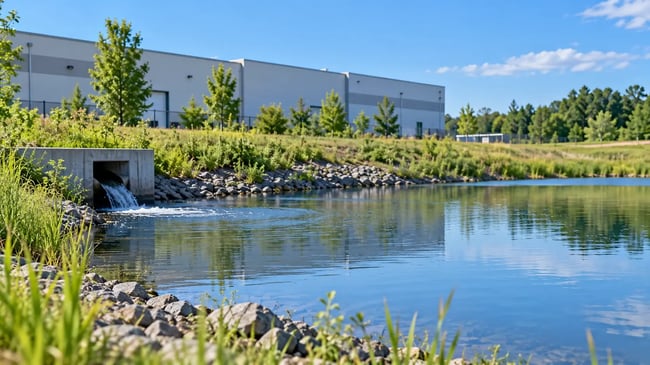
Stormwater is only one branch of NPDES. Another major branch covers facilities that discharge wastewater or process water, either instead of stormwater or on top of it. Process water is water that's touched your operations, as opposed to rain that fell on your site. Those discharges are often handled with individual permits, written around the particular facility and what comes out of its pipe. Our post on the difference between stormwater and process water covers how regulators treat the two.
Terminology gets loose here. Some permits authorize more than one type of discharge, and people don't always use the words consistently. A workable rule of thumb is that someone talking about stormwater runoff is usually talking about the stormwater side of NPDES, and someone talking about wastewater or process water discharges is often talking about an individual NPDES permit. When you're not sure, ask which discharge the permit covers. That one question usually sorts out the rest.
How Do NPDES, Stormwater, Industrial Stormwater, General, and Individual Permits Compare?
Here's the whole hierarchy in one place. The first three rows are about what a permit covers, and the last three are about how it's written, so one permit can show up in more than one row.
| Term |
What it means |
Where it fits |
| NPDES permit |
The federal discharge permitting program under the Clean Water Act |
Top level, the umbrella over everything else |
| Stormwater permit |
Covers stormwater runoff that leaves a site and could carry pollutants to nearby waters |
One major branch under NPDES |
| Industrial stormwater permit |
Covers industrial facilities where rain can touch materials, equipment, or activities before leaving the site |
A subset of the stormwater branch |
| General permit |
A standardized permit written to cover a large group of similar facilities |
Describes how a permit is written, not what it covers |
| Individual permit |
A permit written for one specific facility and its specific discharges |
Describes how a permit is written, and it's the usual route for wastewater and process water |
| Multi-sector general permit |
One general permit with requirements organized by industry sector |
A type of general permit |
Reading down the table, a facility's industrial stormwater general permit is an NPDES permit, a stormwater permit, an industrial stormwater permit, and a general permit at the same time. A facility's wastewater permit is an NPDES permit and, most likely, an individual permit. Two people can describe the same permit with different words and both be correct.
Why Do State Permit Names Like NJPDES, SPDES, and PAG-03 Look So Different?
Because states run their own programs, the names change even when the underlying idea doesn't. New Jersey calls its program NJPDES, and New York calls its version SPDES. Pennsylvania's general permit for industrial stormwater is PAG-03. Florida uses a multi-sector general permit in Florida. Within a state, individual general permits get their own codes too, like New Jersey's 5G2 basic industrial stormwater permit. All of these are NPDES-based permits with local names.
Whether you need coverage, which general permit applies, and what the conditions say all come from your state agency. Start by finding your state's name for the permit, then read what it covers. Some states trip people up in their own way. In New York's SPDES stormwater permit, for example, the permit and the plan that goes with it get mixed up all the time. If you operate in several states, expect a different vocabulary in each one.
What Ongoing Requirements Come With an Industrial Stormwater Permit?
Most facilities assume getting permit coverage is the hard part. It usually isn't. The application is a one-time task, and the real workload is the routine that follows it, year after year.
Under an industrial stormwater permit, that routine typically includes a SWPPP that you keep current, routine inspections of the site, employee training for the people who handle materials and stormwater controls, sampling when the permit calls for it, reporting to the agency, and corrective actions when something goes wrong. The exact list depends on the permit, but those are the pieces we see most often. If your team needs training, our online training library is a good place to start.
We help facilities work out whether they need NPDES permit coverage, identify which stormwater permit applies, prepare applications and SWPPPs, and keep up with inspections, sampling, reporting, and the rest of the ongoing requirements. If you're wondering what that help would cost, our NPDES pricing calculator is below. It asks a few quick questions and gives you a price on the spot, with no email or sales call required.
How Can RMA Help With NPDES and Stormwater Permitting?
Most of the confusion around NPDES comes down to vocabulary, and once you know the hierarchy, the rest follows. If you'd like help figuring out whether your facility needs coverage, which stormwater permit applies, or how to stay on top of inspections, sampling, and reporting, we're glad to talk it through. You can call us at 888-RMA-0230, send an email, or fill out the form on our website, and you can get in touch with RMA whenever it suits you. There's no pressure and no obligation.
If you only needed to decode what a regulator, vendor, or neighbor meant by "NPDES permit," this article may be all you need, and that's a fine outcome. We'd rather you leave with a clear picture of your permit than sign up for help you don't need.

