A Sheen Leaving Your Site Can Be a Reportable Oil Discharge and a Stormwater Permit Violation at the Same Time
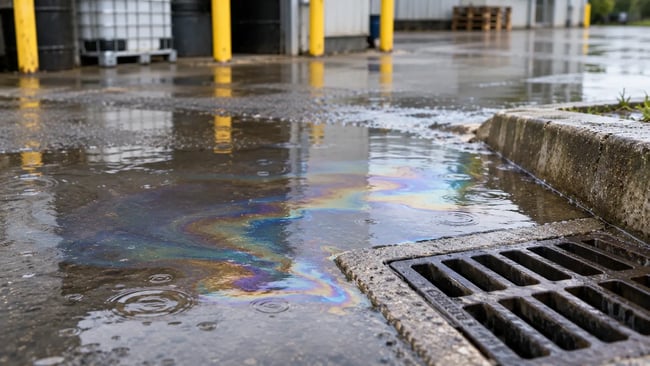
You're walking the yard after a rain and you spot a rainbow film on the water at an outfall, in a ditch, or pooled at a storm drain. The first question is whether it's oil. The second is which rulebook just got involved, because a sheen on stormwater can be a reportable oil discharge under federal and Pennsylvania spill rules, a violation of your PAG-03 stormwater permit, and a reason to take another look at your SPCC Plan, all from the same puddle. PAG-03 is Pennsylvania DEP's general stormwater permit for industrial facilities, and an SPCC (Spill Prevention, Control, and Countermeasure) Plan is the federal oil spill prevention plan required for facilities with large amounts of oil storage.
The short answer is that it can be both, and which one it is depends on where the oil came from and what your facility has in place. Below, we start with a short list of what to do right now, then cover how to tell whether the sheen is oil, how to sort out SPCC versus PAG-03, who you have to call, what penalties are possible, and how your SPCC Plan and PAG-03 PPC Plan should work together afterward. If you'd rather talk it through with someone, you can reach out to RMA and we'll help you figure out where you stand.
Table of Contents
TL;DR
Yes, a sheen on stormwater can be an SPCC problem, a PAG-03 problem, or both. Oil that creates a sheen on water has to be reported by phone right away to the National Response Center and to Pennsylvania DEP, and there's no minimum amount. Where the oil came from decides the rest: oil from storage, transfer, or equipment points back to your SPCC Plan, any sheen leaving a PAG-03 facility is a permit problem, and many facilities face both. Afterward, fix the source, document what happened, and update both plans so they agree.
What Should You Do Right Now If You See an Oil Sheen on Stormwater?
If anyone is hurt, there's a fire, or the spill is a danger to people, call 911 first and stay clear. If it's only a sheen, this order works for most facilities.
- Stop the source if you can do it safely. Close a valve, stop a transfer, upright or plug a leaking container, or shut down the dripping equipment.
- Contain what's left with absorbent pads, socks, or a boom at the inlet or outfall. Don't hose it down or push it downstream.
- Call the National Response Center at 1-800-424-8802 right away if the sheen is on water or has reached a ditch, storm drain, or creek. It's staffed around the clock.
- Call PA DEP right away, either the regional office for your county or the statewide emergency number at 800-541-2050, and notify downstream users if you reasonably can.
- Write it down while it's fresh: the time, location, rain conditions, likely source, size of the sheen, and who you called and when. Take photos.
- Pull out your SPCC Plan and PPC Plan and follow the response and reporting steps in them. The sections below explain who needs to hear about it, why, and what to fix afterward.
How Do You Tell an Oil Sheen From a Natural Film on Stormwater?
Not every film on water is oil. Pollen, decaying leaves, and naturally occurring bacteria can leave a skin on a pond or ditch that looks like a sheen from a distance. Poke the surface with a stick. A natural film usually breaks into separate pieces and stays broken, while oil swirls back together into a continuous, rainbow-colored sheen. If you poke it and still aren't sure, treat it as oil and make the calls. A report that turns out to be a false alarm costs you a phone call, and a missed report can cost a lot more.
EPA defines a sheen as an iridescent appearance on the surface of water, and the federal rule has no minimum volume. It also covers vegetable oil and other non-petroleum oils, so a sheen from cooking oil gets treated like one from diesel. Take photos either way, and write down why you decided it was or wasn't oil. Our article on the sheen rule goes deeper on how regulators think about it, and our guide to stormwater visual inspections shows how to build sheen checks into your routine.
Is a Stormwater Oil Sheen an SPCC Problem, a PAG-03 Problem, or Both?
They're two separate programs with two separate agencies. The SPCC rule is federal, it's found in 40 CFR Part 112, and EPA Region 3 enforces it in Pennsylvania. It applies when a facility has more than 1,320 gallons of aboveground oil storage capacity in containers of 55 gallons or more (or more than 42,000 gallons completely buried) and a spill could reasonably reach navigable waters or adjoining shorelines. It's about how oil is stored, contained, transferred, and responded to. PAG-03 is DEP's general NPDES permit for industrial stormwater. It doesn't depend on how much oil you store. It prohibits floating solids, scum, and sheen in what leaves your site, and it requires a Preparedness, Prevention, and Contingency (PPC) Plan, DEP's plan that covers every pollutant that could reach stormwater, not just oil.
The federal sheen rule and DEP's spill notification rule sit on top of both. They apply with or without an SPCC Plan or a stormwater permit, so the next question after the calls is where the oil came from. This table shows how the source usually sorts out.
| Where the oil came from |
SPCC angle |
PAG-03 angle |
| Leak or overflow at a bulk tank, drum area, or transfer point |
Direct SPCC problem. Containment, overfill prevention, inspection records, and response procedures all come into question. |
Also a PAG-03 problem if the oil reached an outfall, since sheen is prohibited and the PPC Plan and BMPs get reviewed. |
| Oil-filled equipment such as a hydraulic system or transformer |
Covered when it counts toward your storage total. Check the containment or contingency plan option in your plan. |
PAG-03 problem if the oil reached stormwater leaving the site. |
| Drips from trucks, loaders, and other equipment in the yard or parking area |
A fuel tank that powers its own vehicle doesn't count toward SPCC, but fuel trailers, skid tanks, and nearby storage may. |
Mostly a housekeeping and BMP problem the PPC Plan should address. |
| Used oil containers, floor drains, or a wash area |
Used oil containers of 55 gallons or more count toward the threshold. |
A separate problem if floor drain or wash water reached an outfall as an unauthorized non-stormwater discharge. |
| A natural film or an off-site source |
Not an SPCC problem if you can document the cause. |
Record it in your inspection notes. |
| A facility under the 1,320 gallon threshold |
No SPCC Plan required, but the sheen rule and DEP notification still apply. |
PAG-03 still applies if you have coverage. |
Plenty of facilities land in the "both" row. A tank overflows, the oil runs across the yard in the next rain, and it leaves through an outfall, so the same event shows up in your SPCC inspection records and your PAG-03 inspection and sampling records. Our article on how storm drains and creeks define SPCC spill risk explains why drainage paths decide so much of this. And if your facility has exposed industrial activity but no PAG-03 coverage or No Exposure Certification, a sheen at the outfall may raise a separate question about whether you needed coverage in the first place, which our guide to stormwater permits in Pennsylvania walks through.
Who Do You Have to Report an Oil Sheen on Stormwater to in Pennsylvania?
Reporting duties stack, so one sheen can mean several calls to several agencies. They aren't interchangeable. A call to DEP doesn't satisfy the federal rule, and the reverse is also true.
| Who |
When |
What triggers it |
| National Response Center, 1-800-424-8802 |
Immediately, as soon as you know |
Oil reaching navigable waters or adjoining shorelines that causes a sheen, discoloration, or a sludge or emulsion (40 CFR 110.3). There's no minimum amount. |
| PA DEP regional office, or the statewide emergency line at 800-541-2050 |
Immediately, by phone |
A spill or release that causes or threatens pollution of waters of the Commonwealth (25 Pa. Code 91.33(a)), which includes ditches, storm sewers, and ponds. DEP says to call when you're unsure, and to notify known downstream users if you reasonably can. |
| PA DEP, PAG-03 noncompliance report |
Oral report within 24 hours, written report within 5 days unless DEP waives it |
Noncompliance that may endanger health or the environment, which a prohibited sheen can be. DEP's guidance also tells NPDES permittees to notify as soon as possible and no later than four hours after becoming aware (25 Pa. Code 92a.41(b)). Use DEP's Non-Compliance Reporting Form (3800-FM-BCW0440) for the written report. |
| EPA Region 3, written information |
Within 60 days, with a copy to the state agency in charge of oil pollution control |
Only for SPCC facilities with a single discharge of more than 1,000 gallons, or two discharges of more than 42 gallons each within any 12-month period, to navigable waters or adjoining shorelines (40 CFR 112.4). |
Most sheens involve far less than 42 gallons, so the EPA Region 3 submission rarely comes into play, but the phone calls still do. The event still belongs in your records, because a facility can only self-certify its SPCC Plan if, over the prior three years, it hasn't had a single discharge over 1,000 gallons or two discharges over 42 gallons each within 12 months to navigable waters or adjoining shorelines. Our article on qualified facility status covers that test. If aquatic life is affected, DEP's guidance also lists the Pennsylvania Fish & Boat Commission at 855-347-4545.
You may hear that a facility with a stormwater permit doesn't have to report a sheen, because the Clean Water Act excludes discharges that comply with an NPDES permit from its oil spill provisions. PAG-03 prohibits sheen, though, so a sheen leaving a covered facility generally isn't a compliant discharge, and DEP's guidance says to err on the side of caution when you're unsure.
What Penalties Can an Oil Sheen at a Pennsylvania Facility Lead To?
Most reported sheens end with a follow-up conversation and a confirmation that you handled it properly, not a penalty. Outcomes depend on the volume, the cause, how fast you responded, your compliance history, and how you work with the agencies. The trouble starts when a facility doesn't report and is later tied to the discharge, since failing to notify is its own violation under the Clean Water Act, separate from the spill. For context, here are the federal statutory maximums, as adjusted for inflation under 40 CFR 19.4 for penalties assessed on or after January 8, 2025.
| Provision |
Statutory maximum |
| Oil discharge, civil judicial penalty (CWA 311(b)(7)(A)) |
$59,114 per day of violation, or $2,364 per barrel of oil discharged |
| NPDES permit violation (CWA 309(d)) |
$68,445 per day per violation |
Those are ceilings, not typical outcomes, and EPA adjusts them periodically, so check the current table before you quote a number. Pennsylvania adds its own enforcement authority under the Clean Streams Law, and DEP administers PAG-03, so one sheen can draw both federal and state attention. Our article on top SPCC Plan violations and fines covers the SPCC side. Spills, violations, and penalties are also where an environmental attorney may be appropriate, so consider calling one before you go beyond the required notifications and factual reports.
How Should Your SPCC Plan and PAG-03 PPC Plan Work Together After a Sheen?
If your facility has both plans, treat them as one system with two sets of rules. PAG-03 lets an SPCC Plan satisfy the PPC Plan requirements as long as the PPC minimum elements are covered, but an SPCC Plan covers oil only, and a PPC Plan has to cover every pollutant that could reach stormwater. Some facilities combine them into one document, and others keep two that point to each other. Our articles on whether you need both plans and whether one document can cover SPCC, PPC, and SPRP requirements walk through that choice. If you don't have an SPCC Plan, a sheen is also a prompt to check whether you need one, since the 1,320 gallon threshold counts every container of 55 gallons or more plus oil-filled equipment.
After a sheen, this is what we'd compare across the two plans.
| Check after a sheen |
SPCC Plan |
PAG-03 PPC Plan |
| Drainage paths |
Facility diagram shows where oil would flow |
Site map shows structures, control measures, and outfalls |
| Source controls |
Containment, overfill prevention, transfer procedures |
BMPs and housekeeping for exposed areas |
| Response steps and call list |
Discharge response procedures and contacts |
Spill response procedures and contacts |
| Records |
Inspections, training, spill history |
Visual inspections, corrective actions, annual report |
| Update rule |
Five-year review, plus an amendment when the facility or procedures change |
Review at least annually, with updates documented in the annual report |
Two documents with two different call lists is how people end up making only one of the calls, so match the contacts and the site maps first. On updates, the SPCC rule calls for an amendment when you change the facility or its procedures in a way that affects discharge potential, generally within six months, and a technical amendment to a PE-certified plan goes back to the professional engineer. PAG-03 expects the PPC Plan to be reviewed at least annually and updated when needed. If a sheen exposes a gap, don't wait for the next scheduled review. Our article on when to update your PPC Plan covers the triggers. Use the event for training too, since both plans expect trained staff. Our online environmental training library is there for ongoing training.
Then fix the source. Most fixes are small, like drip pans under equipment, covered drum storage, spill kits where spills happen, and sweeping before storms, and our guides on stormwater BMPs and spill kits for Pennsylvania SPCC facilities cover the common ones. Keep dated records of what you changed, since that's your best evidence that you responded. If the fix means building new containment or replacing a tank, that work belongs with your engineer and contractor, and we don't prepare the construction permits or approvals that come with it. We can update your SPCC Plan and PPC Plan once the changes are in place.
How Can RMA Help With an Oil Sheen, Your SPCC Plan, and PAG-03 Compliance?
If you have an active spill, make the calls above first and bring in a spill cleanup contractor. We're consultants, not an emergency response crew. Once the immediate situation is handled, we can help you work through what it means: walking your drainage paths to find the source, checking whether an SPCC Plan applies, writing or rebuilding the plan, and making sure your PPC Plan and SPCC Plan agree on the site map, the call list, and the controls. If you already have PAG-03 coverage, we can help with PPC Plan updates, corrective actions, inspection and sampling records, and DEP reporting. When an SPCC Plan needs PE certification, we work with an outside professional engineer who reviews and seals it, and if another firm wrote your existing plan, we usually rebuild it rather than update it.
There's no pressure and no obligation in asking, and if you don't need us, we'll tell you. You can call us at 888-RMA-0230, email us, or fill out the form on our website, or you can contact RMA directly. You can also read more about our Pennsylvania SPCC Plan services and our Pennsylvania NPDES and stormwater services.