How Annual Inspection and Certification Work Across NJPDES Industrial Stormwater Permits, What Gets Reviewed, and How to Document It
If your New Jersey facility has coverage under an industrial stormwater permit, the odds are very good that you owe NJDEP an annual inspection of your site and a signed certification that you did it. The names of the permits change (5G2, CPM, R4, and so on), and the paperwork details change with them, but the basic yearly routine shows up almost everywhere. Most facility managers we talk to know they have a permit. Far fewer know exactly what the annual inspection has to cover, who has to sign, or what NJDEP expects to find in the file if someone asks.
The short answer is yes: if you hold a general permit for industrial stormwater, expect an annual inspection and an annual certification or report, with the permit-specific details set by your own permit and authorization. In this article we'll walk through what the common thread is, what a good annual inspection reviews, how to document it so it holds up, and where the permits really do differ. If you'd rather have someone walk through your authorization and paperwork with you, you can always reach out to RMA.
Table of Contents
TL;DR
Yes. New Jersey's industrial stormwater general permits generally call for a once-a-year inspection of the whole facility and a signed annual certification or report, built on the same idea: you checked the site against your stormwater plan and tell NJDEP whether you're in compliance. The permits differ in the form, the due date, whether it's submitted or kept on site, and what else comes with it, like sampling. Your permit and your authorization letter control those details, so read the current versions, keep the records behind every statement you sign, and don't copy last year's form.
What Do Annual Inspection and Certification Mean Under NJPDES Stormwater Permits?
New Jersey regulates rain and snowmelt that touches industrial activity through the New Jersey Pollutant Discharge Elimination System (NJPDES), run by the New Jersey Department of Environmental Protection (NJDEP). Most facilities get coverage through a general permit, which is a master permit NJDEP writes once for a group of similar facilities. You sign up through a Request for Authorization (RFA), and NJDEP sends back an authorization showing your facility's effective date. A few facilities have individual permits written for them, and a few qualify for a Permanent No Exposure Certification instead of a permit.
Every one of these permits is built around a written stormwater pollution prevention plan. NJDEP calls it an SPPP, and you'll also hear it called an SP3 or just a stormwater plan, but we'll call it a SWPPP here. The annual inspection is the yearly check that the plan still matches the site and that people are following it. The annual certification (or annual report, depending on the permit) is the paperwork that tells NJDEP the check happened and what you found.
The common thread comes from the rule behind the permits. NJDEP's stormwater monitoring rule at N.J.A.C. 7:14A-24.9 describes an annual inspection to identify areas contributing to industrial stormwater discharges and to evaluate whether the controls are working, a report summarizing the results, and an annual certification of compliance with the plan and the permit. If there were incidents of non-compliance, the certification identifies them and the report explains the steps taken to fix them and keep them from happening again. The rule also calls for a signature by a person described in N.J.A.C. 7:14A-4.9 and for keeping the report and certification for at least five years.
Keep three things separate, because facilities mix them up. Routine monthly walks are one thing, the deeper annual inspection is another, and the certification is the statement you sign about it. Sampling, where a permit requires it, runs on its own track. Our article on how to do a stormwater visual inspection covers the routine walk, and our guide to what a SWPPP is covers the plan itself.
Which New Jersey Industrial Stormwater Permits Require an Annual Inspection and Certification?
New Jersey doesn't have one industrial stormwater permit. It has the Basic Industrial Stormwater General Permit (5G2) for regulated facilities that have eliminated, or can eliminate within six months, exposure of industrial materials and activities to rain and snowmelt. On top of that are industry-specific general permits: Concrete Products Manufacturing (CPM), Hot Mix Asphalt Producers (R4), Mining and Quarrying (R13), Sand and Gravel (RSG), Scrap Metal (SM2), Vehicle Recycling (RVR), and Wood Waste Recycling and Leaf Composting (WRC). Facilities that don't fit any of those may need an individual permit. Our guide on which NPDES permit you need sorts out the categories, and our post on which NJ stormwater permit fits a concrete, asphalt, or quarry operation helps if you're in one of those industries.
From NJDEP's permit documents and program pages, the 5G2, R4, CPM, SM2, RVR, and WRC all carry an annual inspection of some kind, and most pair it with a certification or annual report form. The table later in this article lays out what we found for each one.
Permanent No Exposure is the exception that proves the rule. It isn't a permit, and it doesn't come with the yearly inspection and certification cycle. It's a signed certification filed with NJDEP on a multi-year cycle, and the site has to stay in that no-exposure condition the whole time. Our post on checking your facility for permanent no exposure walks through how to check.
What Does a New Jersey Annual Stormwater Inspection Typically Review?
The annual inspection has two halves, a site walk and an office review, and a good one covers both. NJDEP's own annual self-inspection language for the 5G2 asks whether the plan is current and up to date, whether it's properly implemented, and whether the facility is effectively eliminating exposure of source materials and industrial activity to stormwater through structural and non-structural controls. The industry permits add their own subject matter on top of that, but those three questions are a sound frame for any of them.
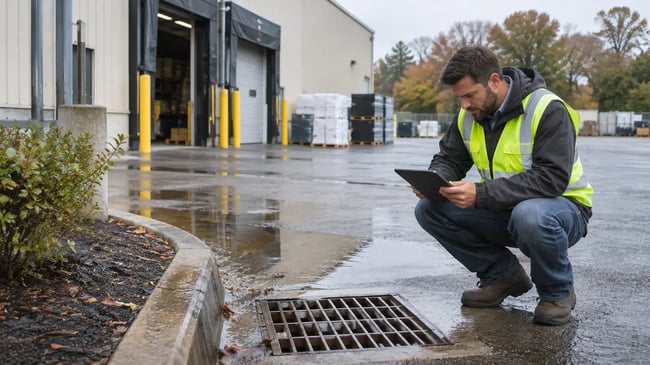
On the site walk, you're covering every area that sheds rain or snowmelt: roofs and roof drains, loading docks, dumpsters, parking, fueling and fluid storage, storm drains, outfalls, and the property edges where water leaves. Compare what you see to your site map and plan, and look for materials that have drifted outdoors, housekeeping that's slipped, controls that are worn out or missing, stains or sheen near drains, and drainage that no longer goes where the map says.
The office review is the half people skip, and it's where the gaps usually are. Pull the year's routine inspection logs and check that they were done on schedule, that problems were fixed and the fix was written down, that training has records, and that the plan was updated for any change in operations. If your permit requires sampling, confirm that it was done and reported on time. It's also the moment to ask whether you still fit your permit, since new outdoor storage or a new process can push you toward a different one. Our article on leaving the 5G2 when changes move you to a different permit covers what to watch for.
How Do You Document an Annual Stormwater Inspection for NJDEP?
Documentation turns a walk around the yard into something that counts. The test is whether you could hand an NJDEP or EPA inspector a record showing what was inspected, by whom, when, what was found, and what was done about it. A solid record has the date, the name and title of the inspector, the areas covered (a marked-up site map works well), findings area by area, corrective actions with an owner and a due date, and any plan updates the inspection triggered.
Dated photos are useful when you're later asked what a spot looked like, but they're supporting evidence, not the record itself. The record is the written summary. Where the form has a checklist, don't tick a box unless you can point to a log, a training sign-in sheet, or a photo that backs it up. Keep the plan, the routine inspection logs, the training records, the annual inspection report, and a copy of the signed certification together at the facility. The 5G2 requires you to hold the plan and certifications on site and to provide a copy to the facility owner, and you hand it over to NJDEP when asked. Plan on retaining the annual report and certification for at least five years, and longer if your permit or NJDEP says so.
If you're taking over a facility mid-stream, our post on taking over stormwater compliance at a New Jersey plant shows what to ask the previous operator for, and our guide on checking your own New Jersey SWPPP for compliance problems works as a pre-inspection checklist.
What Are You Certifying, and Who Can Sign an Annual Stormwater Certification?
When you sign the annual certification, you're telling NJDEP that the annual inspection happened on a stated date, that the plan was evaluated in line with the permit, and that the facility is in compliance with the plan and the permit, with any exceptions identified. On the 5G2 form, you also pick the right option. The same form is used for the plan-preparation certification, the update certification after a renewal, and the annual certification, and checking the wrong one is an easy mistake to make. Read the instructions each year, because NJDEP revises these forms.
The signer matters as much as the content. The rule points to N.J.A.C. 7:14A-4.9, which defines who can sign NJPDES documents, and for a corporation that generally means a responsible corporate officer or someone the rules allow, with any delegation made in writing. A plant manager can do the inspection. Whether that person can also sign depends on how your company is organized and what the rule allows, so check before you route the form. Signing is a legal statement, and a signature on something the records don't support is a bigger problem than a late filing. If you find noncompliance and you're worried about exposure from past years, that's a good moment to consider speaking with an environmental attorney before you file.
How Do Annual Inspection Requirements Differ Between the 5G2, CPM, R4, R13, RSG, SM2, RVR, and WRC?
The shared structure is real, but the permits aren't copies of each other. We've checked what NJDEP publishes for each, and the table below shows where the differences are. Treat it as a map of what to confirm in your own permit and authorization, not a replacement for them. Permit numbers, form versions, and due dates change when NJDEP renews a permit, and several of these were renewed recently.
| Permit |
Annual inspection |
What goes to NJDEP each year |
What to confirm in your permit |
| 5G2 Basic Industrial |
Annual self-inspection of the site and the plan |
Signed certification form, due in the quarter set by your effective date of authorization. The plan itself isn't submitted. |
Current form version and your assigned quarter. No sampling requirement. |
| CPM Concrete Products |
Annual inspection, with training |
Annual certification tied to your authorization |
Sampling schedule and parameters, which sit alongside the annual paperwork |
| R4 Hot Mix Asphalt |
Annual inspection |
Annual certification using NJDEP's certification form |
Monitoring and reporting schedule for your site |
| R13 Mining and Quarrying |
Per the permit |
Certification form is published with the permit documents |
Inspection wording, any process wastewater and dewatering conditions |
| RSG Sand and Gravel |
Per the permit |
Per the permit, which was renewed effective January 1, 2026 |
Renewal terms and form versions. RSG covers stormwater discharges to groundwater |
| SM2 Scrap Metal |
Annual inspection under the plan |
Annual certification and summary report |
Form, due date, and any monitoring conditions |
| RVR Vehicle Recycling |
Annual inspection to check BMPs and permit conditions |
NJDEP's page describes an annual report maintained on site |
Whether your current permit text calls for submitting anything |
| WRC Wood Waste and Leaf Composting |
Annual inspection of the facility |
Department's Annual Report Form summarizing results, under the permit effective January 1, 2026 |
New form and due date after the renewal |
A few notes on the table. On the 5G2, the due date isn't a fixed calendar date for everyone. NJDEP ties it to the effective date of your authorization and assigns a calendar quarter, which shows up on your authorization and in the form's due-date table. On the CPM and R4, the annual paperwork is only part of the monitoring picture, and sampling is separate, as we cover in our posts on CPM sampling and reporting and R4 monitoring and reporting. For scrap yards and auto recyclers, NJDEP's October 2025 compliance advisory says its enforcement division will inspect all permitted scrap metal and vehicle recycling facilities, so your annual paperwork is likelier to get looked at. Our guide for scrap yards and auto recyclers has the background.
If your facility has an individual NJPDES permit, the annual inspection and reporting terms are written into that permit, and they can differ from the general permits above. We didn't find a single set of terms that applies across individual permits, so the permit itself is the only reliable source there. Our article on individual NJPDES industrial permits explains when they apply.
What Annual Stormwater Certification Mistakes Do New Jersey Facilities Make?
The most common one is simply not knowing the certification exists. In an EPA Region 2 inspection report on a New Jersey 5G2 facility, the facility representative said he didn't know annual inspection certifications were required to be submitted, even though the permit calls for them. That's an easy trap when a permit was set up years ago by someone who's since left, and nothing in the daily routine reminds anyone about it.
The next is treating the form as a formality: boxes ticked, form signed, while the monthly logs are incomplete or the plan hasn't been touched since authorization. Others are using an old form version, choosing the wrong option on a multi-purpose form, and missing the quarter. Because the due date comes from your authorization, a facility authorized years ago may not remember when its quarter falls, so put it on a shared calendar with a reminder a few weeks ahead and inspect early enough to fix what you find before you certify.
The last runs the other way: certifying compliance when you know about a problem. The rule contemplates identifying non-compliance in the certification and describing the fix, which is a far better place to be than a clean certification the records contradict. Our article on what happens if a New Jersey business ignores stormwater rules covers the consequences, and our guide on the 5G2 annual report and certification goes step by step on the 5G2 version.
How Can RMA Help With Annual Stormwater Inspections and Certifications in New Jersey?
Plenty of facilities handle their own annual inspection and certification without any outside help, and if you have a current plan, good logs, and a person who knows the permit, you may not need us at all. Our online training library can help your team build those skills in house. Where we usually come in is when a plan is out of date, nobody's sure which form or quarter applies, a new person is taking over the permit, or the facility wants a second set of eyes before signing.
For facilities we work with after they're permitted, we offer annual support: reminders ahead of your due date, help preparing for the inspection, reviewing records and findings, updating the plan, and answering questions as they come up. It can be hands-off or hands-on, and we train your team to do the routine work themselves. We don't take your samples or do lab work, since your people know the site and storm timing makes it impractical for us to be there when it counts. We're a small firm with senior people doing the work, so we're not always the cheapest option, and we tell you up front when a timeline is tighter than we can meet. If you'd like to talk through your own situation with no obligation, you can call us, email us, or fill out the form when you contact RMA.