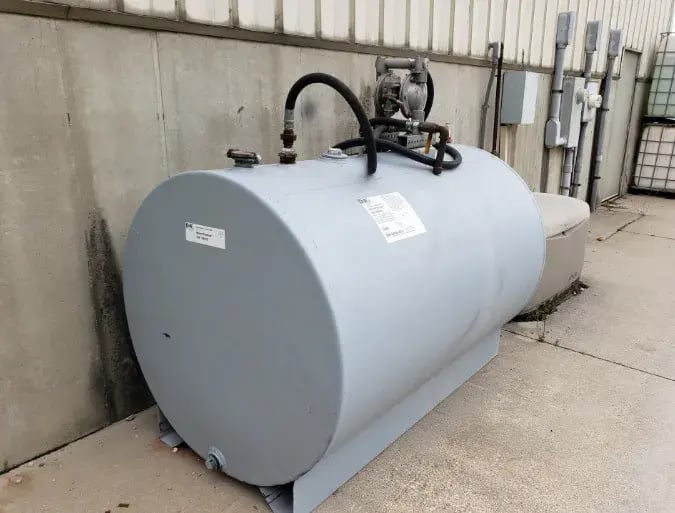
How Bulk Motor Oil, Used Oil, Hydraulic Lifts, and Fuel Add Up to the 1,320-Gallon SPCC Threshold at a New Jersey Dealership
If you run a dealership service department in New Jersey, you probably have a lot of oil on site. There's new motor oil in a bulk tank, used oil waiting for pickup, transmission fluid, hydraulic oil for the lifts, and sometimes a fuel tank for the lot. Once the total gets past a certain size, federal law requires a written oil spill plan, formally called a Spill Prevention, Control, and Countermeasure (SPCC) plan. Most dealership managers have never been told whether they're past that line.
The short answer is that many dealerships with bulk oil systems do need a plan, and the math is simple enough to check yourself. This article walks through how the 1,320-gallon count works in a service department, how to contain bulk oil in the service bays, and how to handle used oil storage. If you'd rather have someone check your numbers, you can reach out to RMA any time.
Table of Contents
TL;DR
A New Jersey dealership needs an SPCC oil spill plan when its containers of 55 gallons or more can hold more than 1,320 gallons of oil in total. Bulk motor oil, used oil, transmission fluid, hydraulic oil, and fuel all count, and the count uses capacity, not what's in the tank today. A service department with a few bulk tanks and a couple of drums can cross the line without trying. Once you're over it, bulk oil needs containment, and used oil tanks need the same treatment as new oil tanks.
Does an Auto Dealership Need an SPCC Plan in New Jersey?
Under 40 CFR Part 112, a facility needs an SPCC plan if it stores more than 1,320 gallons of oil in aboveground containers and could reasonably be expected to discharge oil to navigable waters or adjoining shorelines. Only containers of 55 gallons or more count toward the total. EPA Region 2 enforces the rule in New Jersey, and an inspector can ask to see your plan during a visit.
Two details trip dealerships up. The first is that the count uses container capacity, not contents. A 500-gallon tank that usually sits half full counts as 500 gallons. The second is that oil means more than fuel. New motor oil, used oil, transmission fluid, gear oil, and hydraulic oil all count. Antifreeze and windshield washer fluid don't, because they aren't oil.
The other half of the test is whether a spill could reasonably reach water. A storm drain, ditch, or stream near your property can be enough, and the rule says you can't rely on curbs, dikes, or other manmade structures to rule that out. If you want to work through your own site, our guides on whether your New Jersey facility needs an SPCC plan and how to inventory your tanks, drums, and equipment cover the steps.
How Fast Does Service Department Oil Storage Add Up to 1,320 Gallons?
Quickly, because bulk systems come in large, round sizes. Here's an example of a mid-size New Jersey dealership. The capacities are illustrative, so swap in the numbers off your own tank labels.
| Container |
Example capacity |
Counts toward 1,320? |
| Bulk new motor oil tank |
500 gallons |
Yes |
| Used oil tank |
500 gallons |
Yes |
| Bulk transmission fluid tank |
275 gallons |
Yes |
| One 55-gallon drum of hydraulic or gear oil |
55 gallons |
Yes |
| Lift reservoirs and hand-held containers under 55 gallons |
Varies |
No, not individually |
| Antifreeze and washer fluid |
Varies |
No, not oil |
| Total counted |
1,330 gallons |
Over the line |
That's 1,275 gallons from the three bulk tanks, and a single drum pushes the facility past the threshold. Add a 1,000-gallon fuel tank for the used car lot or the service shuttles and you're far past it. Drums are the easy ones to forget, because they move around and nobody writes them down.
Hydraulic lifts need a closer look. The oil in a lift's power unit counts toward the total only if the container holds 55 gallons or more, and most do not. Oil-filled equipment that is large enough to count has its own handling options, which we cover in our article on oil-filled equipment and the contingency plan option. Buried tanks follow different counting rules, and a buried used oil tank may fall under tank rules instead of SPCC. Our guide to underground tanks and SPCC explains where the line falls.
If your total lands just over 1,320, you have a legitimate option to look at. Swapping a 500-gallon bulk tank for a smaller one, or moving to drums under the count, can bring a facility back under the threshold. It only works if the new setup is how you really operate, and it's worth pricing against the cost of running a plan before you decide.
How Should Bulk Oil Systems in Service Bays Be Contained?
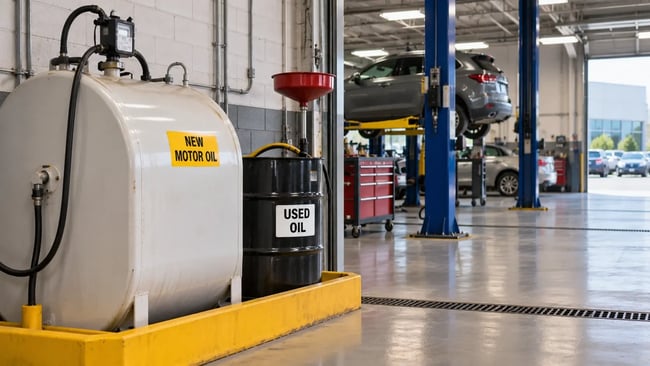
Once a dealership is covered by the rule, bulk oil tanks need secondary containment. The general standard is a dike, berm, or other containment sized to hold the largest single container, plus extra room for rain if the tank sits outdoors. The containment also has to be impervious enough that oil doesn't soak through before someone responds. Indoors, rain isn't a factor, but the rest of the standard still applies. Our walkthrough on evaluating secondary containment shows how to check your own numbers.
In a service department, a few spots cause most of the trouble. Floor drains are the biggest one, because a spill near a tank can reach a drain in seconds, and where that drain goes decides whether you have a cleanup or a reportable discharge. The piping and hose reels that carry oil from a bulk tank to the bays are the next. They leak at fittings, and a worn reel can drip for weeks. The third is the delivery. Whoever fills the new oil tank should have a procedure for watching the fill, and the tank should have a way to avoid overfilling.
Drums and totes in the lube room or parts area need containment too. Spill pallets and containment lockers work for most of them, and our comparison of secondary containment for drums and totes covers the options. Double-walled tanks help, but they don't always satisfy the rule on their own, so check how the second wall is built before you count on it. Bulk oil inside a building can also draw questions from the local fire official, and our article on how the fire code and SPCC overlap explains what each one looks at.
What Are the SPCC Rules for Used Oil Storage at a Dealership?
Used oil counts as oil under SPCC, so a used oil tank gets the same treatment as a tank of new oil. It counts toward the 1,320 gallons, and it needs containment sized to the tank. Dealerships often skip that second part, because used oil tanks tend to be tucked behind the shop or in a corner of a bay, where the last person to look at them was the pickup driver.
Separate from SPCC, federal used oil standards require containers to be labeled "Used Oil" and kept in good condition with no leaks. Keep lids closed, and keep the tank clear of floor drains and storm drains. Outdoor used oil tanks add a rain problem, because rainwater collecting in containment has to be drained in a way that doesn't carry oil out with it. Our guide to draining rainwater from containment covers that, and our summary of used oil regulations covers the waste side.
Pickup day is the other risk. When a hauler pumps out the tank, the transfer hose and the connection are where spills happen. Someone from your staff should be there for it, and the area around the tank should be able to hold a small release until it's cleaned up.
What Does New Jersey Add to the Federal SPCC Rule for Dealerships?
New Jersey's Spill Compensation and Control Act, usually called the Spill Act, applies to petroleum and many other hazardous substances, and it's separate from the federal SPCC plan. It generally requires discharges to be reported to NJDEP, and it holds the responsible party liable for cleanup costs. That liability is broad, and it doesn't depend on fault. NJDEP's website lists the current hotline for reporting. For anything involving a real discharge or possible liability, an environmental attorney may be the right call alongside your consultant. If you're ever unsure whether a spill needs to be reported, our articles on the sheen rule and on reporting to EPA are good starting points.
New Jersey also has discharge prevention plans, called DPCC and DCR plans, under N.J.A.C. 7:1E. They apply to "major facilities," which are defined by total storage capacity of petroleum and other hazardous substances. Whether a dealership is one depends on its whole inventory, so check the rule against your own numbers. We explain how the two plan types differ in our SPCC and DPCC comparison.
A few ongoing duties come with the plan. It needs a review at least every five years, and whenever you add or remove oil storage, for example when you install a bigger bulk tank. Inspections and annual training for the people who handle oil are part of it too, and our online training library has courses for staff. Plans that fall under the federal qualified facility limits can often be self-certified, but we think a professional engineer reviewing and approving the plan is what makes it hold up when an inspector or an insurer reads it. See our article on self-certifying versus using an engineer for the details.
How Does RMA Help New Jersey Dealerships With SPCC Plans?
We help dealerships count their oil, decide whether a plan is required, and build one that matches how the service department really runs. Senior staff do the work, and we don't use AI to write client deliverables. SPCC plans from RMA run from $2,500 to $15,000, and the price depends on total storage, the number and type of containers, and how much containment needs evaluating. If your count comes out under 1,320 gallons, we'll tell you that, and you won't need us. If you're not sure, we're glad to look over your tank list with you.
There's no pressure and no obligation. You can call, email, or fill out the form on our website, and you can reach out to RMA whenever it suits you. For more on how the process works and what we publish on SPCC, our guide to SPCC plans in New Jersey is a good place to start.