Oil Spill Plan Rules for New Jersey Steel Mills, Foundries, and Metal Fabricators: Capacity Counting, Tank Inspections, and Containment in Older Plants
Most steel and metal plants don't think of themselves as oil storage sites. The oil is part of making the product: hydraulic power units on presses and rolling lines, lube oil systems on gearboxes and mill stands, quench oil for heat treating, and diesel for yard equipment and backup generators. Add it all up across a whole plant, though, and the total often lands well above the line that triggers a federal oil spill plan, which EPA calls an SPCC (Spill Prevention, Control, and Countermeasure) Plan.
The short answer is that most New Jersey metals plants of any real size do need one, and many face state planning rules on top of it. This article walks through how the oil adds up, how oil-filled equipment gets counted, what inspections large and field-erected tanks need, and why containment is the hard part in older plants. If you'd rather talk through your own site, you can reach out to RMA at any point.
Table of Contents
TL;DR
Yes, in most cases. If a plant stores more than 1,320 gallons of oil above ground, counting every container and piece of equipment that can hold 55 gallons or more at full capacity, federal law requires a written oil spill plan, and New Jersey adds its own discharge rules. Hydraulic and lube oil systems count toward that total, large steel tanks need formal inspections by certified inspectors, and older plants usually struggle most with containment. A plant this size almost always needs a licensed Professional Engineer to review and certify the plan.
Do Steel and Metal Plants Need an SPCC Oil Spill Plan in New Jersey?
The federal rule sits in 40 CFR Part 112. It applies to a non-transportation facility that stores more than 1,320 gallons of oil above ground in total, or more than 42,000 gallons in completely buried tanks, and that could reasonably be expected to discharge oil to navigable waters or adjoining shorelines. Only containers that hold 55 gallons or more count toward the aboveground total. The rule counts capacity, not what's in the container today, so a half-empty 5,000-gallon tank still counts as 5,000 gallons. In New Jersey, EPA Region 2 enforces the rule.
Metals plants tend to reach the threshold quickly once someone builds a full inventory. Larger hydraulic power units and lube oil reservoirs can run to hundreds of gallons each, and a plant with a few production lines, a bulk lube oil tank, a diesel tank, and a couple of transformers gets past 1,320 gallons without trying.
The reasonable-expectation test rarely lets a plant off the hook. It ignores manmade features that might stop oil, so a curb, a catch basin, or a storm sewer doesn't take you out of the rule. If spilled oil could reach a creek, river, or tidal water by flowing overland or through a drain, the plant is covered.
Some shops don't need a plan. A small fabricator that stays under the 1,320-gallon total isn't covered, and our post on which New Jersey containers and facilities the SPCC rule doesn't cover shows how to check.
Which Oil Sources at a Steel or Metal Plant Count Toward the SPCC Threshold?
Oil shows up in more places in a metals plant than in most industrial facilities, and each source is treated a little differently. The table below sorts the usual suspects. How a specific piece of equipment is classified depends on how it's built and used at your site, so treat it as a starting point.
| Oil source |
How it's usually treated |
What to check |
| Hydraulic power units on presses, rolling lines, and shears |
Oil-filled operational equipment, counted toward the total if the unit can hold 55 gallons or more |
Reservoir capacity, not the current level |
| Lube oil reservoirs, circulating systems, and gearboxes |
Oil-filled operational equipment, counted the same way |
Every connected tank and sump |
| Quench oil tanks |
Depends on the setup. A tank that stores oil is a bulk storage container, while a tank where oil is part of the process may be oil-filled manufacturing equipment |
How the tank is used, which settles which rules apply to it |
| Transformers and oil-filled switchgear |
Oil-filled operational equipment if the plant owns it |
Who owns the unit, the plant or the utility |
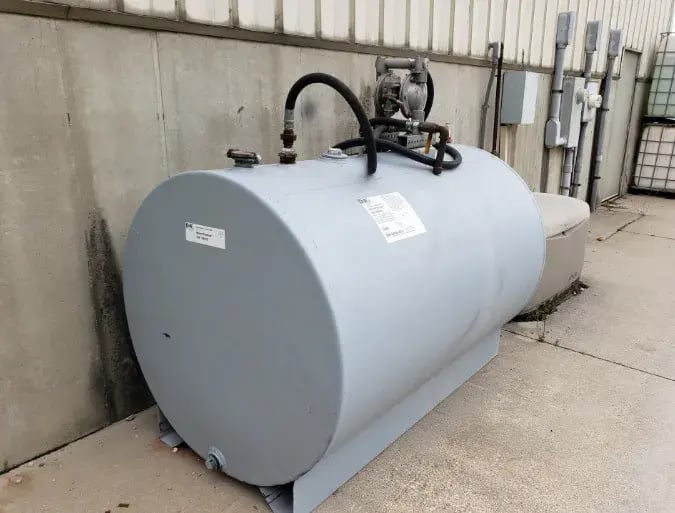
| Diesel and fuel oil tanks, including field-erected tanks |
Bulk storage containers |
Shell capacity, age, and which inspection standard applies |
| Drums and totes of lube, rolling, cutting, and waste oil |
Containers of 55 gallons or more count |
Areas where drums pile up |
| Fuel tanks on forklifts, cranes, and yard equipment |
Motive power containers are left out of the total |
Whether a skid tank is part of the vehicle |
How Does Capacity Counting Work for Oil-Filled Equipment?
EPA's answer is direct. Oil held in equipment goes into the facility's storage capacity even when it only serves a supporting purpose, and EPA uses a hydraulic press as its example. The carve-out is equipment that can't hold 55 gallons or more. A gearbox or reservoir that holds under 55 gallons doesn't count toward the 1,320-gallon total.
The 55-gallon cutoff applies piece by piece. Fifty gearboxes at 40 gallons each add nothing, while a single 60-gallon reservoir counts in full. Equipment is counted by what it can hold, so a hydraulic reservoir kept three-quarters full still counts at full capacity. Equipment can make up a large share of a plant's total, even when nothing on site looks like a traditional tank.
What Changes Once Oil-Filled Equipment Is Counted?
The rule doesn't treat oil-filled operational equipment, which it defines to include hydraulic systems, lubricating systems, gear boxes, and transformers, as a bulk storage container. The tank-style integrity testing described below doesn't apply to it, and its spill protection falls under the general containment requirement, which drip pans, curbs, and sumps can meet.
There's also an optional alternative for qualified oil-filled operational equipment. Instead of containment, a plant documents inspection or monitoring and adds a spill contingency plan and a written commitment of personnel, equipment, and materials. To qualify, the plant can't have had one discharge over 1,000 gallons from this equipment, or two over 42 gallons each in any twelve-month period, during the prior three years. The option doesn't extend to oil-filled manufacturing equipment, where oil flows through a process, so it won't cover everything on a mill floor. Our post on oil-filled equipment and the SPCC contingency plan option goes through how that route works, and our guide to inventorying oil tanks, drums, and equipment shows how to build the list the whole plan rests on.
What Inspections Do Large and Field-Erected Oil Tanks Need at a Metals Plant?
Under 40 CFR 112.8(c)(6), every aboveground bulk storage container of 55 gallons or more has to be tested or inspected on a regular schedule and again after material repairs. EPA doesn't write the schedule. It points to industry standards, and the standard your plan names becomes the one you're held to. For big steel tanks, that standard is usually API 653.
| Container type |
Common standard |
Who does the formal work |
| Large field-erected steel tanks |
API 653 |
API 653 certified inspector, with plant staff handling routine walk-arounds |
| Shop-built tanks and small field-erected tanks |
STI SP001 |
Plant staff for periodic checks, certified inspectors for formal inspections |
| Drums, totes, and portable containers |
STI SP001 also covers portable containers |
Plant staff |
API 653 covers steel tanks built to API 650. Its formal inspections come in two forms: in-service external inspections, with visual checks and ultrasonic thickness readings of the shell, and out-of-service internal inspections of the floor, shell, roof, and nozzles. The rule doesn't give fixed intervals. They depend on the tank's age, service history, measured corrosion rates, and earlier results, and they can change over the tank's life. Your plan has to document the schedule and revisit it at the five-year review.
The practical problem in a working plant is the internal inspection. The tank has to be emptied, cleaned, and made safe to enter, so it needs to be planned around production schedules, with a certified inspector lined up well ahead of time.
Watch in-house repairs, too. Welding, cutting, or altering a tank shell can count as a material repair, which triggers retesting under the standard your plan names. For field-constructed containers, the rule also calls for evaluating the risk of brittle fracture after a repair, alteration, or change in service (40 CFR 112.7(i)). A maintenance crew that patches a weeping seam on a bulk tank may be doing something that needs a formal follow-up, so check before anyone puts a torch on the shell.
Inspection and test records have to be kept at least three years, and EPA recommends keeping formal test reports for the life of the tank. New Jersey's rules for major facilities add tank testing requirements of their own. Our post on integrity testing for bulk oil containers at New Jersey facilities covers the standards and intervals in more depth, and our monthly SPCC inspection checklist is useful for the routine walk-arounds your own staff handle.
Why Is SPCC Secondary Containment So Hard in Older Metals Plants?
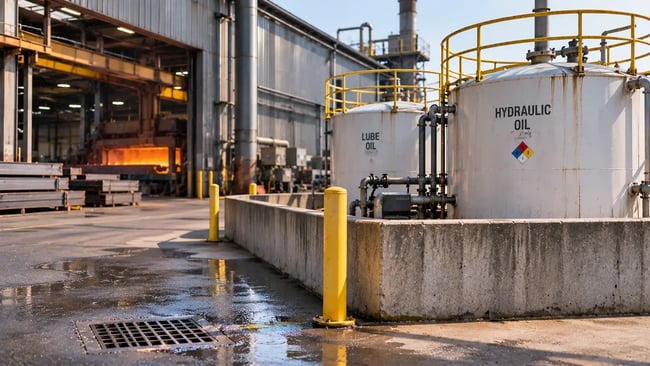
For bulk storage, the rule requires containment for the entire capacity of the largest single container plus freeboard for precipitation, and the containment has to be sufficiently impervious to hold oil (40 CFR 112.8(c)(2)). Dikes, curbs, and pits are the usual methods. Everywhere else a discharge could happen, such as transfer areas, drum storage, and equipment, the general containment requirement applies.
Older plants run into trouble because they were built or expanded long before anyone sized containment this way. A dike that was adequate for the original tank may now share its space with two more. Concrete cracks and spalls after decades of heavy equipment. Pipe penetrations get cut through walls and never sealed. Floor and trench drains run to a storm sewer or process sewer, giving oil a direct path out. Hydraulic power units sit in basements, pits, and mill cellars where leaks collect, and nobody's quite sure where the drain goes.
Rain adds to the problem. The federal rule asks for sufficient freeboard to contain precipitation without giving a number, and EPA points to the 25-year, 24-hour storm. A dike sized years ago at 110 percent of the largest tank can fall short of that outdoors. At New Jersey major facilities, the state rules add six inches of rainwater where rain can collect, and where both programs apply, the larger number controls. Our posts on sizing SPCC containment and evaluating secondary containment walk through the math, and our piece on draining rainwater from a containment dike covers what to do once the water's in there.
What Can an Older Plant Do When Full Containment Isn't Practical?
Start with fixes that cost less than rebuilding: sealing cracks and penetrations, coating or lining concrete, drip pans and spill pallets under hydraulic units, closing floor drains or routing them to a sump, and berms where there's room. Each one still has to be sized and built so it holds oil.
Some equipment can't be contained because of how it's built, where it sits, or the risks of boxing it in. For those cases, the rule offers an impracticability route under 40 CFR 112.7(d). The plan has to explain why containment isn't practicable, then include periodic integrity testing of bulk containers, integrity and leak testing of valves and piping, a spill contingency plan, and a written commitment of personnel, equipment, and materials. A Professional Engineer has to certify the determination, and expense alone is a weak argument.
Housekeeping counts too. Visible discharges from seams, gaskets, piping, pumps, valves, rivets, and bolts have to be promptly corrected, and oil that accumulates in a dike has to be removed promptly (40 CFR 112.8(c)(10)). Oil staining around a hydraulic unit shows up in inspection reports.
How Do New Jersey's Spill Act and DPCC Rules Add to a Metals Plant's Oil Plan?
New Jersey's Spill Compensation and Control Act, usually called the Spill Act, generally makes the party responsible for a discharge liable regardless of fault, and it requires reporting discharges to NJDEP. If a spill threatens people or a waterway, call 911 first and then report to NJDEP using the current hotline number on its website. Our post on the federal sheen rule for reporting an oil spill covers the federal side. For anything involving liability, enforcement, or cleanup costs, an environmental attorney may be the right person to bring in alongside your environmental consultant.
The Spill Act also reaches beyond oil. Under N.J.A.C. 7:1E, a "major facility" has to prepare a DPCC plan (Discharge Prevention, Containment and Countermeasure) and a DCR plan (Discharge Cleanup and Removal), submitted to NJDEP as a single document. NJDEP's guidance defines a major facility as one with total storage capacity of 20,000 gallons or more of hazardous substances other than petroleum, or 200,000 gallons or more of all hazardous substances including petroleum products. Out-of-service tanks and containers of five gallons or less aren't counted toward that capacity.
Metals plants can get caught on that second number. A plant that stores acids for pickling, solvents, or other listed substances can reach the threshold through its chemicals even when oil alone wouldn't. Whether a substance is listed, and how your containers are counted, depends on your own inventory, so check it against the rule. A major facility has state tank testing, containment, and rainfall requirements on top of the federal ones, and the two plans need to be reconciled. Our post on whether a New Jersey facility needs both an SPCC plan and a DPCC plan explains how the two fit together, and our guide to SPCC plans in New Jersey covers the basics.
Who Certifies a Metals Plant's SPCC Plan, and What Does It Cost?
Federal rules let some small facilities certify their own plans. Tier I self-certification is only open to facilities with no single aboveground container over 5,000 gallons, and Tier II is limited to facilities with 10,000 gallons or less of total aboveground capacity. A metals plant with a large field-erected tank, or enough equipment to pass 10,000 gallons in total, falls outside both, and impracticability determinations need a PE certification at any tier. In practice, a licensed Professional Engineer has to review and approve the plan. Some consulting firms have a PE on staff and others work with a trusted outside PE, and either way the plan isn't finished until that engineer has reviewed the site and signed off. Our posts on Professional Engineer requirements for SPCC plans and why PE-certified plans cost more in New Jersey explain the difference.
SPCC plans generally run from about $2,500 to $15,000, and a plant with field-erected tanks and a lot of equipment can sit toward the higher end. The factors that move the number are total storage capacity, how many containers and pieces of equipment need to be inventoried, whether a PE certification is needed, and whether secondary containment needs a real evaluation. Tank inspections by certified inspectors, containment repairs, and a DPCC and DCR plan for a major facility are separate costs. Our pricing calculator below gives you a ballpark for RMA's help with the plan itself.
How Can RMA Help a New Jersey Metals Plant With Its Oil Spill Plan?
We're a family-run firm based in New Jersey, so NJDEP's rules and EPA Region 2's expectations are familiar ground. For a metals plant, our help usually starts with an inventory that finds the oil in equipment, basements, and storage areas nobody had on the list. From there we work through how each source is treated, which containment approach fits each area, and what inspections your tanks need. We write the plan, coordinate the Professional Engineer review, and help line up your state and federal documents if you're a major facility. Our online training library can help with staff training.
Some of what a plant needs sits outside what we do. If you're building containment, installing a new tank, or expanding, the construction-phase permits, fire permits, and engineering design go through your engineer, contractor, or a soil erosion specialist, and we don't prepare them. We can help you work out what the construction phase will need and point you to the right people, then help with the operational side once the new equipment is running: the SPCC Plan, spill reporting procedures, inspections, and training. And if your oil storage turns out to be under the threshold, we'll tell you so.
If you'd like a second set of eyes on your plant, there's no obligation. You can call or email us, or fill out the form on our website. When you're ready, contact RMA and we'll start with a conversation about what you have on site.