Why River Terminals and Riverside Plants in Southwest Pennsylvania Face Higher Stakes, and What Good Oil Storage Practice Looks Like
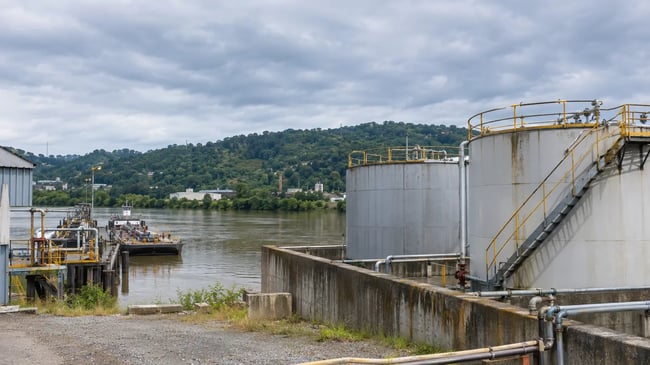
Southwest Pennsylvania has a long history of storing oil right at the water's edge. Fuel terminals, steel and manufacturing plants, power generation sites, and barge-served businesses sit along the Monongahela, the Allegheny, and the Ohio, close enough that a tank failure or a bad transfer can put oil in the river within minutes. If your facility stores diesel, gasoline, lubricating oil, or any other oil in bulk near one of these rivers, you're dealing with a stack of overlapping requirements, from a federal oil spill prevention plan (called an SPCC Plan) to Pennsylvania's tank program and, for some sites, a federal response plan and Coast Guard rules.
This article explains why the stakes are higher on these rivers, how the layers of requirements fit together, and what good practice tends to look like. Where the answer depends on your capacity, layout, or how you move oil, we've said so rather than guess, because two neighboring sites can land in different places. If you'd like help sorting out which layers apply to your site, you can reach out to RMA at any point.
Table of Contents
TL;DR
Oil storage on the Monongahela, Allegheny, and Ohio Rivers is held to a higher standard because a spill can reach the water quickly and affect communities and drinking water supplies downstream, as the 1988 Floreffe tank collapse showed. Most facilities face a federal SPCC Plan overseen by EPA Region 3 and Pennsylvania's DEP storage tank program. Larger sites, and sites that move oil to or from vessels, can also face a federal Facility Response Plan, Coast Guard rules, or a state Spill Prevention Response Plan. Which layers apply depends on your capacity, layout, and operations, so confirm each one against your own site.
Why Are the Stakes So High for Oil Storage Near Southwest Pennsylvania's Rivers?
The three rivers meet at Pittsburgh, and the oil that gets into any one of them doesn't stay put. It moves downstream with the current, and the Ohio carries it past a long list of towns and industries. Many communities along these rivers draw drinking water from them, and so do industrial users that need clean intake water to run. A spill at a single facility can therefore become a problem for people who have never heard of the company that caused it, and it can happen faster than most response plans assume.
Geography adds to the risk. Many river sites are built on narrow strips of flat ground between a hillside and the water, where there's little room for large containment areas and not much distance between a tank and the bank. Storm drains, ditches, and old outfalls on industrial property often lead straight to the river, which means a spill that never touches the water directly can still get there through the drainage system. Older industrial sites may also have decades-old tanks, piping, and drainage that were built long before today's rules existed. None of this means a river facility can't store oil safely. It means the margin for error is smaller than it would be at an inland site.
What Did the 1988 Floreffe Spill Teach Pennsylvania About Oil Tank Safety?
On January 2, 1988, a large diesel storage tank at a terminal in Floreffe, on the Monongahela, split apart and collapsed. Reports put the tank's capacity at roughly four million gallons, and estimates of how much oil reached the river run from around 750,000 gallons to about a million. The tank was a reassembled older tank that was being filled to capacity for the first time since it was rebuilt at the site, and investigators pointed to a structural flaw, along with inadequate testing and missing permits. The surge of fuel overwhelmed the earthen dikes around it, and oil flowed to a nearby drain and into the river.
The effects traveled. Oil moved down the Monongahela and into the Ohio, water supplies for communities along both rivers were disrupted, and the Coast Guard closed part of the Monongahela to vessel traffic. A federal grand jury later indicted the company for negligently discharging oil into the river. The spill also prompted a federal review of the oil spill prevention program, and Pennsylvania's Storage Tank and Spill Prevention Act followed in the years after. Several lessons from Floreffe still apply to a riverside facility today: containment has to be sized and built for a real failure, a rebuilt or relocated tank deserves a careful look before it's filled, and the drainage path from your site to the river matters as much as the tank itself. Our post on why Pennsylvania takes oil tanks so seriously covers the history in more detail.
How Do the Federal SPCC, Facility Response Plan, and Coast Guard Rules Fit Together?
Start with the federal SPCC rule, which is the foundation. It applies to a facility that could reasonably be expected to discharge oil to navigable waters and has aboveground oil storage capacity over 1,320 gallons (counting only containers of 55 gallons or more) or buried capacity over 42,000 gallons. A facility next to a river has an easy time meeting that "reasonable expectation" test. In Pennsylvania, EPA Region 3 enforces the rule. If you're not sure whether you have a plan, or what's in the one you have, our overview of everything you need to know about SPCC plans is a good place to start.
Bigger sites and sites that move oil over water can face more. A federal Facility Response Plan (FRP) is a separate requirement for facilities that could cause what the rule calls substantial harm, and the screening criteria include a total oil storage capacity of 42,000 gallons or more combined with transfers of oil over water to or from vessels. They also include very large facilities, with a total capacity of one million gallons or more, that meet certain additional conditions, such as lacking adequate secondary containment or being close enough to a public drinking water intake that a discharge could shut it down. EPA's regional office can also decide that a facility needs one. On top of that, the Coast Guard regulates the marine transportation-related part of a facility, which in general runs from the vessel connection to a point near the storage tanks, and a single terminal can be split between EPA and the Coast Guard. Where the line falls depends on the layout, so treat the table below as a map and not as a determination.
| Requirement |
Who oversees it |
When it generally comes into play |
| SPCC Plan (40 CFR Part 112) |
EPA Region 3 |
Aboveground oil capacity over 1,320 gallons (containers of 55 gallons or more), or buried capacity over 42,000 gallons, with a reasonable expectation of a discharge reaching navigable water. |
| Facility Response Plan |
EPA |
Facilities that could cause substantial harm, which includes 42,000 gallons or more of storage with over-water transfers, or one million gallons or more with additional risk factors. EPA can also decide a facility needs one. |
| Marine transportation-related facility rules (33 CFR Part 154) |
U.S. Coast Guard |
The part of a facility used to transfer oil to or from vessels. How the facility divides between EPA and the Coast Guard depends on its layout and operations. |
Our post on when Pennsylvania oil storage goes beyond SPCC explains the response plan side in more detail. For a site that might fall into the Coast Guard's territory, confirm the boundaries with the agencies and your own engineer, since a plan written to the wrong rule can leave gaps.
What Does Pennsylvania Add to Oil Storage Requirements at Riverside Facilities?
Pennsylvania runs its own storage tank program through DEP under 25 Pa. Code Chapter 245. The core pieces are registration, certified people, and a state-level plan for the largest sites. DEP regulates stationary aboveground tanks over 250 gallons that hold regulated substances, and those tanks have to be registered. Work on a regulated tank system other than routine maintenance has to be done by a DEP-certified installer, and the inspections the regulations require have to be done by a DEP-certified inspector. Facilities with more than 21,000 gallons of regulated substances aboveground in total are generally treated as large facilities and need a Spill Prevention Response Plan (SPRP). A Preparedness, Prevention, and Contingency (PPC) Plan can also come up through certain state permits and programs, and local fire codes add their own rules for tanks, which vary by municipality.
| Pennsylvania layer |
What it generally covers |
What to confirm for your site |
| DEP tank registration |
Stationary aboveground tanks over 250 gallons holding regulated substances, with annual registration. |
Whether each tank is covered or exempt, and whether registrations match current owner and tank details. |
| Certified installers and inspectors |
Tank work and required inspections done by DEP-certified people. |
Which inspections and which tank work apply to your tanks, and who is certified for them. |
| Spill Prevention Response Plan (SPRP) |
A state response plan for large aboveground tank facilities, generally those over 21,000 gallons in total. |
How your capacity is counted, and whether one document can serve more than one requirement. |
| PPC Plan and local fire code |
Depends on your state permits and your municipality. |
Which permits you hold and what your local fire official requires. |
Our posts on which tanks have to be registered with DEP and the difference between SPCC, PPC, and SPRP plans walk through the state side in more depth. If you're building or expanding a river facility, the construction-phase approvals, such as construction stormwater and erosion control permits, building permits, and the tank installation itself, are handled by your engineer, contractor, and certified installers. RMA doesn't prepare those. Once the facility is running, though, it almost always needs an SPCC Plan or an amendment, DEP tank registration, inspections and testing, and staff training, and that's the work we do.
What Are Good Practices for Oil Storage Along the Monongahela, Allegheny, and Ohio?
The rules set a floor. Facilities that do well on a river tend to go past it in a handful of places, mostly where Floreffe showed the biggest gaps. None of these is a substitute for what your plan, your engineer, or DEP and EPA require, and the right version depends on your tanks and your site. They're a starting list for the conversation.
| Practice |
Why it matters on a river |
| Inspect and test large tanks to a recognized standard, using certified inspectors where required |
Large field-built tanks may fall under API 653, and many shop-built tanks follow STI SP001. Floreffe involved a tank with a structural flaw that testing hadn't caught. |
| Get qualified review before filling a tank that was rebuilt, relocated, or returned to service |
The tank that failed was being filled to capacity for the first time after being rebuilt. What review is appropriate depends on the tank, so ask an engineer or certified inspector. |
| Evaluate secondary containment against your largest container and your site conditions |
Containment that can't hold a real failure, or that leaks through cracks, drains, or old penetrations, doesn't protect the river. |
| Trace and control every drainage path from tanks and transfer areas to the water |
At Floreffe, oil reached the river through a drain. Valves, plugs, and procedures for rainwater release are only useful if staff know where the drains go. |
| Use overfill prevention and written transfer procedures, including for vessel transfers |
Fills and transfers are where many releases start, and a release over water spreads quickly. |
| Train staff and run drills, and keep spill response equipment where it's needed |
Response speed decides how much oil leaves the site, and people only respond well to what they've practiced. |
| Know whom to call, and keep the list current |
If oil reaches water, the National Response Center (1-800-424-8802) has to be notified, and your plan should name the state and local contacts too. |
Each of these has its own detail in our library. See API 653 inspections for large tanks, when you need a DEP-certified tank inspector, how to evaluate secondary containment, and how storm drains and creeks define spill risk. For staff training, our online training library is one option. If a spill has already reached the water, start with what to do when an oil spill reaches a creek, and consider talking to an environmental attorney, since spills, violations, and enforcement can carry legal exposure that goes beyond the plan itself.
How Can RMA Help With Oil Storage Near Southwest Pennsylvania's Rivers?
We're a family-run firm, and we can help you work out which of these layers apply to your site, write and maintain your SPCC Plan, line up the inspections and training the plan calls for, and coordinate with an outside professional engineer when your plan needs PE certification. If your site looks like it may need a Facility Response Plan, or sits in the gray area between EPA and the Coast Guard, we'll tell you what we can help with and where you'll need other specialists. There's no pressure and no obligation. You can call us, send an email, or fill out the form when you contact RMA, and you can browse everything we've published for Pennsylvania facilities on our Pennsylvania SPCC plans page.