The Driver, the Supplier, and Your Facility Can All Share Responsibility When a Fuel Delivery Goes Wrong, So Here's How to Respond, Who Reports What, and How to Settle Roles Before the Next Truck Arrives
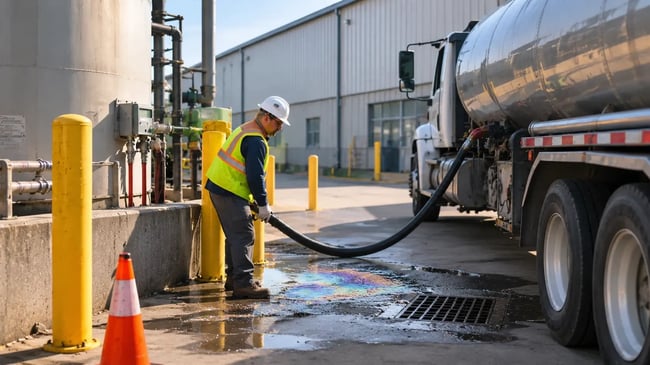
A fuel truck is partway through a delivery when your tank overfills and diesel starts running across the pavement toward a storm drain. Everyone on site asks the same thing within seconds: whose fault is this? The driver had the controls, the supplier owns the truck and trained the driver, and your facility owns the tank and the ground under it. Regulators don't wait for that argument to end before they expect people to act, and your facility usually carries duties no matter who made the mistake. If your oil storage is large enough to fall under the federal oil spill rule, you'll need a written Spill Prevention, Control, and Countermeasure (SPCC) Plan, the plan that explains how you prevent, contain, and respond to oil spills. If you already have one, it should already cover fuel deliveries, and if you don't, a delivery spill is a good prompt to find out whether you need one.
Below, we cover who can be held responsible under federal and Pennsylvania rules, what your oil spill plan has to say about deliveries, what to do in the first minutes, who reports to whom, what comes after the cleanup, and how to put roles into your delivery agreement and your delivery-day procedure. We're not attorneys, so questions about liability and who pays get a general explanation and a pointer to someone who can answer them for your situation. If you'd like a second set of eyes on how deliveries work at your site, you can reach out to RMA at any point.
Table of Contents
TL;DR
When a fuel delivery spills at your Pennsylvania facility, responsibility is usually shared, and regulators expect the people on site to act and report without waiting to sort out fault. Your oil spill plan has to cover fuel transfers whether or not the driver or supplier caused the problem, so the first moves are to stop the transfer, keep oil out of drains, and make the federal and state calls that apply. Who ultimately pays turns on your contract, your insurance, and the facts, which is a question for an environmental attorney, so settle roles, call procedures, and cost terms with your supplier before the next delivery.
Who Is Responsible When a Fuel Delivery Spills in Pennsylvania?
Fault and responsibility are two different questions, and most of the confusion comes from treating them as one. Fault is about who made the mistake, which is what the driver, the supplier, and your staff will argue about afterward. Responsibility, in the regulatory sense, is about who owes duties to the government when oil gets out, and those duties start the moment the oil does.
On the federal side, the SPCC rule applies to the owner or operator of the facility, so the duty to have a plan that covers deliveries sits with you. Under Pennsylvania's Clean Streams Law regulations, DEP describes the responsible party for a spill as the person in charge of the substance, or the person owning or in possession of the premises, facility, vehicle, or vessel it came from. Read plainly, that can describe the driver and supplier, who are in charge of the fuel and the truck, and your facility, which is in possession of the premises, all at once. Whether DEP treats one party or several as responsible for a particular spill depends on the facts, and that's a question for an attorney, not a blog post.
The line between the truck and your facility is another gray area. A tank truck on the road falls under transportation rules, while your tank, piping, and transfer area are part of your site's operations. How the agencies divide a spill at the hose connection is a technical question, and we wouldn't count on it working in your favor.
| Party |
Why it may have duties |
What it usually controls during a delivery |
| Facility owner or operator |
The SPCC rule and Pennsylvania's tank and spill rules point at whoever owns or runs the site and the tank |
Tank condition, overfill devices, drainage, containment, the written plan, who is present |
| Fuel supplier |
Employs the driver, owns the truck and its equipment, and usually sets delivery practices |
Driver training, truck equipment and hoses, dispatch, insurance |
| Delivery driver |
At the controls, and typically the person attending the unloading under transportation rules |
Starting and stopping the transfer, hose connections, watching the fill |
| Tank owner, if it isn't the facility |
Pennsylvania's tank program puts some duties on owners, including DEP registration |
Registration, and sometimes testing and repairs, depending on the contract |
The cost of getting it wrong can be high. When a discharge reaches water, the Clean Water Act allows civil penalties of up to about $59,000 per day of violation, or up to about $2,400 per barrel of oil discharged, based on the inflation-adjusted figures in 40 CFR Part 19. What's assessed in a real case depends on how serious the spill was, how it was handled, and your history, and our article on top SPCC plan violations and fines covers how enforcement tends to go. In Pennsylvania, EPA Region 3 enforces the federal SPCC rule, while DEP runs the state tank and spill programs, and our piece on who enforces oil spill plans in Pennsylvania explains how the two fit together.
What Does an SPCC Plan Have to Say About Fuel Deliveries?
If your facility needs an SPCC Plan, the plan has to cover fuel deliveries whether the driver, the supplier, or your own crew would get the blame. The rule asks for discharge prevention measures that include procedures for routine handling, such as loading, unloading, and facility transfers. It also asks you to predict the direction, rate of flow, and total quantity of oil that could be discharged if equipment known to be a source of discharge fails, and the rule names loading and unloading equipment and tank overflow as examples. A plan that describes your tanks in detail but says nothing about delivery day has a hole in it, and an inspector looking at a delivery spill will see it.
If you're not sure whether you need a plan at all, our guide to counting your oil storage against the 1,320-gallon rule walks through the math. If you add it up and land comfortably under the threshold, you probably don't need a plan, though the spill reporting rules later in this article still apply to you.
| Plan element |
Where it comes from |
What it looks like on delivery day |
| Transfer procedures |
40 CFR 112.7(a)(3)(ii) |
Written steps for checking tank room, connecting, watching the fill, and disconnecting |
| Overfill prevention |
40 CFR 112.8(c)(8) |
At least one alarm, shutoff, gauge, or communication method for each bulk container, with the devices tested regularly |
| Drainage where trucks may discharge |
40 CFR 112.8(b)(3) |
Undiked areas where a truck could discharge drain to a catchment that holds oil, not to a storm drain or ditch |
| Loading and unloading racks |
40 CFR 112.7(h) |
If you have a rack, warning lights or barriers, signs, wheel chocks or a brake interlock, and containment or quick drainage |
| Vehicle warnings |
40 CFR 112.8(d)(5) |
Vehicles entering the site are warned so they don't strike aboveground piping or transfer equipment |
| Contacts, reporting facts, and emergency procedures |
40 CFR 112.7(a)(3)(vi), (a)(4), and (a)(5) |
A contact list with the National Response Center, cleanup contractors, and agencies, plus the information a caller needs, organized so people can use it in an emergency |
| Training and a responsible person |
40 CFR 112.7(f) |
Trained oil-handling staff, a named person accountable for discharge prevention, and annual briefings |
Our article on overfill prevention for oil tanks at Pennsylvania facilities goes through the device options and testing, and our guide to how big your spill containment needs to be covers sizing, so we won't repeat either here. The point for this article is that every row in the table is your facility's job, even on a day when someone else's mistake started the spill.
What Should You Do in the First Minutes of a Fuel Delivery Spill?
Safety comes first. If there's a fire, an injury, or a vapor hazard, call 911 before anything else and get people away from the area. Once it's safe, the first few minutes are about stopping the source and keeping oil from reaching a drain, ditch, or stream, because oil that reaches water brings federal and state reporting duties into play.
| Step |
What to do |
Who usually does it |
| 1. Stop the transfer |
Shut down the pump and close the truck's valves, and close the fill valve on your side if it's safe to reach |
Driver and your attendant |
| 2. Protect people |
Keep ignition sources and bystanders away, and call 911 for fire, injury, or a safety hazard |
Whoever is closest, then your designated person |
| 3. Block the drains |
Cover storm drains and place socks, mats, or berms across the flow path toward ditches and low spots |
Your crew |
| 4. Contain and absorb |
Use the spill kit, keep the oil inside the dike or containment area, and keep the dike drain valve closed |
Your crew, with the driver's kit as backup |
| 5. Capture the facts |
Driver name, company, truck number, delivery ticket, gauge readings, time, and photos |
Your designated person |
| 6. Make the calls |
Work down the contact list in your plan, covered in the next section |
Your designated person |
Don't wash the spill off the pavement with water. Washing pushes oil toward drains and can turn a contained spill into a discharge. Ask the driver to stay until you've collected the details in step five, since you'll need them for reports and for any later conversation about cost. The SPCC rule asks for the emergency portions of your plan to be organized so people can use them in the moment, so the steps above belong on a page by the fill port, not buried in a binder. Our guide to stocking and placing spill kits covers what to keep near the delivery area.
Who Has to Report a Fuel Delivery Spill in Pennsylvania?
Reporting duties come from three places, and one spill can trigger more than one of them. Federal oil discharge rules, Pennsylvania's Clean Streams Law regulations, and Pennsylvania's storage tank regulations each have their own trigger, and a call to one agency doesn't count as a call to another.
| Who to notify |
When |
Where it comes from |
| National Response Center, 1-800-424-8802 |
Immediately, once you know a discharge has reached navigable waters or adjoining shorelines and caused a sheen, discoloration, sludge, or emulsion. No minimum gallons. |
40 CFR Part 110, including 110.6 |
| EPA Region 3, by written report, with a copy to the state agency |
Within 60 days after a single discharge of more than 1,000 gallons, or two discharges of more than 42 gallons each within 12 months, that reach navigable waters or adjoining shorelines |
40 CFR 112.4 |
| PA DEP, by telephone |
Immediately, when a spill causes or threatens pollution of waters of the Commonwealth, which includes storm sewers, drains, and ditches that lead to them. No minimum amount. |
25 Pa. Code 91.33 |
| PA DEP regional office, by telephone, then in writing |
As soon as practicable and within 24 hours after a release from a regulated storage tank is confirmed, with written notice to DEP and affected municipalities within 15 days. Some small, fully contained releases under 25 gallons to an aboveground surface are exempt. |
25 Pa. Code 245.305 |
| County emergency management, PEMA, and DEP, plus downstream water users |
Immediately, for releases at facilities with more than 21,000 gallons of aboveground storage. Downstream water users within 2 hours if a water supply is threatened. |
25 Pa. Code 245.305(g) |
| Local fire authority |
Immediately, if a release creates a fire, explosion, or safety hazard |
25 Pa. Code 245.305(h) |
The gallon figures in the federal written report count oil that reaches water, not the total amount spilled. The storage tank rows apply only when the tank is regulated under DEP's storage tank program, and whether yours is depends on its size, type, and use, so check it against our article on Pennsylvania aboveground tank registration. DEP asks for the call to go to the regional office covering the county during business hours, or to its statewide emergency line, 800-541-2050, outside them. Confirm the current numbers on DEP's Report an Incident page and keep them in your plan's contact list, because phone numbers change. DEP's own guidance recommends erring on the side of calling when you're unsure, and our explainer on when you have to report an oil spill covers the sheen rule in more detail.
Who makes the calls is where delivery spills get messy. The federal duty to notify falls on the person in charge of the facility, and DEP's definition reaches both the person in charge of the substance and the person in possession of the premises. A driver may call the dispatcher, the dispatcher may assume the facility will report, and the facility may assume the supplier already did, so nobody calls. Your plan and your delivery procedure should name who makes each call, and the safe approach is for your designated person to make yours even if the driver says they've already reported it. Treat the supplier's calls as additions to yours, not replacements.
What Happens After the Cleanup When a Fuel Delivery Spills?
Cleanup usually involves a spill contractor, and your plan is supposed to describe both your own response capability and the contractors you'd call. The recovered oil, contaminated soil, and used absorbents then have to be handled and disposed of under the waste rules that apply, and the SPCC rule asks your plan to describe disposal methods for recovered materials. Pennsylvania's Clean Streams Law regulations also expect residual oil to be removed from the ground and affected waters within 15 days of the incident, to the extent DEP's regulations require.
Write the timeline down while it's fresh. Record when the delivery started, the gauge readings before and after, what alarms or shutoffs did or didn't do, who stood where, who was called and when, and keep the photos and the delivery ticket. Those records support your reports, any insurance claim, and any conversation with the supplier about cost. Check your insurance policy's notice requirements early, since some policies require prompt notice and your supplier will be dealing with its own insurer.
Who ultimately pays depends on your contract, your insurance, and facts like whether the overfill device worked, whether the driver followed the agreed procedure, and whether your tank or gauge played a part. We can't answer that for you, and an environmental attorney can. If a spill leads to an information request, a notice of violation, or a claim from a neighbor or a downstream user, bring an attorney in early, before you write anything to an agency beyond the required reports.
Review your plan afterward and fix what the spill exposed, such as nobody knowing who calls, an alarm that didn't sound, or drainage that sent oil toward the street. The rule asks for annual discharge prevention briefings that highlight known discharges, failures, and malfunctioning components, which gives you a natural place to walk your team through what happened. A reportable discharge can also affect which type of plan you can use, because the qualified facility test looks at your spill history over the three years before certification. Our article on whether your Pennsylvania facility is a qualified facility explains the test.
What Should Your Fuel Delivery Agreement Say About Spills?
Most fuel supply contracts say little about spills. If yours is silent, ask for an addendum or a written delivery procedure, and have an environmental attorney review anything about liability and indemnification, since that's where risk gets divided. A contract can decide who does the work and who pays for it, but it generally can't stop EPA or DEP from holding the facility accountable, so the agreement works alongside your plan and doesn't replace it. If the supplier also owns your tank, our article on supplier-owned tanks and spill responsibility covers the ownership side, including registration and testing.
| Topic |
What to settle in writing |
| Ordering and fill limits |
You tell the supplier the gallons you want and the most the tank can take, and drivers don't top off beyond it |
| Attendance and stop authority |
Who must be at the fill, and that either the driver or your attendant can stop the transfer without debate |
| Truck equipment |
The supplier maintains hoses, valves, and fittings, and the driver checks connections and the truck's drains and outlets for leaks |
| Spill notice |
Who calls whom, in what order, and how fast, including that the driver alerts your designated person immediately |
| Response resources |
Whether the supplier brings spill materials or a cleanup contractor, and whose contractor takes the lead |
| Cost and indemnification |
Who pays for cleanup, fines, and third-party claims, and under what circumstances. This is the part to have an attorney draft or review. |
| Insurance |
Proof of the supplier's pollution liability coverage and any additional insured requirements |
| Training and records |
The supplier confirms its drivers are trained, you keep delivery tickets, and the supplier sends you incident reports |
| After-hours deliveries |
Who is on site or on call, how the driver gets access, and what the driver does alone if something goes wrong |
How Should You Assign Roles on Fuel Delivery Day?
Roles are easier to settle on a calm day than during a spill, and the SPCC rule already expects one piece of it: a person at the facility who's accountable for discharge prevention and reports to facility management. The table below shows one way to divide the work, and your plan's transfer procedures should say the same thing in your own terms.
| Role |
Before the truck arrives |
During the transfer |
If something goes wrong |
| Facility's designated person |
Confirms the tank has room, drain valves are closed, the spill kit is staged, and devices were tested |
Stays reachable and knows who is at the fill |
Takes charge, makes the calls, and collects the facts |
| Facility attendant at the fill |
Unlocks the fill port and tells the driver the gallons ordered and the stop point |
Watches the gauge or alarm and stays in sight of the driver |
Signals the driver to stop and closes the fill valve if it's safe |
| Driver |
Checks the ticket against the ordered gallons and inspects hoses and fittings |
Stays with the truck, watches the hose, and follows the stop signal |
Shuts down the transfer, tells the designated person, and stays on site |
| Supplier's dispatcher |
Has your fill limits and after-hours contacts on file |
Is reachable by the driver |
Provides emergency contacts and notifies the supplier's insurer and response resources |
Federal transportation rules require a qualified person to attend a cargo tank during unloading, staying alert and within 25 feet of the tank, with a view of the tank and delivery hose where practicable (49 CFR 177.834). That's usually the driver, and the driver can't see your tank's level from the truck, which is why your facility needs its own overfill measure and its own attendant. Post a short version of the roles at the fill port, cover it in training, and walk through it with your regular driver at the next delivery. Our guide on developing your own SPCC inspection and spill response procedures helps with the writing, and our annual discharge prevention briefing agenda gives you a place to review the delivery procedure each year. For staff who handle oil but need broader training, our online training library has courses you can buy.
How Can RMA Help With Fuel Delivery Spill Planning?
We help facilities write the delivery and spill response parts of an SPCC Plan so they match what happens at your fill port, including transfer procedures, the contact list, the notification steps, and who does what. If your oil storage puts you over the federal threshold and you don't have a plan, we can prepare one. Tier I plans typically run about $1,500 to $4,000, and our overall SPCC range runs from $1,500 to $15,000 depending on the number of containers, how the plan is certified, and whether your secondary containment needs evaluating. Our SPCC pricing calculator gives you a feel for your own number, and initial SPCC training is free with a new plan from us. If you're under the threshold, you probably don't need a plan, and we'll tell you so.
We aren't attorneys, and we don't draft supply contracts or decide who owes what after a spill. What we can do is give you and your attorney the same checklist of terms to bring to your supplier. If a spill has just happened, handle safety, containment, and the required calls first. When you're ready for help with the plan, you can call, email, or fill out the form on our website and contact RMA. There's no obligation, and you'll get a straight answer about what you need. Our SPCC resource library is also there if you'd like to read more first.


