How to Count Bulk Oil, Used Oil Tanks, and Drums to Find Out If Your Shop Is Covered by SPCC Rules
Walk into almost any quick-lube or busy repair shop and you'll find more stored oil than most owners ever add up. There's a used oil tank in the back, a few bulk tanks or totes of new motor oil feeding the bays, drums of transmission fluid and gear oil, and a stack of smaller containers on shelves. Federal law has a name for the oil spill planning rule that can apply to all of that, the Spill Prevention, Control, and Countermeasure rule, or SPCC, and a lot of shop owners have never heard of it until an insurer, a lender, or an inspector brings it up.
The short answer is that some shops need an oil spill plan and plenty of small ones don't. It comes down to a simple count of how much oil your containers can hold, and we'll walk through exactly how to do that count, what typical containment looks like, and what still applies to you if you land under the line. If you're close to the number or you're not sure how something counts, you can always reach out to RMA and we'll talk it through with you.
Table of Contents
TL;DR
An auto repair shop or quick-lube needs a federal oil spill plan if its aboveground containers of 55 gallons or more can hold more than 1,320 gallons of oil in total, and if a spill could reasonably reach a waterway. Many independent repair shops come in under that number, and many quick-lubes with bulk oil and used oil tanks come in over it. Count what the containers can hold, not what's in them. Even if you're under the line, New Jersey's Spill Act, spill reporting duties, and used oil rules still apply to your shop.
What Is an Oil Spill Plan (SPCC) and Does It Apply to Auto Repair Shops?
An SPCC plan is a written plan for preventing oil spills and responding to them if they happen. It describes what oil you store, where it sits, how it's contained, how you inspect it, and who does what in a spill. The rule is federal, it comes from 40 CFR Part 112 under the Clean Water Act, and in New Jersey it's enforced by EPA Region 2. It exists because oil that reaches a storm drain or a stream causes real damage and real cleanup bills, and shops move a lot of oil through a small footprint.
Two things have to be true for the rule to apply. First, the facility has to store more than 1,320 gallons of oil in aboveground containers, counting only containers that hold 55 gallons or more. Second, a spill has to be reasonably expected to reach navigable waters or adjoining shorelines, which in practice includes storm drains and ditches that lead to streams. Once a shop is over the 1,320-gallon line, that second test is almost always met in New Jersey, because there's water close to nearly everything. We cover the full applicability test in our guide on whether your New Jersey facility needs an SPCC plan, so here we'll stay focused on how shops land on one side of the line or the other.
How Do You Count Oil Storage at a Quick-Lube or Repair Shop?
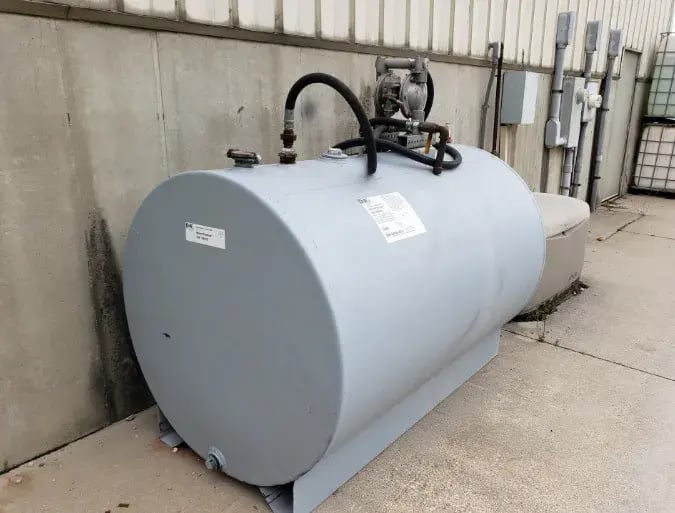
Count capacity, not contents. A 275-gallon tote of motor oil that's sitting at 20 gallons still counts as 275 gallons, and an empty 500-gallon used oil tank counts as 500. You add up every aboveground container of 55 gallons or more that holds oil anywhere on the property, indoors and outdoors, and compare the total to 1,320 gallons. Oil here means petroleum oils like motor oil, used oil, transmission fluid, gear oil, hydraulic oil, and diesel, and it also includes vegetable oils and animal fats.
The second part of the count is that each container is counted on its own. A rack of rack-mounted 65-gallon drums feeding a lube dispensing system adds up as 65 gallons per drum, and EPA's own example plan for a small service station counts exactly that way. In that example, a 1,500-gallon waste oil tank, a heating oil tank, a kerosene tank, and twelve rack-mounted drums pushed the site well past the threshold. Two illustrative shops show how the math plays out.
| Container |
Independent repair shop |
Quick-lube with bulk oil |
| Used oil tank |
One 275-gallon tank = 275 |
One 500-gallon tank = 500 |
| New motor oil |
Two 55-gallon drums = 110 |
Three 275-gallon totes = 825 |
| Transmission fluid and gear oil |
One 55-gallon drum = 55 |
Two 55-gallon drums = 110 |
| Five-gallon pails, quarts, small tubs |
Not counted |
Not counted |
| Total counted |
440 gallons, under 1,320 |
1,435 gallons, over 1,320 |
The independent shop has a few drums and a used oil tank and sits at about a third of the threshold. The quick-lube crosses the line mostly because of its bulk new oil totes and a larger used oil tank, even though it's a smaller building. Your own numbers will differ, and the only way to know is to walk the property and write every container down. Our guide on how to inventory oil tanks, drums, and equipment gives you a worksheet-style approach, and we've also answered the common question on whether 55-gallon drums are included in SPCC plans.
What Doesn't Count Toward the 1,320-Gallon SPCC Threshold?
Several things that look like oil storage don't go into the total. Containers under 55 gallons are skipped completely, so a shelf full of five-gallon pails or a 30-gallon antifreeze tote adds nothing. Fuel tanks on vehicles that power the vehicle itself, called motive power containers, are excluded, and so are the hydraulic reservoirs on lifts when each one holds less than 55 gallons. Antifreeze and windshield washer fluid generally aren't oil, though if you have a mixed or unusual product it's worth checking the safety data sheet or asking us.
Underground tanks need more care. EPA exempts completely buried tanks that are fully regulated under the federal underground storage tank program, and New Jersey runs its own program for those tanks under N.J.A.C. 7:14B with NJDEP-certified contractors doing the work. A buried tank that holds gasoline or diesel for sale, or a regulated used oil tank, generally doesn't count toward the aboveground 1,320 gallons. An unregulated tank, such as a buried heating oil tank used only for the building, can still count, and a shop that's already over the line has to show every buried tank on its facility diagram anyway. Our posts on underground tanks and SPCC and SPCC exemptions go through the edge cases.
Propane and other gases aren't oil and don't count. Oil-filled equipment that holds 55 gallons or more does count, so a large hydraulic system, an oil-cooled compressor, or a bulk oil dispensing skid belongs in your tally. If a shop is under the line today but planning to add a bulk tank or a bigger used oil tank, run the count with the new numbers first, because a single new 500-gallon tank is often all it takes to change the answer.
What Does Typical Secondary Containment Look Like for Shop Oil Tanks and Drums?
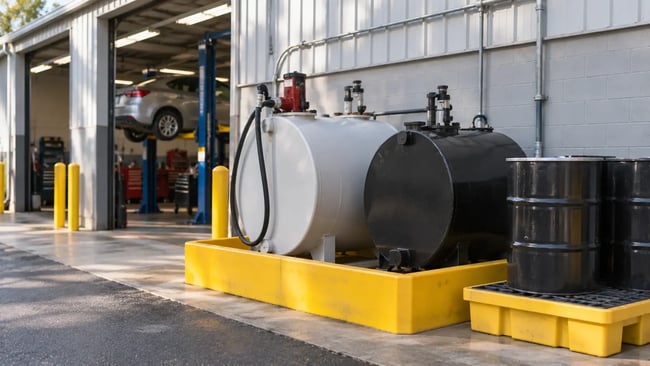
Secondary containment means a second layer that catches oil if the tank, drum, or hose fails. For a shop that's covered by the SPCC rule, the general standard is that containment holds the full capacity of the largest container in the area, plus extra room for rainfall if it's outdoors. The rule is flexible about how you get there, and shops use a handful of common setups that depend on the container.
Drums and totes usually sit on spill pallets, in prefabricated containment lockers, or inside a curbed area of the shop. Spill pallets are cheap and work well for a small number of drums, but they're sized to the drums on them, so a pallet that holds two drums isn't protecting four. Bulk new oil and used oil tanks inside a building often sit in a poured concrete curb or a steel containment basin, and tanks outside sit in a concrete dike or a manufactured containment system. Floor drains in the bays deserve attention too, because a drain that leads to a storm sewer or a dry well turns a small indoor leak into a discharge. Many shops plug or reroute those drains, or send them to an oil-water separator.
Double-walled tanks are common in this industry, and they help, but the second wall only covers the tank shell, not the fill pipe, the dispenser, or the area where a delivery truck connects. We explain the gap in our post on whether double-walled tanks count as secondary containment, and our guide on containment for drums and totes compares pallets, lockers, and berms. Where a tank truck unloads, EPA doesn't require a specific size of containment, but it does expect good engineering practice, and we cover those details in our post on delivery area requirements.
Which Small New Jersey Shops Are Under the SPCC Threshold, and What Still Applies?
We'll be straight about this: a lot of small shops aren't covered. A one- or two-bay repair shop with a single used oil tank, a few drums, and nothing else usually lands well under 1,320 gallons, and if that's you, you don't need an SPCC plan and you don't need us to write you one. Paying a consultant for a plan you aren't required to have is money wasted, and the best first step is just doing the count on paper.
Being under the threshold doesn't mean oil storage is unregulated, though. New Jersey's Spill Control and Compensation Act, usually called the Spill Act, applies to any discharge of oil or other hazardous substances regardless of how much you store. It requires you to report a discharge to NJDEP, and liability under the Act can fall on the party that caused or owns the spill, so a leaking drum behind a small shop can still become an expensive cleanup. The NJDEP hotline number is posted on NJDEP's website, and it's worth putting it next to your spill kit. Federal rules also require reporting a spill that creates a sheen on water, which we explain in our post on the sheen rule.
Used oil handling has its own rules, covering labeling, container condition, and who can haul it away, and we summarize them in our post on used oil regulations. The Uniform Fire Code, which local fire officials enforce, also has rules for flammable and combustible liquid storage that apply whether or not you need an SPCC plan, and our post on fire code and SPCC overlap shows where the two line up. The practical move for an under-threshold shop is simple: use spill pallets, keep drums off bare floors and away from drains, keep a spill kit stocked, and train your team to report and clean up quickly. Staff training is easy to arrange through our online training library.
What Happens If Your Shop Is Over the SPCC Threshold?
If your count tops 1,320 gallons, you need a written SPCC plan, and the good news is that many shops can handle it with a manageable process. A facility qualifies for the simpler self-certified route, called a qualified facility, when its total aboveground oil storage is 10,000 gallons or less, no single aboveground container is larger than 5,000 gallons, and it hasn't had a single oil discharge to a waterway over 1,000 gallons or two over 42 gallons within any twelve-month period. A typical quick-lube meets all of that. EPA publishes a plan template that a qualifying owner can use without hiring anyone, and our posts on self-certifying a plan and Tier I plan costs lay out what that involves.
Some shops need a licensed Professional Engineer to review and certify the plan, for example when the site has a larger total capacity, a spill history that disqualifies it from self-certification, or containment that needs an engineering evaluation. Whether the engineer is on a consultant's staff or an outside partner matters less than making sure one actually reviews and approves the plan. Cost swings with how many containers you have, whether a PE certification is needed, and whether your containment needs work. RMA's published range for SPCC plans runs from about $2,500 to $15,000, and a simple shop sits toward the low end. Plans need a review at least every five years, and any change to your oil storage, like a new tank, can require an amendment sooner.
Two more notes. New Jersey also has discharge prevention plans, called DPCC and DCR plans, for large "major facilities" under N.J.A.C. 7:1E. Those facilities are defined by very large storage capacity, so a typical shop isn't in that category, but you should read the rule against your own inventory if you store a lot of hazardous substances. Our comparison of SPCC and DPCC plans covers the difference. And if you're remodeling or adding bays and tanks, the construction side, such as building permits and tank installation approvals, is handled by your contractor and the right local and state offices, not by us. What we can do is help you figure out what the finished shop will need to run, and point you toward the right construction people.
How Can RMA Help a New Jersey Auto Shop With Oil Spill Planning?
If you'd like a second set of eyes on your count, we're glad to give it. We'll look at your tanks, drums, and equipment, tell you straight whether you're over or under 1,320 gallons, and say so plainly if you don't need a plan. If you do, our senior team writes it, we make sure a Professional Engineer reviews and approves it where one is needed, and we'll explain your containment and inspection duties in plain language so your staff can actually follow them. You can see how our process works on our SPCC plan services page, and our broader guide to SPCC plans in New Jersey is a good place to start if you want background first.
There's no pressure and no obligation. You can call us, email us, or fill out the form on our website, and if you'd rather start with a conversation about your shop, just contact RMA and we'll take it from there.