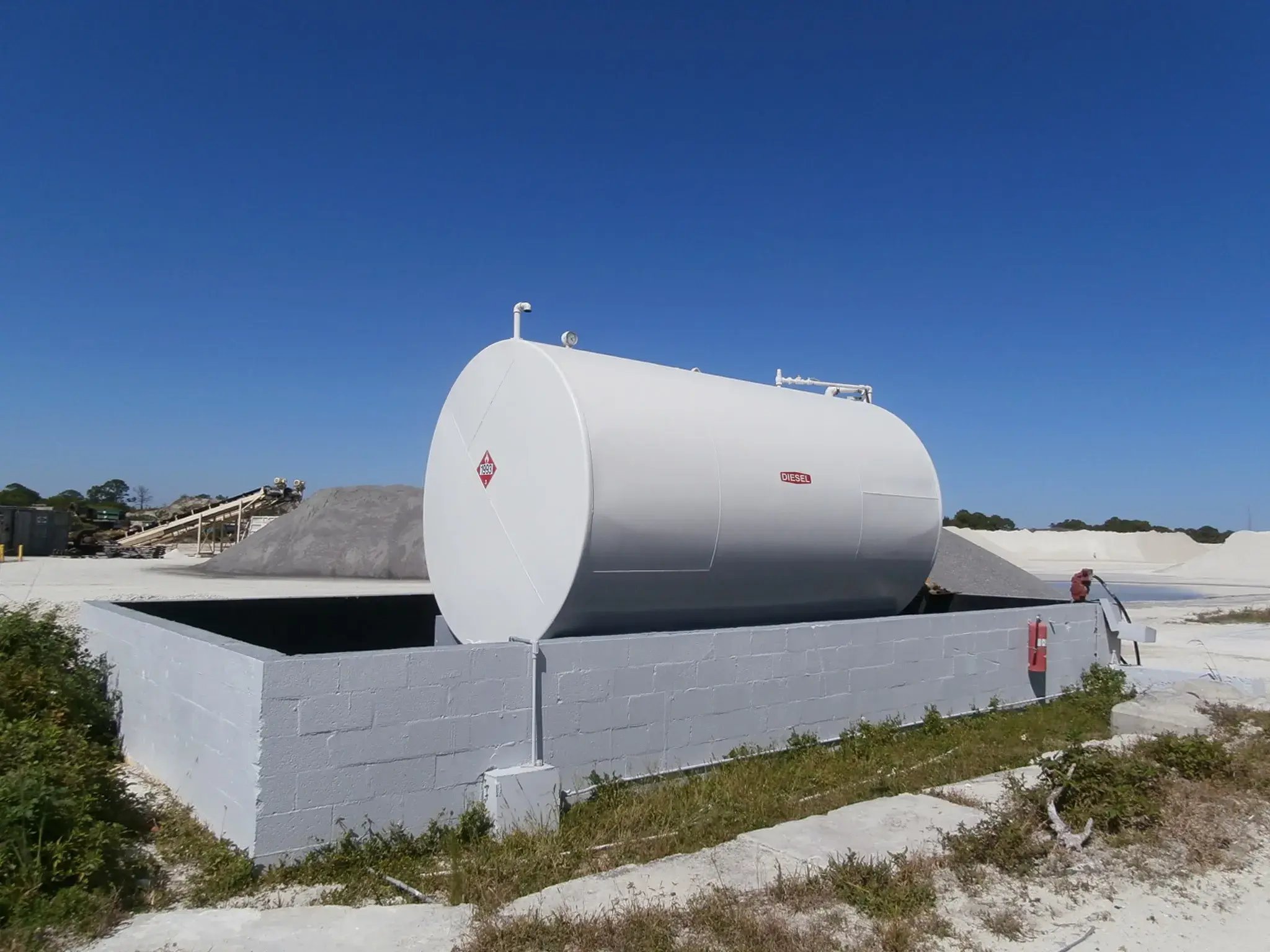
How Fire Marshal Requirements and EPA's SPCC Rule Overlap for Oil Storage, and What to Do When a Fire Inspector Raises Concerns
A fire inspector walks your site, looks at a diesel tank or a row of oil drums, and says something you didn't expect: the tank is too close to the building, the vent isn't right, there's no emergency shutoff, the signage is missing. If you've already paid for an oil spill plan, your first reaction is probably that this should have been covered. It usually wasn't. Fire code and EPA's oil spill rule are two separate sets of requirements enforced by different people, and meeting one doesn't mean you've met the other.
An SPCC Plan (Spill Prevention, Control, and Countermeasure Plan) is the written oil spill plan EPA requires for facilities that store more than 1,320 gallons of oil above ground, counting only containers of 55 gallons or more. If your facility is over that line, you need one. If you already have one, it's the document that shows how you keep oil out of storm drains, creeks, and rivers, not how you keep a tank from burning. In this article we'll walk through what each set of rules looks at, where they overlap on the same piece of steel, how enforcement works across Pennsylvania's municipalities, and what to do if a fire official raises concerns. If you'd rather talk it through with someone who does this every day, you can always reach out to RMA.
Table of Contents
TL;DR
Your SPCC Plan doesn't cover fire code, and passing a fire inspection doesn't satisfy SPCC. Fire code is about preventing fires and explosions, and it's enforced locally, so the rules vary by municipality. SPCC is EPA's oil spill rule. They overlap on tank venting, construction, overfill protection, and condition. If a fire inspector raises concerns, get the findings in writing, find out which code and edition applies, sort the items into fire code and spill plan issues, and check whether any fix changes your SPCC Plan.
What Does a Fire Marshal Check on Oil Tanks in Pennsylvania?
Fire code is about keeping a tank from burning, exploding, or making a fire worse once one starts. A fire official looking at an oil tank typically cares about how the tank was built and whether it carries a recognized listing, such as UL 142 for steel aboveground tanks. They look at how far the tank sits from buildings, property lines, and neighboring tanks. They check whether the tank has normal venting and emergency venting, whether it's protected from vehicle impact, whether ignition sources are controlled nearby, and whether dispensing equipment has an emergency shutoff.
The model codes behind most of this are the International Fire Code, where Chapter 57 covers flammable and combustible liquids, and NFPA 30, the Flammable and Combustible Liquids Code. The category of liquid matters. Gasoline is a flammable liquid. Diesel, heating oil, and most lubricating oils are combustible liquids, which have a higher flash point, and the code is generally stricter on the flammable side. Ask which class of liquid the inspector is treating yours as, because the requirements differ.
What Does the SPCC Rule Require for the Same Oil Tanks?
The SPCC rule is 40 CFR Part 112, and EPA Region 3 enforces it in Pennsylvania. Its only concern is oil reaching navigable waters and adjoining shorelines. To know whether it applies to you, you add up the capacity of every oil container of 55 gallons or more, including oil-filled equipment, and compare it to the 1,320 gallon aboveground threshold (or 42,000 gallons buried). Our article on how to determine whether your Pennsylvania facility needs an SPCC Plan walks through the count, and our plain-English explanation of the SPCC rule covers the basics if you're new to it.
Once a facility is covered, the SPCC Plan has to show how you prevent and contain spills. That means secondary containment sized for the largest container, overfill prevention, integrity testing of bulk containers, regular inspections, spill response equipment and procedures, and training for the people who handle oil. Nothing in that list is about ignition or fire spread. The rule does say that SPCC Plans are meant to complement existing safety, fire prevention, and pollution prevention requirements (40 CFR 112.7), which is EPA's way of acknowledging that other agencies are looking at the same tank for different reasons.
Where Do Fire Code and SPCC Requirements Overlap?
Overlap happens because both sets of rules end up caring about the same physical parts of a tank. A tank that can't relieve pressure in a fire can rupture, and a ruptured tank is both a fire event and a spill. EPA has noted in its own inspector training material that tank integrity inspections done to industry standards sometimes turn up fire code deficiencies, such as inadequate emergency venting, which surprises owners who thought the inspection was only about leaks. The table below shows where the same equipment draws attention from both sides.
| Tank Feature |
What the Fire Official Asks |
What SPCC Asks |
| Venting |
Are normal and emergency vents sized and working so the tank doesn't over-pressurize in a fire? |
Is a blocked or undersized vent a rupture and spill risk the plan should address? |
| Tank construction and condition |
Is the tank built to a recognized standard and in sound shape? |
Has the container been tested or inspected for integrity to industry standards? |
| Overfill protection |
Can a filling operation spill flammable or combustible liquid near ignition sources? |
Is there an alarm, gauge, or procedure that prevents an overfill from reaching the ground? |
| Containment |
Will a spill pool near a building or spread fire? |
Is there sized secondary containment that holds the largest container plus precipitation? |
| Inspections and records |
Is the tank maintained and are problems fixed? |
Are routine inspections and tests documented and kept on file? |
Several of these have their own articles if you want the SPCC side in detail: integrity testing for bulk oil containers, overfill prevention for oil tanks, and whether double-walled tanks count as secondary containment. The overlap is real, but it's partial. A tank can have perfect SPCC containment and still sit too close to a building, and it can pass a fire inspection while sitting in a dike that doesn't hold enough oil.
Where Do Fire Code and SPCC Differ for Oil Storage?
The two systems start from different questions, which is why one doesn't stand in for the other. Fire code asks whether this liquid, in this tank, in this spot, could hurt people or property through fire or explosion. SPCC asks whether this oil could reach water, and what you've done to stop it. That difference drives almost everything else, as the comparison below shows.
| Question |
Fire Code |
SPCC |
| What's the goal? |
Prevent fire, explosion, and fire spread |
Prevent oil from reaching navigable waters |
| Who enforces it? |
Local fire code official or fire marshal |
EPA Region 3 in Pennsylvania |
| What triggers it? |
Storing flammable or combustible liquids, with limits that depend on the code and the local amendments |
More than 1,320 gallons aboveground in containers of 55 gallons or more (or 42,000 gallons buried), plus a reasonable expectation of reaching water |
| What does it cover? |
Flammable and combustible liquids, including some that SPCC doesn't treat as oil |
Petroleum, animal fats, and vegetable oils, including liquids that aren't flammable at all |
Two practical consequences follow. First, your SPCC Plan isn't evidence of fire code compliance. Even a PE-certified plan reflects the engineer's review of the plan against the SPCC rule and good engineering practice, not a fire marshal's approval of your tank location. Second, a liquid can fall under one set of rules and not the other. Vegetable oil in a food plant's tank can bring SPCC without raising much fire concern, while a small gasoline tank can raise real fire code issues without coming near the SPCC threshold. Pennsylvania adds a third layer on top, because DEP's storage tank program has its own registration and inspection rules for certain tanks. Our article on which tanks have to be registered with DEP covers that piece.
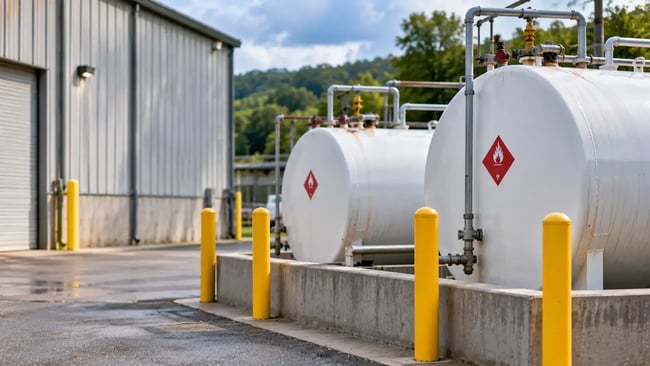
Who Enforces Fire Code for Oil Tanks in Pennsylvania?
Fire code enforcement in Pennsylvania is local, and that's why you can't get a single answer that works statewide. The state's Uniform Construction Code pulls in portions of the International Fire Code for new construction, and the Department of Labor and Industry reports that over 90 percent of the state's municipalities administer the UCC locally. For existing buildings and ongoing operations, many boroughs, townships, and cities adopt their own fire code, usually a version of the International Fire Code with local amendments. The edition can differ from one municipality to the next, and some cities and counties have their own fire marshal offices with their own procedures.
Local amendments can change the answer in ways that matter for tanks. The International Fire Code lets a municipality set geographic limits where aboveground storage of the more flammable classes of liquid outside of buildings is restricted, and some Pennsylvania boroughs have adopted such limits. Others have added their own tank requirements. So when someone tells you what fire code requires for your tank, the next question is which code, which edition, and which local amendments your municipality has adopted. Your insurer and your landlord can also hold you to fire safety standards through their own inspections, which is a separate conversation from what the code requires. Our article on who enforces oil spill plans in Pennsylvania covers the spill side of the same question.
What Should You Do If a Fire Inspector Raises Concerns About Your Oil Tanks?
Start by getting the concern in writing. A verbal comment during a walkthrough isn't something you can act on, and it's easy to misremember. Ask for the specific code section and the edition the inspector is citing, along with the location on your site and any deadline. Then check that the inspector is working from the code your municipality has adopted. Inspectors are usually right, but local amendments are easy to miss, and a generic model code section may not be the one that applies to you.
Sorting Fire Code Findings From Spill Plan Items
Go through each finding and decide which bucket it falls in. Some are purely fire items: clearances, ignition sources, extinguishers, signage, emergency shutoffs. Some are purely spill items. Some land in both, like venting, overfill protection, tank condition, and containment. Your SPCC Plan should already describe how you handle the shared items, so pull it out and see whether it matches what the inspector found in the field. If the plan says the tank is vented one way and the tank in the field is different, that's worth knowing before an EPA inspector finds it too. Our monthly SPCC inspection checklist is a quick way to compare what's in the plan to what's on the ground.
Next, bring in the right professional for the fix. Venting calculations, tank spacing, and fire protection design are fire protection engineering and tank contractor work, and RMA doesn't do them. If the fix is a tank replacement or relocation, you'll likely need your contractor and possibly permits, and in Pennsylvania tank installation may require DEP-certified installers. Ask the fire official whether an alternative method that meets the intent of the code could be approved, since the International Fire Code generally lets the code official consider equivalent approaches when the owner documents why they work. Ask about the appeal process and its deadlines too, because they can be short.
If the concern comes with a formal notice of violation, fines, or a threatened shutdown, it may be time to talk to an environmental or land use attorney. That's especially true if the notice involves a spill or release in addition to the fire code item. Document everything as you go, including photos before and after each fix, dated invoices, and copies of correspondence with the fire office. That paper trail helps with the fire inspector, your insurer, and your SPCC file.
How Do Fire Code Fixes Affect Your SPCC Plan?
Fixes made to satisfy a fire inspector often change something your SPCC Plan describes. Under 40 CFR 112.5, you have to amend the plan when a change in design, construction, operation, or maintenance materially affects your potential for a discharge. Moving or replacing a container, adding or changing piping, building or altering containment, and changing the product stored all count. The amendment has to be prepared within six months of the change, and implemented as soon as possible, no later than six months after the amendment is prepared. If your plan is PE-certified, technical amendments need the engineer's certification. We explain the engineer's role in our article on whether an SPCC Plan needs a Pennsylvania-licensed engineer.
The influence runs the other way too. If an SPCC review shows you need more containment around a tank, the dike or wall you add can create a fire code question about clearances, access, or how a spill would be drained. That's why we suggest talking to the fire official before you build, not after. Construction itself, meaning building permits, fire permits for a tank installation, and the installation work, belongs to your engineer and contractor, and RMA doesn't prepare or manage those approvals. What we do help with is the operational side once the work is in: updating the SPCC Plan, checking whether DEP tank registration is affected, making sure inspections and testing line up with the new setup, and training. If you're adding a generator or a new tank, our article on adding a backup generator and your SPCC status shows how a single piece of equipment can bring both fire code and SPCC questions at once.
How Does RMA Help With Fire Inspector Concerns and SPCC Compliance?
We're a family-run firm, and the people who work on your SPCC Plan are senior staff, not a hand-off to someone junior. When a fire inspector's concerns touch your oil storage, we can compare what they flagged against your SPCC Plan, tell you which items affect your spill plan, and tell you plainly whether a proposed fix means an amendment. If you don't have a plan yet and your tanks put you over the threshold, we can develop one, and initial SPCC training is free with a new RMA plan. If your plan came from another firm, we typically rebuild it rather than patch it, so we'll tell you up front if that's the better route.
We have limits too. We aren't fire protection engineers, we don't interpret your municipality's fire code, and we don't do tank installations or construction permits. If your concern is purely a fire code item, we'll say so and point you toward the right people. There's no pressure and no obligation to start a conversation. You can call us, send an email, or fill out the form on our website, and if you'd like help sorting out where your tanks stand, just contact RMA and we'll take a look with you.