Twelve Questions to Ask, Why Each One Matters, and What a Good Answer Sounds Like
If you're shopping for someone to write your Pennsylvania SPCC Plan, you've probably noticed that the quotes don't look alike. An SPCC Plan is the written oil spill prevention plan that EPA's rule requires when a facility stores more than 1,320 gallons of oil aboveground (counting only containers of 55 gallons or more) or more than 42,000 gallons buried. If you're over that line, or you already have a plan that's out of date, the person you hire decides a lot about what you end up with: how your storage gets counted, whether you need an engineer, what Pennsylvania adds on top, and what you're left holding once the plan is delivered.
This article is a list of questions to ask, with the reason behind each one and what a solid answer sounds like. It's meant to sit next to our broader guide on what it's like to hire an SPCC plan consultant, so we've kept it focused on the Pennsylvania details that tend to separate a good plan from a thin one. If you'd rather talk your situation through with a person, you can reach out to RMA at any point.
Table of Contents
TL;DR
Before you hire anyone to write your Pennsylvania SPCC Plan, ask who visits your site and who certifies the plan, how they count your oil storage and pick your tier, whether they'll deal with DEP tank registration and the PPC and SPRP overlap, what integrity testing they'll recommend, what the price covers, and what help you get after delivery. Specific answers mean the writer knows the rule. Vague answers, or a price far below every other quote, usually mean you'll pay again later.
How Should You Use These Pennsylvania SPCC Plan Questions?
Ask every firm the same questions, and ask them in writing if you can. Quotes are hard to compare when one firm is pricing a Tier I template and another is pricing a full engineer-certified plan, and the questions below are meant to surface that difference before you've signed anything. Writing the answers down also gives you something to hold the firm to when the deliverable arrives.
It helps to remember who reads the finished plan. In Pennsylvania, EPA Region 3 enforces the federal SPCC rule, and an inspector will compare the plan on paper against the tanks, containment, and procedures at your site. A plan that looks polished but doesn't match your facility is a liability, because every mismatch is something the inspector can write down. If you already have a plan from another firm, ask the same questions about it. Plans also need a review at least every five years, so whoever you choose is likely to be part of your compliance picture for a while.
What Should You Ask About Site Visits, Engineers, and Your SPCC Tier?
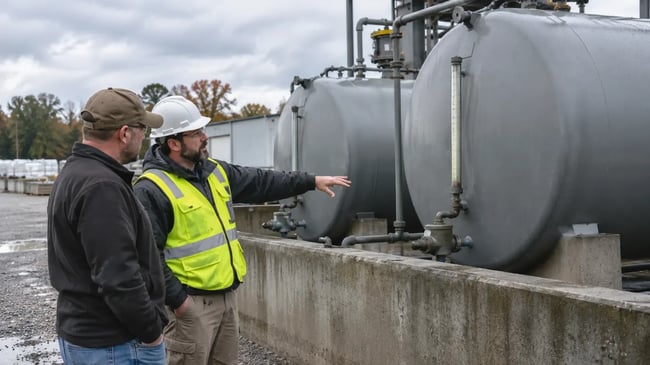
These four questions decide what kind of plan you get and who signs it. They're also where the biggest gaps between quotes come from, since a firm that skips the site visit or guesses at your tier can quote far below one that does the work properly.
| Question to ask |
Why it matters |
What a good answer sounds like |
| 1. Who will visit my site, and who certifies the plan? |
A plan certified by a professional engineer (PE) has to rest on a facility visit and examination by the PE or the PE's agent. If you're self-certifying a Tier I or Tier II plan, EPA says the owner or operator must personally visit and examine the facility. A consultant can't do that part for you. |
A clear statement of who goes on site, who signs, and what the visit covers, including walking every container, piece of oil-filled equipment, and drainage path. |
| 2. Is the engineer licensed in Pennsylvania, and what does the engineer review? |
A stamp is only as useful as the review behind it. Some firms treat the PE step as a signature on a finished document. |
The firm names how the engineer is involved, confirms the engineer is licensed for the state your facility is in, and explains what happens if the engineer wants changes. |
| 3. How will you count my oil storage capacity? |
Capacity is what counts, not how full a tank is. Oil-filled equipment counts, as do animal fats and vegetable oils. Propane and DEF don't. Miscounting can put you in the wrong tier or make a needed plan disappear. |
They talk about container size, not contents, and mention drums, totes, generators, transformers, and hydraulic equipment without being prompted. |
| 4. How do you decide whether I'm Tier I, Tier II, or PE-certified? |
The cheapest route is only open if you qualify. Tier I and Tier II both require no more than 10,000 gallons of total aboveground capacity and a clean spill history over the past three years, and Tier I also requires that no single aboveground container is over 5,000 gallons. |
They ask about your spill history and every container size before quoting, then explain which tier you land in and why. |
If you want to see how those tiers compare in detail, our guide to Tier I, Tier II, and PE-certified SPCC plans in Pennsylvania walks through the decision, and our post on what the PE does when certifying a Pennsylvania SPCC plan covers question two. For counting, see how Pennsylvania businesses should count their oil storage. At RMA, we work with an outside professional engineer when a plan needs PE certification, and our own staff usually handle the site visit and write the plan before the engineer reviews it. Some facilities are also a fit for remote SPCC plan development, and a good firm will tell you whether yours is one of them.
What Should You Ask About Pennsylvania Tank Registration, PPC, and SPRP Overlap?
The federal SPCC rule is only part of the picture in Pennsylvania. The state's storage tank program, run by DEP under 25 Pa. Code Chapter 245, regulates stationary aboveground tanks over 250 gallons that hold regulated substances, and those tanks have to be registered with DEP. Work on a regulated tank system, other than routine maintenance, has to be done by a DEP-certified installer, and the inspections the regulations require have to be done by a DEP-certified inspector. Large aboveground tank facilities, generally those with more than 21,000 gallons of regulated substances in total, also need a Spill Prevention Response Plan (SPRP). On top of that, a Preparedness, Prevention, and Contingency (PPC) Plan can come up through certain state permits and programs. A writer who only knows the federal rule will leave you to find these on your own.
| Question to ask |
Why it matters |
What a good answer sounds like |
| 5. Will the plan address Pennsylvania tank registration? |
An SPCC Plan can be perfect and your tanks can still be unregistered, or registered under an old owner or company name. Whether a given tank needs DEP registration depends on its size, type, and use. |
They check each tank against DEP's program, flag any that look unregistered, and tell you what you'd need to do about it. |
| 6. How will you handle the overlap with PPC and SPRP plans? |
Facilities often end up with several plans that describe the same tanks in slightly different ways, and the differences become problems. Which of these apply to you depends on your capacity and your permits. |
They ask which state permits you hold, explain which plans apply, and tell you whether one document can cover more than one requirement. |
| 7. Who handles tank work that needs DEP-certified people? |
A plan can recommend a new tank, a repair, or a replacement. The installation itself is a separate job for a certified installer, and it often involves construction-phase approvals. |
They're upfront about what they do and don't do, and they can point you to the right trades for the rest. |
Question seven is a place where we're direct about our limits. RMA writes and maintains plans and helps with the operational side once a facility is running. We don't install tanks, and we don't prepare construction-phase permits, such as construction stormwater or erosion and sediment control approvals. If you're building or expanding, you'll work with your engineer or contractor on that piece, and we can help you figure out what the construction phase needs and who to ask. For the registration questions, see our posts on which tanks have to be registered with DEP and whether one document can cover SPCC, PPC, and SPRP requirements.
What Should You Ask About Integrity Testing and Secondary Containment?
The federal rule requires bulk storage containers to be tested or inspected for integrity on a regular schedule and after material repairs, using industry standards. What that means for a given tank varies a lot. A small shop-built tank might call for visual inspections and periodic checks, while a larger field-constructed tank can fall under API 653, and many shop-built tanks follow STI SP001. In Pennsylvania, some inspections also have to be done by a DEP-certified inspector. A writer who copies one testing schedule into every plan will either over-test your small tanks or under-test your large ones.
| Question to ask |
Why it matters |
What a good answer sounds like |
| 8. What integrity testing will you recommend, and why? |
Testing costs real money, and it gets repeated on a schedule. The plan should tie each recommendation to a specific tank and a specific standard. |
They name the standard that fits each container, say who has to perform the work, and explain what you can handle in-house. |
| 9. How will you evaluate my secondary containment, and what happens if it falls short? |
Containment is one of the most common gaps inspectors find. Dikes, double-walled tanks, drums on pallets, and rainwater drainage each have their own questions to answer. |
They measure and calculate sizing, not eyeball it, and they give you options if something falls short rather than leaving the gap undocumented. |
Our posts on integrity testing for bulk oil containers and how to evaluate secondary containment go deeper on both. The reason to ask before you hire is that these two areas drive most of the money you'll spend after the plan is written, so you want to hear the writer's reasoning while you can still compare it against another firm's.
What Should You Ask About SPCC Plan Price, Updates, Training, and Inspections?
Price is the question everyone asks first, and it works better when it comes last, after you know what kind of plan you're pricing. At RMA, SPCC plans generally run from about $1,500 to $15,000, and a Tier I plan runs about $1,500 to $4,000. The spread comes down to total storage capacity, how many containers and pieces of equipment need to be evaluated, whether PE certification is required, and whether your secondary containment needs a closer look. You can run your own numbers with the pricing calculator below, which is designed to show what RMA's help would cost for your facility.
| Question to ask |
Why it matters |
What a good answer sounds like |
| 10. What's included in the price, and what costs extra? |
A low base price can grow through add-ons: the site visit, the PE review, revisions, a facility diagram, or a second location. |
A written scope that lists the site visit, certification, deliverables, revisions, and anything excluded. |
| 11. Will you update a plan another firm wrote, or start over? |
If you already have a plan, this decides whether you're paying for a revision or a rebuild. Firms differ, and the answer shapes the quote. |
They tell you up front. At RMA, we typically don't update another firm's plan and usually rebuild from scratch. |
| 12. Do you help with training and inspections afterward? |
The rule requires annual discharge prevention briefings for oil-handling staff, and inspection records have to be kept for three years. Many plans fail on follow-through, not on the document. |
They describe what's included, what training they offer, and what the monthly inspection routine looks like. At RMA, initial SPCC training is free with a new plan. |
For the details behind these numbers, see what a Tier I SPCC plan costs in Pennsylvania and why PE-certified plans cost more. For what the follow-through looks like, our monthly SPCC inspection checklist shows the routine, and our online training library covers staff training. If you're not sure whether an existing plan can be saved, can I get my SPCC plan updated lays out the options.
Which Answers Should Make You Look for a Different SPCC Plan Writer?
A few answers should slow you down. If a firm can't say who certifies the plan or who visits your site, you don't know what you're buying. If the quote arrives without asking about your containers, equipment, or spill history, the plan will be built from a template and your facility will be filled in afterward. And if a price comes in at a fraction of everyone else's, the work has to come from somewhere, usually a skipped visit, a junior writer, or a document that won't hold up at an inspection. We're not the cheapest option, and we don't try to be, because fixing a plan that failed an inspection costs more than doing it properly the first time.
Be careful with plans produced by a chatbot or an online form, too. They can't walk your site, and they can't tell that the drum rack behind the shop counts toward your capacity. We tested this in can ChatGPT or AI write an SPCC plan. RMA doesn't use AI to produce client deliverables, and you should expect the same from anyone writing a plan you'll be signing or relying on.
It's also fair to ask whether you need to hire anyone at all. If your facility meets the Tier I criteria and you're comfortable doing the site examination and writing the plan yourself, EPA's template is free, and our post on whether your Pennsylvania facility can use EPA's Tier I template explains how to tell. Plenty of small facilities do it themselves, and we'd rather you know that than hire us for something you can handle.
How Can RMA Help With Your Pennsylvania SPCC Plan?
We're a family-run firm, and the senior people you talk to at the start are the ones doing the work. We can help you figure out whether you need an SPCC Plan at all, which tier you fall into, and what Pennsylvania adds on top, and then write and maintain the plan, set up the inspection and training routine, and coordinate with an outside professional engineer when your plan needs PE certification. If you'd like to compare our answers to the questions above with another firm's, you're welcome to. There's no pressure and no obligation. You can call us, send an email, or fill out the form when you contact RMA, and you can browse everything we've published for Pennsylvania facilities on our Pennsylvania SPCC plans page.