Used Oil Storage, Labeling, Spill Response, and Hauling Rules for New Jersey Shops, Fleets, and Manufacturers
Used oil is what's left in the engine, hydraulic system, gearbox, or compressor after it's done its job. Most shops, fleets, and plants collect it in a drum, a tote, or a tank out back and treat it as a housekeeping chore. New Jersey treats it as a regulated recycling material, with its own rules for how it's stored, labeled, cleaned up, and hauled away. Those rules apply whether you keep one 55-gallon drum or a 500-gallon tank, and they sit apart from the oil spill plan rules many facilities already know.
The short answer is that New Jersey's used oil rules, found at N.J.A.C. 7:26A-6 alongside the federal standards at 40 CFR Part 279, require used oil to be kept in sound containers or tanks, marked "Used Oil," cleaned up quickly when it leaks, and shipped only with haulers that hold an EPA identification number. Below we walk through each piece, explain how it overlaps with SPCC (Spill Prevention, Control, and Countermeasures) containment and inspections, and cover the mistakes we see most. If you'd rather talk through your own setup, you can reach out to RMA at any point.
Table of Contents
TL;DR
In New Jersey, any used oil you store has to be in containers or tanks that are in good condition with no visible leaks, marked with the words "Used Oil," and cleaned up right away if it spills. Only haulers with an EPA ID number should take it away, except for loads of 55 gallons or less that you carry yourself to a collection center or your own aggregation point. Don't mix solvents into it, don't spread it on dirt lots, and don't burn it in a heater without state approval. These rules apply at any quantity, and if your total aboveground oil storage passes 1,320 gallons, SPCC applies on top of them.
What Counts as Used Oil Under New Jersey's Used Oil Rules?
Used oil is any oil refined from crude oil, or any synthetic oil, that's been used and has picked up physical or chemical impurities. New Jersey's definitions also name used emulsion oils. In a typical facility that covers engine oil, hydraulic fluid, gear oil, transmission fluid, compressor oil, and cutting oils once they're spent. NJDEP starts from the presumption that used oil is headed for recycling, which is why the rules read as handling standards, not a disposal permit system.
There's no quantity trigger. SPCC only applies once a facility stores more than 1,320 gallons of oil aboveground, but the used oil rules for generators don't work that way. A single drum in a maintenance garage is covered, and so is a five-gallon pail on a workbench. Two edges are worth knowing. Used oil mixed with hazardous waste is regulated as hazardous waste instead, which we cover below. And fryer oil from a food plant is vegetable oil, not petroleum or synthetic, so it generally falls outside these rules even though it counts under the federal spill rules, as our post on vegetable oil at New Jersey food plants explains. Our explainer on used oil versus waste oil covers why the wording matters.
What Are the Used Oil Container and Tank Storage Requirements in New Jersey?
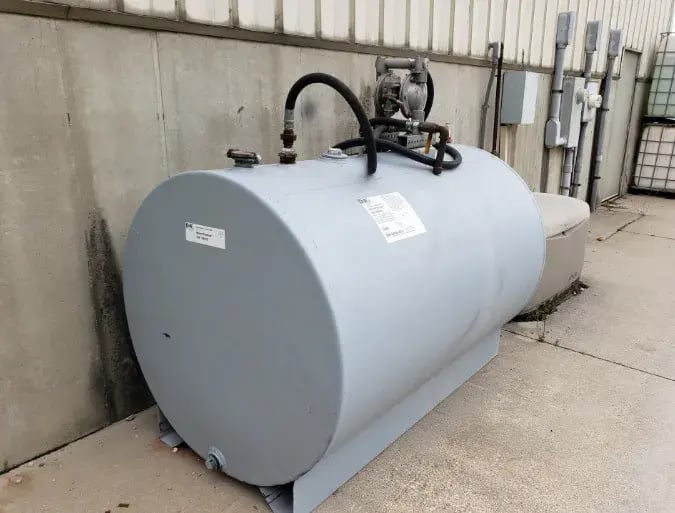
Under N.J.A.C. 7:26A-6.4, a generator can store used oil only in tanks, containers, or units regulated under the hazardous waste storage rules. In practice that means drums, totes, and tanks built to hold liquid, not open-top buckets, unlined pits, or piles of oily material. The containers and aboveground tanks also have to be in good condition. The rule bars severe rusting, apparent structural defects, and deterioration, and it says there can't be any visible leaks.
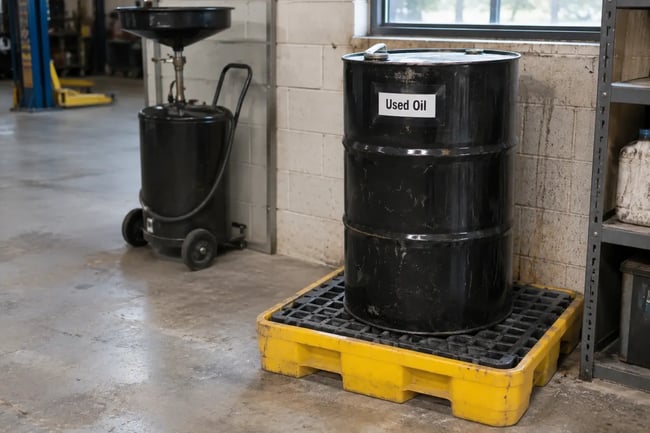
That sounds easy until you look at a drum that's been behind the shop for three years, with a bulging lid, a rusted chime, and dark staining underneath. A drum like that fails on condition before anyone reads the label, and the standard is to move the oil into a sound container, not wait and see how long it holds. Keep the bungs in and the drum off wet ground, because rainwater that gets in through a loose bung raises the level and speeds up rust at the bottom seam. Our monthly inspection checklist for New Jersey facilities is a good place to build those checks into a routine you already run.
Used oil in an underground tank is a different program. Those tanks fall under 40 CFR Part 280 and New Jersey's N.J.A.C. 7:14B whether or not the oil is hazardous, and NJDEP-certified contractors do the tank work.
How Do You Label Used Oil Containers, Tanks, and Fill Pipes in New Jersey?
Every container and aboveground tank that holds used oil has to be clearly marked with the words "Used Oil," and so does any fill pipe used to transfer used oil into an underground tank. That comes from 40 CFR 279.22 and the matching New Jersey standard at N.J.A.C. 7:26A-6.4(d). The rule doesn't set a label size or color, but the marking has to be legible to someone walking up to the unit, so a faded stencil on the back of a tank doesn't do the job.
Use the exact wording. Drums marked "Waste Oil," "Oil," or "Do Not Use" are common in older shops, and none of them is what the rule says. An unlabeled or mislabeled drum is also the easiest violation for an inspector to cite, because it takes four seconds to see. Size doesn't change the rule, so a 5-gallon pail, a drip pan, and a portable transfer tank all need the marking if they hold used oil. NJDEP's inspection checklist for used oil generators asks the same short list: whether storage meets SPCC rules where they apply, whether containers are in good condition and not leaking, whether every unit is marked "Used Oil," whether any release was handled properly, and whether the hauler has an EPA ID number. Our post on the top things to know about used oil regulations is a quick companion read.
What Do You Do When Used Oil Spills or Leaks at a New Jersey Facility?
Safety comes first. If anyone is hurt, there's a fire or fire risk, or oil is heading toward a storm drain or waterway, call 911 before anything else. Once people are safe, the used oil rules give you four steps: stop the release, contain it, clean up and properly manage the oil and anything it touched, and repair or replace a leaking container before it goes back into service. That last step gets skipped. Wiping up a puddle and putting the same cracked drum back on the same pallet is how a second spill happens a week later. Cleanup creates its own waste, too. Oily rags, absorbent pads, and soil all have to be managed properly, and what that means depends on what's in them, so absorbent that also soaked up solvent isn't handled like motor oil absorbent.
Cleanup is separate from reporting. New Jersey's Spill Compensation and Control Act, usually called the Spill Act, covers petroleum, so a used oil spill is a discharge under state law. New Jersey requires most discharges to be reported immediately to the NJDEP hotline at 1-877-WARNDEP (1-877-927-6337). Whether a small drip fully contained on an impervious floor needs a call depends on the circumstances and the exceptions in N.J.A.C. 7:1E, so when you're unsure, call and ask. Our guide to the sheen rule and oil spill reporting covers the federal side of that decision.
If oil reaches soil, groundwater, or a waterway, the picture changes. Spill Act liability is strict and can be joint and several, which in general terms means a responsible party can be held liable for cleanup costs without anyone proving negligence. Soil cleanup typically involves a Licensed Site Remediation Professional (LSRP), and it's reasonable to talk to an environmental attorney about liability early. Stocking the right gear ahead of time keeps most spills small, and our post on spill kits for New Jersey facilities explains what to keep and where.
How Does Used Oil Storage Overlap With SPCC Containment and Inspections?
The used oil rules point straight to the oil spill plan rules. Both the federal standard and New Jersey's say a used oil generator is also subject to every applicable requirement of the SPCC rule at 40 CFR Part 112 and to New Jersey's discharge prevention rules at N.J.A.C. 7:1E. EPA Region 2 enforces SPCC in New Jersey while NJDEP enforces the used oil rules, so a single drum can be examined by two agencies for two reasons. The triggers differ, and that's where most of the confusion starts.
| Question |
Used oil rules (N.J.A.C. 7:26A-6) |
SPCC (40 CFR Part 112) |
| What triggers it? |
Generating or storing any used oil, at any quantity |
More than 1,320 gallons of aboveground oil, counting containers of 55 gallons or more |
| Does a 5-gallon pail count? |
Yes, it needs a "Used Oil" label and a sound container |
No, containers under 55 gallons aren't counted |
| Containment |
No secondary containment standard for generators, only sound containers with no visible leaks |
Secondary containment sized for the largest container, plus containment at transfer areas |
| Inspections |
Condition and leaks, checked by NJDEP inspectors |
Routine inspections and integrity testing recorded under the plan |
| Who enforces it? |
NJDEP |
EPA Region 2 |
A facility can be fully outside SPCC and still owe every used oil standard, which catches smaller shops off guard. A facility that's inside SPCC has to treat the used oil tank as one more piece of oil storage, with containment, overfill protection, inspections, and training, and the used oil counts toward the total. A shop with 900 gallons of other oil that adds one 500-gallon used oil tank crosses the 1,320-gallon line. We walk through the math in our post on whether used oil counts toward federal spill rules, and our posts on secondary containment for drums and totes and overfill prevention cover the next steps. Larger sites should also check New Jersey's own discharge prevention thresholds, which we explain in does my facility need both an SPCC plan and a DPCC plan.
Who Can Haul Used Oil Away From a New Jersey Facility?
Under N.J.A.C. 7:26A-6.4(f), a generator has to make sure its used oil leaves the site only with a transporter that holds an EPA identification number. Transporters get that number by notifying EPA Region 2 of their used oil activity. Before you sign with a hauler, ask for the EPA ID number and for whatever New Jersey transporter credentials apply to them, and keep a copy on file. A hauler who can't give you a number quickly isn't one to use.
The exceptions are narrow. You can move your own used oil, and oil collected from household do-it-yourselfers, without an EPA ID number if you take it to a county or municipally registered or recognized collection center, or to an aggregation point you own or operate. The vehicle has to be owned by the facility or an employee, and the load can't exceed 55 gallons at any time. That works for a van carrying one drum to the town recycling center. It doesn't work for a box truck carrying five. A third exception covers tolling, where a processor reclaims your oil under a contract and returns it to you for use as a lubricant, cutting oil, or coolant, using its own vehicle.
On paperwork, used oil in New Jersey can generally ship under a bill of lading, not a hazardous waste manifest. Keep every pickup receipt with the date, quantity, and the hauler's name and EPA ID number, because it shows where your oil went. A pumpout is also a transfer, and a common spot for spills, so have someone watching and a spill kit nearby. Our posts on unloading areas at New Jersey facilities and New Jersey trucking and fleet companies show how this plays out in a yard with regular pickups.
What Are the Mixing, Burning, and Disposal Rules for Used Oil in New Jersey?
Mixing is where used oil gets expensive. Used oil mixed with a listed hazardous waste, such as certain spent solvents, is regulated as hazardous waste, not used oil. Used oil that contains more than 1,000 ppm total halogens is presumed to have been mixed with a listed halogenated hazardous waste, and it has to be managed as hazardous waste unless you can show otherwise. New Jersey adopts that presumption in N.J.A.C. 7:26A-6.2. In a shop, the usual cause is someone pouring parts washer solvent, brake cleaner, or carburetor cleaner into the used oil drum to get rid of it, and one pour can change how the whole drum has to be handled.
The prohibitions are plain. New Jersey bans using used oil as a dust suppressant, so spreading it on a dirt lot or gravel drive isn't allowed. Burning it in a used oil space heater is allowed only if the heater burns on-specification oil that you generated or received from do-it-yourselfers, its maximum capacity is no more than 0.5 million BTU per hour, the exhaust vents to the open air, and you hold the required New Jersey air permit, certificate, or registration under N.J.A.C. 7:27 before you start it. Burning off-specification used oil in a space heater is prohibited. If there's an old waste oil heater in the back of your garage, check its authorization before the first cold snap.
NJDEP presumes used oil is being recycled, and sending it for disposal instead moves it into the stricter solid and hazardous waste rules. Pouring it on the ground or down a floor drain isn't an option under any program, and it's a Spill Act discharge. If you can't tell whether a drum is used oil, a mixture, or hazardous waste, treat it as a waste characterization question, and our waste and hazardous waste resources are a good starting point.
What Are the Most Common Used Oil Mistakes at New Jersey Facilities?
Most violations come from ordinary habits: a drum swap that left the label behind, a staff change that dropped the weekly walk-through, or a hauler chosen on price. The table pairs each mistake with its fix.
| Mistake |
Fix |
| Drum marked "Waste Oil" or not marked at all |
Label every drum, tote, tank, pail, and fill pipe "Used Oil" |
| Rusted, bulging, or weeping drum still in use |
Transfer the oil to a sound container and retire the old one |
| Solvent or brake cleaner poured into the used oil drum |
Keep a separate labeled container for solvents and train staff on it |
| Hauler with no EPA ID number, or a self-hauled load over 55 gallons |
Check the number, file the receipt, and use a hauler for larger loads |
| Waste oil heater running without state approval |
Confirm authorization and the size and fuel limits, or stop using it |
| Used oil left out of the SPCC capacity count |
Count every aboveground container of 55 gallons or more at full capacity |
The pattern behind most of these is that the person who knew the rule left, or the rule never reached the person who fills the drum. A short walkthrough with the people who handle oil, repeated once a year, prevents most of what's in that table. Our online environmental training library is one way to give new hires the basics without pulling a manager off the floor.
How Does RMA Help With Used Oil and SPCC Compliance in New Jersey?
Plenty of facilities can handle the used oil rules on their own. If your drums are labeled, sound, and off the ground, your hauler has an EPA ID number, and nobody pours solvent in the drum, you're most of the way there and you don't need a consultant to tell you so. Where we come in is the overlap. We help New Jersey facilities add up their oil storage correctly, figure out whether used oil pushes them over the SPCC line, put together a plan that matches what's on site, and set up the inspection and training routines that keep both programs in order. We're based in New Jersey, we work with NJDEP's rules regularly, and senior staff do the work, not a handoff.
If you want a second opinion on your used oil setup, or you're not sure whether your total storage puts you under the federal spill rules, you can call us, email us, or fill out the form on our website. There's no obligation and no pressure. You can also reach out to RMA directly, and we'll tell you plainly whether you need our help or can handle it yourself.