A Step-by-Step Guide to Writing Your First New Jersey Stormwater Pollution Prevention Plan (SPPP), and Knowing When to Bring in Help
If your New Jersey facility just picked up an industrial stormwater permit, or you've taken over a site that already has one, the permit probably came with a requirement you haven't dealt with before: a written stormwater pollution prevention plan. NJDEP calls it an SPPP. You'll also hear it called an SP3 or just a stormwater plan, and because RMA says SWPPP everywhere we work, that's the term we'll use here. A first SWPPP isn't a mysterious document. It's a binder or a PDF that shows where rain touches your site, what could pollute that rain, and what your people do about it.
This guide walks through the order we'd tackle a first plan: build a team, map the site and its drainage, inventory the pollutant sources, choose your best management practices (BMPs), set up inspections and training, and document everything. We'll also cover how industry-specific permits add their own plan elements. A SWPPP is a plan you certify to NJDEP, and it's easy to write one that looks fine and falls apart the first time an inspector walks your site. If you'd rather not take that risk on a first try, you can reach out to RMA and we'll tell you how much help your site needs.
Table of Contents
TL;DR
To write your first New Jersey SWPPP, confirm which NJPDES permit covers you, then work through six steps: pick a team, map the site and where it drains, inventory every pollutant source, choose and schedule your BMPs, set up monthly inspections and annual training, and put it all in a signed plan you keep on site. Industry-specific permits add their own plan elements, and some add sampling. Simple sites can often manage this alone, but a certification to NJDEP rides on the plan being right, so complicated or high-risk sites are usually better off with an experienced consultant.
What Is a New Jersey SWPPP and Which Permits Require One?
A SWPPP is the written program a facility uses to keep rain and snowmelt from picking up pollutants and carrying them off site. In New Jersey it's tied to your NJPDES (New Jersey Pollutant Discharge Elimination System) stormwater permit. Most industrial facilities land on the Basic Industrial Stormwater General Permit, known as the 5G2. Some industries are pushed to their own permits, such as the Concrete Products Manufacturing (CPM) general permit or the R4 for hot mix asphalt, and a few facilities hold individual permits. Our overview of what an SPPP is covers the plan itself.
Because the plan has to match the permit, the permit comes first. If you aren't sure which one applies, start with our post on whether your New Jersey facility needs an industrial stormwater permit. Facilities that keep everything industrial indoors or under permanent cover may qualify for a no exposure exclusion instead, and then there's no permit-required SWPPP to write.
Two practical points before the steps. The plan stays at your facility, and NJDEP asks for a signed certification form rather than the plan itself, though inspectors can ask to see the plan on any visit. The timeline for getting a new plan in place is set by your permit, so check your authorization for your dates.
Step 1: Who Should Be on Your SWPPP Team?
NJDEP's SPPP forms begin with the team, and that's a good place to begin the real work too. At a small facility the team might be the owner and a shop foreman. At a larger plant it's usually someone from operations, someone from environmental or safety, and a person with enough authority to approve a berm, a roof over a storage area, or a new dumpster lid without three levels of sign-off.
Between them, the team should know the site physically, including where water goes when it pours, know what gets bought, stored, and thrown away, and be able to spend money or change how work gets done. Name a backup for each role, because plans built around one person stop working the day that person leaves. Put names, titles, and responsibilities in the plan and update that page when staff changes.
Step 2: How Do You Map the Site and Drainage for a SWPPP?
The site map is where most first plans come together or quietly go wrong. It needs to show your property boundary, buildings, paved and unpaved areas, storm drains and inlets, any basins or ditches, the places water leaves your property, and which way it flows. It also needs to show where your materials and industrial activities sit, so a reader can see how a drum of used oil in the northeast corner relates to the inlet twenty feet away.
Don't draw it from a satellite image and call it done. Walk the site, ideally in the rain, and watch where the water goes. Then trace each storm drain as far as you can. Some drain to the street, some to a basin, some to a ditch, and some tie into a sewer line, which changes which rules apply. Our guide to creating your own New Jersey SWPPP site map walks through the drawing process.
Step 3: How Do You Inventory Pollutant Sources for a SWPPP?
The inventory is a list of everything on your site that could end up in runoff. That covers the obvious materials, like raw materials, products, scrap, aggregate, fuels, oils, and chemicals, and the things people forget because they're always there: dumpsters, pallets, used oil containers, parked equipment that drips, and outdoor wash spots. You also list your industrial activities, such as fueling, loading and unloading, and equipment maintenance, plus any non-stormwater discharges like cooling or process water.
After the list, you write a short assessment of how each material is handled and how it could meet rain. That's where a list becomes a plan, because it's where you decide which items need a fix. The fastest way to find gaps is to walk the site with someone who doesn't work there every day, since fresh eyes spot the open drum behind the shed that your crew stopped seeing years ago. Our post on finding stormwater pollution sources for your NJ SWPPP shows a systematic way to do it.
Step 4: How Do You Choose BMPs for Your SWPPP?
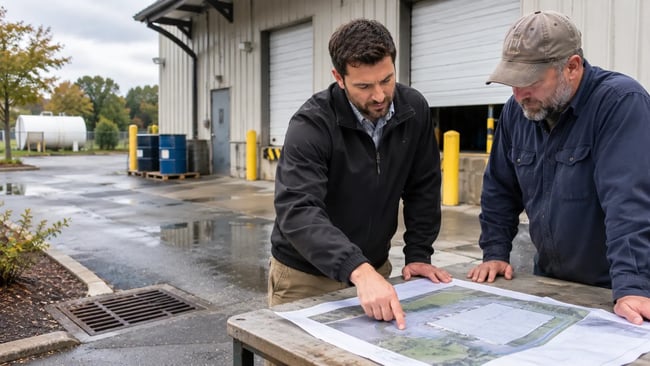
Best management practices are the controls and habits that keep your materials and rain apart. For the 5G2, the strongest move is also the simplest: take the material out of the rain. Put it indoors, under a permanent roof, or in closed containers, and it stops being a stormwater problem. When you can't move something, add controls around it, like covers, berms, containment pads, and drain protection, along with routine practices such as sweeping, prompt spill cleanup, and preventive maintenance.
A plan holds up or doesn't based on how the BMPs are written. "Keep the loading area clean" is a wish. "Sweep the loading apron every Friday and log it, and keep a spill kit within reach of the dock" is something an employee can do and an inspector can verify. Where a BMP isn't in place yet, the plan should say what you'll do and by when. Spill response should also connect to your other plans, so if you have an SPCC plan for oil storage, reference it. Our posts on 5G2 best management practices and the difference between an SPCC plan and a SWPPP go deeper.
Step 5: What Inspection and Training Routines Does a SWPPP Need?
A plan that sits in a drawer doesn't protect anything, so the SWPPP sets up routines that keep it alive. For the 5G2, that means a monthly walk of the areas exposed to rain and snowmelt, a more thorough annual inspection that checks whether the plan is current and the BMPs work, and annual training so employees know the practices for their jobs. Each leaves a paper trail: dated notes on what was found and fixed, documented problems and corrective steps from the annual inspection, and training records showing the date, topic, attendees, and trainer.
Build these routines around how your site runs. Our guide to doing a stormwater visual inspection the right way shows what to look for, and our online training library is one option for the training side. The 5G2 itself doesn't require stormwater sampling, which keeps this step lighter than it is under some industry permits.
Step 6: How Do You Document and Certify Your SWPPP?
Now you assemble the plan. A clean order follows NJDEP's forms: the team, the inventory and narrative, the site map, the BMPs with their schedules, the maintenance plan, the inspection schedule, references to related plans like your SPCC plan, and the training records. The plan gets signed and dated, kept at the facility, and amended when something changes, like a new process, a moved storage area, or a new building.
Then comes the part with consequences. NJDEP wants a certification form saying the plan was prepared and implemented, and later that the annual inspection took place. The due date follows the calendar quarter on your authorization, and you're certifying under penalty of law, so the statement has to be true the day you sign. Permit violations can bring notices of violation and daily penalties under the Water Pollution Control Act. Our posts on the 5G2 annual certification and on checking your own SWPPP for compliance problems are good companions.
How Do Industry-Specific NJPDES Permits Change the SWPPP?
Everything above is the foundation, but an industry-specific general permit asks the plan to do more. New Jersey has separate permits for concrete products manufacturing, hot mix asphalt, mining and quarrying, sand and gravel, scrap metal, vehicle recycling, and wood waste recycling and leaf composting. Each adds elements tailored to that industry, such as BMPs for truck washout or aggregate piles, rules for process water, and often sampling, monitoring, and reporting. What applies to you depends on the permit category and its current terms, so the permit document is the authority.
In practice, the plan has to reflect the activities that moved you off the 5G2 in the first place. A concrete plant's plan deals with washout and high pH water, and a quarry's deals with dewatering and sediment. Where a permit requires sampling, the plan also says who collects samples, how, and what happens with the results. We don't take samples ourselves, since storm windows make that impractical and your own people know your site best, but we train facility staff to sample correctly. If you're not sure which permit fits, our post on which New Jersey permit fits a concrete, asphalt, or quarry operation will help.
Why Is a First SWPPP Easy to Get Wrong, and When Should You Hire an Expert?
Plenty of simple sites can write their own plan. If you have a small facility, few materials, most of them already indoors, and someone with the time to learn the permit, our post on writing your own SWPPP without hiring a consultant gives you a fair look at what that involves.
But a first SWPPP is hard to judge from the inside, and the mistakes are quiet ones. The plan was written for the wrong permit. The site map doesn't match the yard. The inventory skipped the dumpster that's the real problem. A template was copied and never fit. Training happened but nobody recorded it. None of this looks like trouble until an inspector reads the plan against your site, or until you sign a certification that turns out to be wrong. Since you're certifying under penalty of law, we'd rather you not find out that way. The table below shows where we'd lean toward getting help.
| Your situation |
Writing it yourself |
Why |
| Small site, 5G2, most materials indoors |
Often reasonable |
Short inventory, simple map, few BMPs to manage |
| Not sure which permit applies |
Risky |
A well-written plan for the wrong permit still fails |
| Industry-specific permit (concrete, asphalt, mining, scrap) |
Harder than it looks |
Added plan elements, process water, and possible sampling |
| Large or complicated site with many activities |
Time-consuming |
Drainage and inventory get hard to track and verify |
For facilities still being built or expanded, construction-phase approvals like construction stormwater coverage and soil erosion and sediment control certification are separate from the plan in this guide, and RMA doesn't prepare them. Your engineer, contractor, or soil erosion specialist handles that piece, and we can point you toward the right people. What we help with is what comes after: the right industrial permit or no exposure exclusion, the SWPPP, inspections, and annual certification once the facility is running.
What Does It Cost to Have a New Jersey SWPPP Written?
It depends on the site. The biggest drivers are which permit covers you, how many materials and activities are outdoors, how large and complicated the property is, and whether you're updating a plan or starting from nothing. We're not the cheapest consultant, because senior staff do the work, and we don't try to be. We're usually a little less expensive than an environmental engineering firm, since engineering is its own specialty, though real engineering work, like a treatment system design, is priced as engineering. The pricing calculator below gives a first look at what a plan or ongoing support might run for your site, and our post on what 5G2 coverage costs to get and maintain covers the agency side.
How Does RMA Help With Your First New Jersey SWPPP?
We're a family-run firm based in New Jersey, and we know NJDEP and the state's permit categories well. For a first plan, we confirm which permit you're on, walk your site with you, build the plan with senior staff, and train your team so the routines keep running after we leave. We don't use AI to write client deliverables. After you're permitted, we offer annual support, hands-off or hands-on, including reminders, inspection prep, and plan updates.
If you're not sure whether you need us, that's a fine question to ask. You can call, email, or fill out the form on our website, with no obligation, and we'll tell you plainly if a simpler route makes sense. Whenever you're ready, contact RMA and we'll talk through where you stand.