How SPCC, Facility Response Plans, Pennsylvania SPRPs, Tank Inspections, and Coast Guard Rules Stack Up at Southeast Pennsylvania Terminals
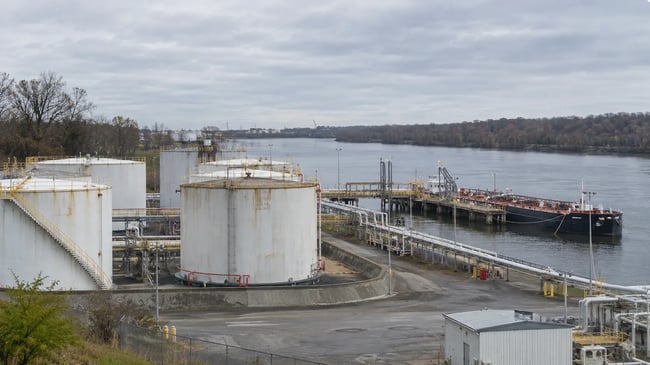
A large oil terminal doesn't answer to one agency. It answers to four or five, and each one looks at a different slice of the same facility: the tanks, the piping, the dock, and the plan for what happens if oil gets out. The federal oil spill prevention rule is called SPCC, short for Spill Prevention, Control, and Countermeasure, and it's the starting point. On top of it, a terminal may need a federal response plan, a Pennsylvania spill plan filed with DEP, certified inspections of its large tanks, and Coast Guard compliance for ship and barge transfers. Terminals in Philadelphia and the Delaware County river towns, from Marcus Hook and Trainer to Chester and Eddystone, often sit in several of those layers at once.
This article explains each layer in general terms, how they fit together, and where they overlap. Which layers apply to a specific terminal depends on its storage capacity, whether it moves oil over water, what's near it, and how the site is laid out, so treat this as a map and not a verdict. If you'd like help figuring out which layers your terminal sits in, you can reach out to RMA and we'll walk through it with you.
Table of Contents
TL;DR
A petroleum terminal on the Delaware River typically sits under five layers: a PE-certified federal SPCC Plan from EPA Region 3, a federal Facility Response Plan if it meets the substantial harm criteria, a Pennsylvania SPRP filed with DEP once tank capacity goes past 21,000 gallons, certified inspections of large tanks under DEP's storage tank rules, and Coast Guard requirements for the dock and transfer side. The layers overlap, so the tank list, the containment figures, and the worst-case discharge numbers need to agree across every plan. Which layers apply depends on your capacity, whether you move oil over water, and how your site is laid out.
Which Oil Storage Rules Apply to a Delaware River Terminal?
Large terminals often hold millions of gallons and move product by ship, barge, pipeline, rail, and truck. Each of those activities pulls in a different set of rules, which is why more than one layer usually applies. The table below shows the five layers side by side. The sections after it take them one at a time.
| Layer |
Who runs it |
What it asks for |
When it applies |
| SPCC Plan |
EPA Region 3 (40 CFR Part 112) |
A PE-certified plan covering containment, inspections, testing, and training |
Over 1,320 gallons of aboveground oil storage, counting containers of 55 gallons or more |
| Facility Response Plan (FRP) |
EPA Region 3 |
A detailed response plan built around a worst-case discharge, with drills and training |
Substantial harm criteria, or written notice from EPA |
| Spill Prevention Response Plan (SPRP) |
PA DEP storage tank program |
A state spill plan filed with DEP and revised as the facility changes |
Large aboveground tanks or tank facilities, over 21,000 gallons |
| Large-tank inspections |
PA DEP (25 Pa. Code Chapter 245) |
Inspections by DEP-certified inspectors |
Field-constructed tanks and aboveground tank systems over 21,000 gallons |
| Marine transfer rules |
U.S. Coast Guard (33 CFR Part 154) |
Transfer procedures and a Coast Guard response plan for the marine side |
Docks and piers that move oil to or from vessels |
The question of who enforces what trips up a lot of facilities, and who enforces oil spill plans in Pennsylvania covers the split between EPA and DEP in more detail.
Layer 1: What Does the Federal SPCC Plan Require of a Large Terminal?
An SPCC Plan is the federal oil spill prevention plan. It covers how a facility stores oil, how it keeps oil from reaching water, and how it responds if a spill gets past those defenses. Any facility with more than 1,320 gallons of aboveground oil storage, counting only containers of 55 gallons or more, needs one, and a terminal is far past that line. EPA Region 3 enforces the rule in Pennsylvania.
Size changes how the plan gets built. The self-certified plan types are for smaller facilities, and a facility loses Tier II qualified status once its aggregate aboveground capacity goes over 10,000 gallons. A terminal needs a full plan under 40 CFR 112.7 certified by a professional engineer under 112.3(d). Our posts on Tier I, Tier II, and PE-certified plans and what the PE does when certifying a plan explain what that involves.
The core requirements are the same ones smaller facilities face, just multiplied across a larger site. Containment around bulk storage has to hold the entire capacity of the largest single container plus freeboard for rainfall, which at a terminal means evaluating many dikes, loading racks, and piping runs. Every aboveground container has to be tested or inspected for integrity on a regular schedule under industry standards, with records kept. The plan needs a documented review at least every five years, and an amendment within six months of a change that materially affects discharge potential, like adding a tank or changing piping. We cover the details in how to evaluate secondary containment and the five-year SPCC review rule.
Layer 2: When Does a Terminal Need an EPA Facility Response Plan?
If the SPCC Plan is mostly about prevention, a Facility Response Plan, or FRP, is about response: how fast you can get equipment on the water, who's in charge, and what you'll do in a worst-case discharge. Under 40 CFR 112.20, a facility has to prepare and submit an FRP to the EPA Regional Administrator if it could reasonably be expected to cause substantial harm by discharging oil into navigable waters or onto adjoining shorelines.
The substantial harm criteria have two paths. The first is an over-water transfer: a facility that transfers oil over water to or from vessels and has total oil storage capacity of at least 42,000 gallons meets the criteria. That one describes a lot of Delaware River terminals with docks. The second is storage-based: total capacity of at least 1 million gallons plus at least one of four conditions. Those are aboveground storage areas that lack secondary containment sized for the largest tank in each area plus freeboard, a discharge that could injure fish, wildlife, or sensitive environments, a discharge that would shut down a public drinking water intake, or a reportable discharge of at least 10,000 gallons within the last five years. The environmental and drinking water tests use distance calculations from the rule's appendices, and the Delaware carries both habitat and water intakes, so those calculations deserve a careful look. EPA can also require an FRP by written notice even when a facility doesn't meet the criteria on paper.
An FRP also brings drills, exercises, and training with logs that show they happened. Facility response plans: when Pennsylvania oil storage goes beyond SPCC explains how the line between the two plans works.
Layer 3: What Is a Pennsylvania SPRP and Who Has to File One?
Pennsylvania runs its own tank program on top of the federal rules. It comes from the Storage Tank and Spill Prevention Act and 25 Pa. Code Chapter 245, and DEP's Southeast Region office in Norristown covers the Delaware River counties. The Act passed in 1989, a year after the 1988 Floreffe tank collapse put Pennsylvania's tank safety under a spotlight, and our post on the 1988 Floreffe spill tells that story.
The state's spill plan is the Spill Prevention Response Plan, or SPRP. It's required for large aboveground storage tanks and large aboveground tank facilities, meaning a single tank over 21,000 gallons or a facility whose regulated aboveground capacity adds up past that. Facilities at or below 21,000 gallons are outside the SPRP chapter of the Act. The required elements look a lot like SPCC, which is why the two plans are often written side by side. The SPRP gets filed with DEP, and the owner has to submit a revised plan or addendum when the facility changes in ways the Act and regulations cover. Tank registration sits beside it, and whether a given tank has to be registered depends on its size, type, and use, so confirm each one against DEP's storage tank program. The difference between SPCC, PPC, and SPRP plans sorts out the alphabet, and whether one document can cover all three explains when combining them works.
Chapter 245 also has release reporting rules, and facilities with aggregate aboveground capacity over 21,000 gallons have immediate notification duties to county emergency officials on top of the federal reporting that applies to spills reaching water.
Layer 4: What Do Pennsylvania's Large-Tank Inspection Rules Require?
Federal SPCC integrity testing and Pennsylvania's tank inspection rules overlap, but they're separate obligations. Under 25 Pa. Code 245.21, tank handling activities on field-constructed aboveground tank systems, and on aboveground systems over 21,000 gallons, have to be inspected by a DEP-certified inspector, and the operation of a storage tank facility is subject to inspection by a certified inspector as well. Most large terminal tanks are field-erected, so they land squarely in this group.
Certified inspectors fall into categories, with field-constructed and manufactured tanks both covered by the IAF category, which requires API 653 certification. DEP's rules also say a certified inspector can't be an employee of the tank owner. In-service inspections follow nationally recognized guidance like API 653 and API 570, and out-of-service inspections are set by the tank's calculated service life or half of its corrosion rate life, with a maximum of 20 years between them. The inspection report stays at the facility until the next out-of-service inspection is complete.
A well-run inspection program can serve both the federal and state sides, since API 653 shows up in each, but the records have to satisfy each agency's requirements. We go through the standards in API 653 inspections for large tanks, DEP-certified tank inspectors, and integrity testing for bulk oil containers.
Layer 5: Where Does Coast Guard Jurisdiction Start for Marine Transfers?
EPA and the Department of Transportation split oil facility oversight under a long-standing agreement. Non-transportation-related facilities fall to EPA, and transportation-related facilities, including marine transportation-related facilities, fall to DOT, with the Coast Guard handling the marine side. The definitions are in Appendix A to 40 CFR Part 112. For a Delaware River terminal, that usually means the tank farm sits on the EPA side, while the pier, hoses, and connections that move oil to and from ships and barges sit on the Coast Guard side.
The Coast Guard's rules are in 33 CFR Part 154. They cover transfer operations, including operations manuals and transfer procedures, and Subpart F requires certain marine transportation-related facilities to prepare a response plan and submit it to the local Coast Guard Captain of the Port. The Coast Guard plan and the EPA plan have to line up. Where the facility also has a non-transportation-related side, the Coast Guard plan has to use the same worst-case discharge volume that appears in the EPA response plan for that side.
Exactly where the line falls depends on the layout of the terminal and how the dock connects to the tanks. Terminals that have worked with both agencies for years still sometimes have to confirm the boundary for a new piece of equipment. When it isn't clear, ask the agencies, and consider involving an environmental attorney if the answer carries real cost either way.
Where Do the Terminal Oil Storage Layers Overlap?
The layers use the same facts, and they have to agree with each other. The tank list, the capacities, the containment figures, and the worst-case discharge volume show up in the SPCC Plan, the FRP, the SPRP, and the Coast Guard plan. When one plan says a dike holds one number and another says something different, an inspector from either agency has a finding without even leaving the office. The most useful habit at a terminal is keeping one master inventory and one set of containment calculations that every plan draws from, then updating all of them whenever something changes. A new tank, a rerouted line, or a changed product can trigger an SPCC amendment, an SPRP revision, an FRP update, and a change to the Coast Guard plan at once.
A few boundaries need care. Federal pipeline rules sit with the Department of Transportation, and Pennsylvania's tank program has its own boundaries around pipelines and certain wastewater facilities, so check where your piping and treatment units fall before assuming a rule applies or doesn't. Local fire code for tanks is enforced by the municipality and varies from place to place. Air permits for tanks, vapor controls, and generators run through separate programs, and Philadelphia runs its own air program, so confirm requirements with the local authority. Those sit outside the oil storage layers described here, but a terminal needs all of them.
What About Building or Expanding a Terminal?
New tanks bring construction-phase requirements. In Pennsylvania, a site-specific installation permit application for large aboveground tanks has to include the location of the proposed tanks and an SPRP that covers them, and the tank installation itself has to be done by DEP-certified installers. Building permits and local fire approvals apply as well. We don't prepare construction-phase permits or approvals, and we don't install tanks, so for that piece you'll work with your engineer, your contractor, and DEP's certified installers. We can help you figure out what the construction phase needs and point you toward the right people.
Once the new tank is running, the operational layers all show up. A facility that begins operating has to have its SPCC Plan prepared and implemented before it starts, and an existing facility has to amend its plan when a change materially affects discharge potential. An FRP facility has to update its plan before a planned change begins operating. DEP tank registration, the SPRP, inspections, and training follow. That's the part of the process we help with, and expanding a Pennsylvania facility walks through how new storage changes an SPCC Plan.
How Can RMA Help With Terminal Oil Storage Compliance?
Our work at a terminal starts with mapping the layers. We look at your capacities, how you move product, what's near the site, and what plans and registrations you already hold, then tell you which layers apply and where your documents disagree with each other. We prepare SPCC Plans, bring in an outside professional engineer for certification, and help with the Pennsylvania plans that sit beside them. Where a layer falls outside what we do, like the dock-side Coast Guard work or construction permits, we'll say so and point you to the right people. We're a family-run firm, and the people who scope your job are the people who do it.
If you'd like to talk it through, you can call us, email us, or fill out the form on our website, with no pressure and no obligation. Whether you're sorting out a plan stack or training your people, contact RMA and we'll take it from there. Our online training library is also there for your staff.