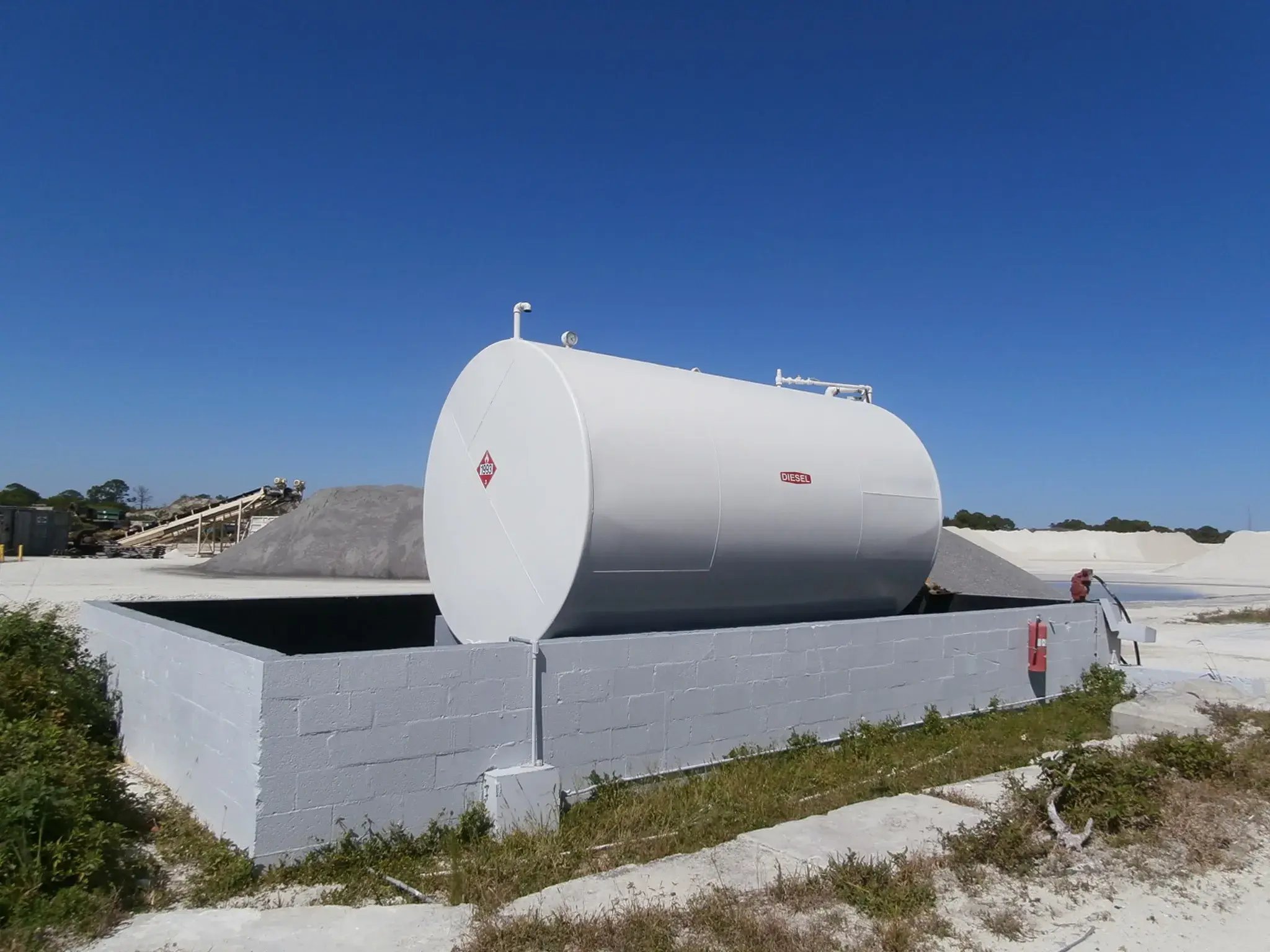
Pennsylvania Facilities Can Own Most Recurring SPCC Work Themselves. Here's What to Keep In-House, What Needs Outside Help, and What It Costs
If your Pennsylvania facility stores enough oil to need an SPCC Plan, the federal oil spill prevention plan EPA requires once aboveground oil storage passes 1,320 gallons (counting only containers of 55 gallons or more), you'll eventually ask whether you really need to pay a consultant to keep it going. And if you're not sure you have one yet, the question comes down to the same thing: how much of this can your own people run, and how much needs a specialist? The plan itself is a one-time project, but the work around it never stops. Somebody has to walk the tanks, sign the inspection records, log the rainwater drained out of containment, train the people who handle oil, and notice when a change on site means the plan needs to change too.
Most of that recurring work is well within reach of a trained facility team, and a handful of tasks really do call for a professional engineer or a qualified tank inspector. This article sorts the two lists, compares the cost and risk of each approach, and covers a third option for facilities that would rather not own the ongoing work at all. We'd rather teach you to handle the routine pieces than bill you for them every year, and if you decide you'd like help anyway, you can reach out to RMA and we'll talk through what makes sense.
Table of Contents
TL;DR
Most recurring SPCC work can be owned by your own team after some training: monthly inspections, annual training and briefings, record keeping, containment drainage logs, and the five-year review. Outside help usually makes sense for PE certification, tank integrity testing, and technical amendments after physical changes. A trained team costs staff time but keeps outside spending to the jobs that need it, while paying a consultant for everything every year costs more and often leaves nobody on site who knows the plan. If you don't want the ongoing work at all, you can hire a full-time person or outsource it completely.
Which SPCC Tasks Can Your Pennsylvania Team Handle Itself?
The SPCC rule puts the legal responsibility on the owner or operator of the facility, not on whoever wrote the plan. A plan is a set of commitments, and the commitments that repeat every month or every year are carried out by people standing on your site. A consultant visiting once a year can't walk your tanks every month, and nobody outside your building knows when a drum got moved or a new tote showed up. That's why the recurring work belongs with your team in most cases, and why we like to train it in rather than keep it.
If you already have an SPCC Plan, it spells out your inspection schedule, your training commitments, and your procedures. If you don't have one and a new tank or generator pushes you over the threshold, you'll need to get a plan first, and then the same division of labor applies. Here's how the work usually splits.
| SPCC Task |
Who Usually Owns It |
Why |
| Routine tank and containment inspections |
Your team |
Frequent, on-site, and follows written procedures your plan already contains |
| Containment drainage logs |
Your team |
Only someone present can inspect the water and record each drainage event |
| Oil-handler training and annual briefings |
Your team, with training material to start |
Needs to cover your own equipment, procedures, and past incidents |
| Record keeping and plan upkeep |
Your team |
Records sit with the plan and change whenever the site changes |
| Five-year plan review |
Your team, often with a second set of eyes |
A documented review and signed statement, no engineer required for the statement itself |
| PE certification of a plan |
Outside help |
Only a licensed professional engineer can certify |
| Tank integrity testing |
Outside help |
Calls for qualified inspectors, specific methods, and sometimes equipment |
| Technical amendments after physical changes |
Usually outside help |
Often needs engineering judgment, and PE-certified plans need PE sign-off on technical changes |
How Do You Run SPCC Inspections, Training, and Records In-House?
Start with inspections. The federal rule requires that inspections and tests follow written procedures, that each one is recorded and signed by the appropriate supervisor or inspector, and that the procedures and records are kept with the plan for three years. The rule doesn't set a frequency in the text, so your plan does. Monthly walk-throughs are the common commitment, and they're a good fit for a trained operator because the job is looking for what changed: staining, seeps at seams and valves, damaged gauges, corrosion on supports, oil sitting in a containment area, and a spill kit that's been raided. Our monthly SPCC inspection checklist for Pennsylvania facilities walks through what to look at, and the written inspection procedures in your plan are the standard you're held to, so inspectors should know them cold. If your plan's procedures are thin, you can develop your own inspection and spill response procedures without outside help.
Containment drainage is the log people forget. Where you have a diked area or other containment and you let rainwater out of it, the rule expects the bypass valve to stay sealed closed, the retained water to be inspected before it's released to make sure it won't cause a discharge, the valve to be opened and resealed under responsible supervision, and each drainage event to be recorded. A simple sheet with the date, who looked at the water, what they saw, and who sealed the valve covers it, and it's the record an inspector can ask for whenever containment is involved.
Training and records round out the routine. Oil-handling personnel need training on how the equipment works and is maintained, how to respond to a discharge, applicable pollution laws, general facility operations, and what's in the plan. Your plan also needs a designated person accountable for discharge prevention, and the rule calls for discharge prevention briefings at least once a year covering any past discharges, failed components, and new precautions. Our guides on what SPCC training should include and a ready-to-use annual briefing agenda cover the content, and our online training library is there if you'd like structured courses for new hires. The Pennsylvania SPCC compliance calendar helps lay the whole year out so nothing gets lost between busy seasons.
The five-year review is the other task your team can own. The rule requires you to review the plan at least every five years, document it, and sign a statement saying whether you'll amend it. That statement doesn't need an engineer's seal. What it does need is somebody who'll walk the site with the plan in hand and compare the two, which is easier for a person who's there every week. We cover the mechanics in our post on the five-year SPCC review rule.
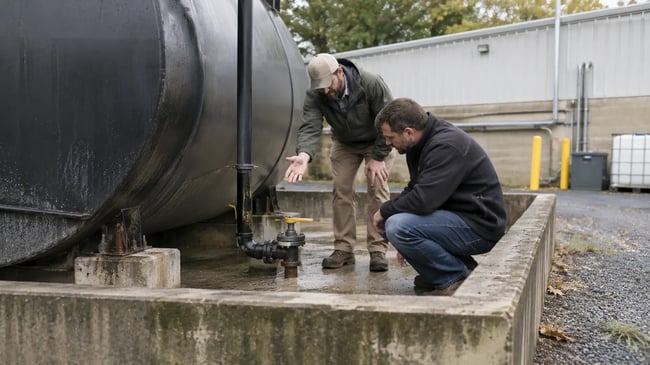
Which SPCC Tasks Usually Need Outside Help in Pennsylvania?
PE certification is the clearest one. A licensed professional engineer has to review and certify a full SPCC Plan, and by certifying, the engineer attests that they or their agent visited and examined the facility, that the plan follows good engineering practice, and that inspection and testing procedures are established. Smaller facilities may be able to self-certify. A Tier I qualified facility, one with no more than 10,000 gallons aboveground, no single container over 5,000 gallons, and a clean recent discharge history, can use EPA's template and certify its own plan. A Tier II qualified facility can self-certify too, but if the plan relies on environmental equivalence or on a determination that secondary containment isn't practicable, those pieces still need an engineer. Our post on whether you can self-certify in Pennsylvania helps you sort out where you land, and what the PE does during certification explains the engineer's role. RMA doesn't have a professional engineer on staff. When a plan needs certification, we work with an outside engineer, and our staff typically does the site visit and develops the plan before the engineer reviews, stamps, and seals it. That review is paid for separately and adds time, which is part of why PE-certified plans cost more.
Integrity testing is the second. The rule requires aboveground bulk containers to be tested or inspected on a regular schedule and after material repairs, using industry standards to set the frequency, the methods, and the qualifications of the people doing it. Visual checks, ultrasonic testing, and other methods can all qualify depending on the tank. Your team can do the frequent exterior checks, but the formal testing usually goes to a qualified inspector working to a standard such as STI SP001 or API 653. Depending on the tank, Pennsylvania's storage tank program may add its own requirements, including DEP-certified inspectors for certain tanks. Our posts on integrity testing for bulk oil containers and DEP-certified tank inspectors help you figure out which applies to your tanks.
Technical amendments are the third. When a change to your design, construction, operation, or maintenance materially affects discharge potential, such as installing, moving, or removing a container, rerouting piping, altering containment, or switching products, you have to amend the plan within six months and put the change in place within six months after that. Technical amendments to a PE-certified plan need the engineer's certification. Self-certified plans handle this differently, but a facility that crosses 10,000 gallons has to move to a full PE-certified plan within six months. Your team should still do the legwork by tracking changes as they happen and calling for help early, since a change nobody mentioned until the five-year review is how plans end up out of date.
How Do In-House and Consultant SPCC Costs Compare?
Start with what we know. RMA's Tier I SPCC plans run about $1,500 to $4,000, and our overall range for SPCC plans, from simple to complex and PE-certified, is about $1,500 to $15,000. Initial SPCC training comes free with a new RMA plan, so the training that sets your team up to run the routine work doesn't add a line item. If another firm wrote your current plan, we typically don't update it and instead rebuild it from scratch, which is worth knowing before you budget for taking over a plan someone else built. For your own estimate, the pricing calculator below gives a number for the plan itself.
| Approach |
What You Pay For |
What Pushes the Cost Up |
| Train your team, buy outside help as needed |
Staff time for inspections, records, and briefings, plus outside work for PE certification, integrity testing, and technical amendments |
Turnover, many tanks, large or complex containers, frequent site changes |
| Consultant handles everything every year |
Consultant time for routine work your team could do, plus the same outside specialists |
Visit frequency, number of facilities, how much documentation the consultant produces |
| Hire someone full time or outsource the whole program |
A salary and benefits, or an annual program fee, with outside specialists still needed for PE work and testing |
Number of sites and how many other environmental programs the person or firm covers |
We don't publish a single price for integrity testing or engineering work because it depends on tank size, type, number of containers, and who's doing the work, so we'd rather say that than hand you a number that doesn't fit your site. The in-house approach isn't free. You're paying in staff hours, and those hours cost more when people leave and someone new has to learn the plan from scratch. We wrote about that problem in keeping a plan alive after the person who wrote it leaves. Even so, paying a consultant to do the monthly walk-through and sign the records is usually the most expensive way to get work done that your own people can do with a little training and a sign-off each month.
What Are the Compliance Risks of Each SPCC Approach?
Each approach fails in its own way. When a team runs things itself, the usual failures are quiet ones: inspection records with gaps, a drainage log that was never started, training that lapsed when the person who ran it moved on, or a new tank that went in without anyone thinking about the plan. Any of those turns up fast when EPA Region 3, the office that enforces SPCC in Pennsylvania, comes to look. We walk through what to expect in what happens during an EPA SPCC inspection, and how EPA Region 3 calculates penalties shows why paperwork gaps cost real money. A self-certified plan can also be wrong in ways that matter, such as a facility that doesn't qualify for self-certification or a containment evaluation that doesn't hold up.
Paying a consultant for everything has different problems. The plan can end up living in the consultant's files rather than your building, and the people who handle oil never learn what it says. Training becomes a once-a-year slide deck, inspections become somebody else's job, and when the consultant isn't there on the day a hose fails, no one on site knows the response procedure. Signing records you didn't witness isn't any better. A cheap consultant makes all of this worse, since the lowest price usually buys a template with your name on it and no site visit. The rule says certification doesn't relieve you of the duty to fully carry out the plan, so a stamped plan nobody follows is still a violation waiting to be found.
The sensible middle is a team that does the routine work, with outside help brought in on a schedule for the tasks that need it. That setup keeps your costs tied to the work and puts knowledge in the building where spills happen.
What If You Don't Want to Handle Ongoing SPCC Compliance at All?
That's a legitimate choice, not a failure. Plenty of facilities have no one with spare hours, and some would rather hand the whole job to somebody whose full-time role is environmental compliance. There are two common ways to do it. You can hire a person, either a dedicated environmental, health, and safety employee or a maintenance lead whose job description explicitly includes SPCC. That makes the most sense when you run several sites or have other environmental programs competing for the same person's time, and our post on managing SPCC plans across multiple Pennsylvania facilities covers how that plays out.
The other route is to outsource the ongoing work completely. RMA's full environmental programs work as an outsourced environmental department, typically $20,000 to $60,000 a year, and they cover the whole compliance picture, not only SPCC. That's a better fit when your facility has stormwater, Tier II, waste, and oil rules all in play and you'd like one team handling the calendar for all of it. We'll tell you if that's more than you need.
Either way, remember that the legal responsibility stays with the facility. Your plan will still name someone accountable for discharge prevention, and your staff will still be the first people at a leak. Hiring or outsourcing moves the paperwork and the scheduling, so choose someone who'll visit the site and teach your operators the basics rather than disappear after the plan is delivered.
How Does RMA Help Pennsylvania Facilities Take Over SPCC Compliance?
We're a family-run firm, and the people who do the work are senior staff, not a handoff to someone junior. For facilities that want to run SPCC themselves, we build the plan, train your team on it, and show you which tasks to keep in-house and which to schedule with outside specialists. When a plan needs a PE, we bring in an outside engineer. If your plan came from another firm, we'll look at it and tell you straight whether it can be used as it is, which in many cases means rebuilding it. If you'd rather hand off the ongoing work, we'll talk through that too, and if you don't need us, we'll say so.
There's no pressure and no obligation. You can call, email, or fill out the form on our website, and we'll go through your oil storage, what you can realistically handle in-house, and where an outside hand makes sense. Whenever you're ready, contact RMA. For a broader overview of the rule itself, our guide to everything you need to know about SPCC plans is a good place to start.