A Checklist for Comparing SPCC Proposals: Site Visit, Containment Calculations, PE Certification, and Price
Anyone who stores enough oil may be handed a proposal for an SPCC Plan, and the proposals differ widely in what they cover. Some describe a real scope of work with a site visit and engineering behind it. Others are a short page that says "SPCC Plan, one price" and leaves you guessing about what you'll receive. If you're a facility manager in Pennsylvania trying to compare them, it helps to know what a solid proposal contains.
Below we walk through each element of a good Pennsylvania SPCC proposal: the site visit, the container inventory and capacity check, the facility diagram, the containment evaluation, integrity testing, plan preparation and PE certification, coordination with Pennsylvania tank and PPC requirements, deliverables, schedule, and price. If you want a second set of eyes on a proposal you already have, you can reach out to RMA at any point.
Table of Contents
TL;DR
A solid Pennsylvania SPCC Plan proposal names who visits your site, explains how your oil containers get counted and verified, includes a facility diagram and shown containment calculations, addresses integrity testing, says whether the plan is self-certified or PE-certified and who pays for that review, and covers how it fits with DEP tank registration and PPC requirements. It should also list every deliverable, the schedule, and a price that says what's included. If any of those are missing, ask before you sign.
What Should a Pennsylvania SPCC Plan Proposal Include?
A good proposal for an SPCC Plan reads like a scope of work, not a price tag. It tells you what the firm will do at your site, what you'll get when it's done, who's responsible for each step, and what it costs. If you can't tell from the proposal whether someone will walk your facility, check your tank sizes, and run the containment math, you're probably looking at a template with your company name dropped in.
The table below is the checklist we'd hold any proposal against, ours included. Each element gets its own section after this, with what a solid version looks like and where proposals tend to go thin.
| Proposal element |
What it should spell out |
| Site visit |
Who goes, what they'll look at, and what you need to have ready |
| Container inventory and capacity verification |
How containers, drums, totes, and oil-filled equipment get counted and how capacity is confirmed |
| Facility diagram |
What the diagram shows and who draws it |
| Containment evaluation and calculations |
Whether the calculations are included and shown, not just summarized |
| Integrity testing recommendations |
Which inspection standards apply and who does the testing itself |
| Plan preparation and certification |
Self-certified or PE-certified, and who covers the engineer's review |
| Pennsylvania tank and PPC coordination |
What's checked against DEP's tank program and the PPC Plan, and what isn't |
| Deliverables |
Exactly what documents, forms, and training you receive |
| Schedule |
The steps, who controls each one, and what can slow things down |
| Price |
A clear total, what's included, and what's billed separately |
If your facility stores enough oil to need an SPCC Plan, a federal oil spill prevention plan under 40 CFR Part 112, the proposal should also say what the firm believes your plan type will be and why. That one sentence tells you whether they've looked at your site or just at your industry.
What Should the Site Visit Look Like in an SPCC Proposal?
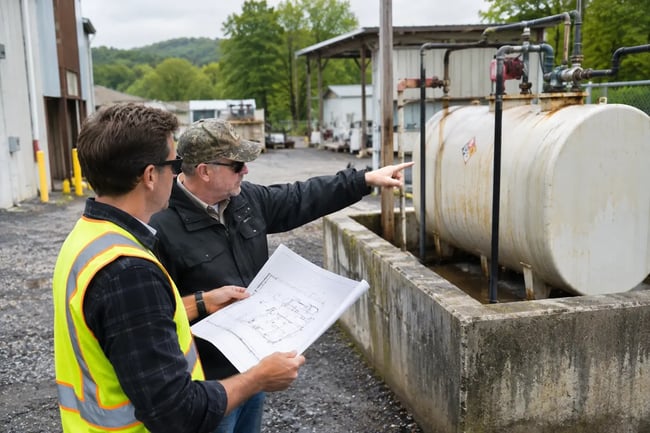
The site visit is where a plan either gets built on facts or on guesses. A proposal should say who's coming, roughly how long they'll be on site, and what they'll walk through: every oil container, the loading and unloading areas, the containment structures, the drains and low spots, and the path oil would take if it got loose. It should also list what you need to have ready, such as an existing plan, tank registration paperwork, past inspection records, and any spill history.
The federal rule has its own expectation here. For a plan that needs a Professional Engineer (PE) certification, the PE or an agent of the PE has to visit and examine the facility before certifying it. Qualified facilities that self-certify under the Tier I option don't carry that same requirement, but the visit still matters, because you can't evaluate containment you haven't seen. If a proposal skips the visit entirely, ask how the firm plans to verify what's on your site. Some facilities are a good fit for remote development, and we've written about how remote SPCC development works, but that's a deliberate choice with its own process, not a shortcut around looking at your tanks.
The visit should also have a defined end. Ask whether follow-up questions and a second look at anything unclear are covered, or whether each extra trip is billed.
How Should a Proposal Handle Container Inventory and Capacity Verification?
The whole plan hangs on the inventory. Federal SPCC rules apply when your aboveground oil storage capacity is over 1,320 gallons, counting only containers of 55 gallons or more, or when buried capacity is over 42,000 gallons. It's capacity that counts, not what's in the tank on the day someone visits, so an empty 5,000-gallon tank counts and a permanently closed one doesn't. Oil-filled equipment counts too, and so do animal fats and vegetable oils. A proposal that says "we'll inventory your tanks" without saying how is leaving the hardest part vague.
Look for three things. First, the proposal should say how capacity gets confirmed, whether from nameplates, manufacturer documents, or measurements, since the number on a tank is sometimes wrong or missing. Second, it should say whether drums, totes, generator tanks, transformers, and mobile or portable containers are in scope. Third, it should say what happens if the count lands near the 1,320-gallon line, because that's where people get surprised. Our guide on how to inventory oil tanks, drums, and equipment walks through the counting rules in detail, and our post on whether your Pennsylvania facility needs an SPCC Plan covers the question that comes before the proposal.
Does the Proposal Cover the Facility Diagram and Containment Evaluation?
The facility diagram is a required piece of the plan, and it should be listed as a deliverable, not folded into a vague "documentation" line. A solid diagram shows where each container sits, its capacity and contents, the loading and unloading areas, drains, containment structures, and the direction oil would flow. It should also show nearby storm drains and surface water, because the point of an SPCC Plan is to keep oil out of waterways. We've covered how the diagram gets built in how to draw an SPCC facility diagram.
The containment evaluation is where proposals separate. For bulk storage containers, the general rule is that containment has to hold the capacity of the largest single container plus enough freeboard for precipitation. That takes real math: dike dimensions, the space taken up by other tanks or equipment sitting inside it, and the rain allowance. Ask whether the calculations come with the plan or only a conclusion that containment is "adequate." Also ask what happens if your containment falls short. A good firm tells you what the gap is and what the options are, whether that's a bigger dike, a different container, or an alternative the rule allows. Fixing containment is outside what the plan itself delivers, so the proposal should be clear about that line. Our post on how to evaluate secondary containment shows what the evaluation involves.
What Should an SPCC Proposal Say About Integrity Testing?
The SPCC rule requires regular inspections and integrity testing of aboveground containers, based on recognized industry standards. The plan has to describe the inspection and testing program, and your team has to follow it. A proposal should tell you whether the firm is recommending a testing program as part of the plan, and whether it's also doing any of the testing, because those are two different jobs with two different price tags.
For many smaller shop-built tanks, the standard that comes up is STI SP001, and for large field-erected tanks it's API 653. We explain each in our posts on STI SP001 inspections and API 653 inspections. Pennsylvania adds a layer, because DEP's storage tank program has its own inspection and certification rules for larger aboveground tanks, and some work has to be done by DEP-certified individuals. Whether that applies to a given tank depends on its size, type, and registration status, which is why the proposal should flag it for your tanks specifically. Our guide to DEP-certified tank inspectors covers when that comes into play, and integrity testing for bulk oil containers covers the testing itself.
How Should a Proposal Explain Plan Preparation and PE Certification?
There are three possible paths for a plan: a self-certified Tier I plan built on EPA's template, a self-certified Tier II plan, or a full plan certified by a licensed Professional Engineer. Which one applies depends mainly on your total aboveground oil storage and your spill history, and the rules for qualifying are in 40 CFR 112. A proposal should name the path the firm expects for your facility and give the reason. If it doesn't, you can't tell whether the price is for the right kind of plan. Our post on whether you can self-certify in Pennsylvania explains how to find out.
When a plan does need a PE, ask who the engineer is and how they're paid. We don't have a PE on staff. When a plan needs one, we work with an outside professional engineer in the state the plan is for. Our team usually does the site visit and develops the plan, and the PE then reviews, stamps, and seals it. That review is paid work and it adds time, so a proposal should say whether the PE's fee is in the price or on top of it, and roughly how it affects the schedule. Our article on what a PE does for an SPCC Plan goes deeper on the roles.
Two more items belong here. The proposal should say what happens at the five-year review, since plans have to be reviewed at least every five years, and we explain the timing in the five-year SPCC review rule. And it should say whether employee training is covered, since the rule expects trained oil-handling staff. With a new SPCC Plan from RMA, initial SPCC training is free, and our online training library is there for anyone who needs more.
How Does a Proposal Coordinate With Pennsylvania Tank Registration and PPC Requirements?
The federal SPCC rule is enforced in Pennsylvania by EPA Region 3. A separate set of state requirements sits alongside it, and a proposal for a Pennsylvania facility should show the firm knows where the two meet. DEP runs the storage tank program under the Storage Tank and Spill Prevention Act and 25 Pa. Code Chapter 245, which includes tank registration and, for larger aboveground facilities, a Spill Prevention Response Plan (SPRP). Many facilities also need or already have a Preparedness, Prevention and Contingency (PPC) Plan, which is a different document with a different purpose.
You don't need the proposal to do all of that work, but you do need it to say where its edges are. Does the scope include checking whether your tanks are registered with DEP and whether the registration matches what's on site? Will the firm tell you if your facility looks like it triggers an SPRP or a PPC Plan, even if preparing those is a separate job? A tank that's missing from DEP's records or listed with the wrong capacity is a real finding, and it's far better to hear about it during plan development than during an inspection. Whether a tank needs DEP registration depends on its size, type, and use, so confirm yours against DEP's storage tank program. Our posts on how SPCC and PPC Plans differ and Pennsylvania tank registration costs cover both sides of this.
What Deliverables, Schedule, and Price Should an SPCC Proposal Include?
Deliverables should be a plain list. At minimum, you want the finished plan in both a PDF and an editable format, the facility diagram, the certification page that matches your plan type, inspection forms and logs you can start using, a record for the five-year review and any later amendments, and the training described above. If the proposal says "SPCC Plan" and nothing else, ask what's inside it.
The schedule should list the steps and who controls each one. Time passes on your side while you gather documents and answer questions, on the firm's side while the plan gets written, and on the engineer's side if a PE reviews it. A proposal that promises a firm completion date without mentioning any of that is selling you a number. Our post on how long an SPCC Plan takes in Pennsylvania breaks down where the time goes.
On price, here's what the ranges look like at RMA. They're a guide, not a quote, because the details of your site move the number.
| Plan type |
Typical range |
What pushes it up or down |
| Tier I qualified facility plan |
About $1,500 to $4,000 |
Number of containers, site layout, how complete your records are |
| Larger or more complex plans, including PE-certified |
Up to about $15,000 |
Total capacity, loading areas, containment complexity, number of sites, PE review |
Across all plan types, the overall SPCC range runs from about $1,500 to $15,000. The proposal should say what's included in the price and what isn't: the PE's review, integrity testing, travel, extra site visits, and anything like containment design. Our guide to what an SPCC Plan costs shows how those pieces add up, and you can get a number for your own facility with the pricing calculator below.
What Are the Red Flags in a Cheap SPCC Plan Proposal?
The lowest price usually means something got left out. The common gaps are no site visit, no containment calculations, a PE who's never named, and a plan built from a template that doesn't reflect the tanks you own. Another is a promise that the plan "guarantees" compliance. No firm can guarantee how EPA or DEP will see your facility, and the plan only works if your team follows it. We've written about the trade-offs in what it's like to hire an SPCC plan consultant, and about why AI isn't a substitute in our test of AI-written SPCC Plans.
If you already have a plan, the proposal should say whether the firm updates it or starts over. We typically don't update another firm's plan and rebuild from scratch, because we can't stand behind work we didn't do and often find the inventory or containment math needs redoing anyway. Other firms handle this differently, so it's worth asking. Our article on whether an existing SPCC Plan can be updated explains how we think about it.
How Can RMA Help With a Pennsylvania SPCC Plan Proposal?
We're a family-run firm, and senior staff do the work on every plan. Our proposals follow the checklist in this article, including the parts that are less flattering to us, like the PE review being a separate paid step and the fact that we usually rebuild another firm's plan rather than update it. If you're still working out whether you need a plan at all, we'll tell you, even when the answer is that you don't. You can look at our SPCC Plan process to see how we work before you talk to anyone.
If you've got a proposal from another firm and want a second opinion on what's in it, or you'd like us to scope your facility, there's no obligation. You can call, email, or contact us through the form on our website and tell us what you're storing and where.