What an Environmental Audit of Your Oil Storage Examines, Why Facilities Order One, and How the Findings Get Ranked
If you store oil at a New Jersey facility, you've probably run into the SPCC plan, short for Spill Prevention, Control, and Countermeasure plan. It's the written plan EPA requires from facilities with more than 1,320 gallons of aboveground oil storage, counting every container of 55 gallons or more. An SPCC compliance audit is an outside review of that plan and the site it describes. The auditor reads your plan, walks your tanks, drums, and oil-filled equipment, pulls your records, and compares everything against the federal rule and New Jersey's discharge rules. You get a written list of gaps, ranked so you know what to fix first.
This article covers what an auditor typically examines, why facilities order audits, how findings get prioritized, and what an audit usually costs. If you'd like a second set of eyes on your own site, you can reach out to RMA at any point.
Table of Contents
TL;DR
An SPCC compliance audit is an outside review of your oil spill plan and the site behind it. The auditor checks that the plan is current and certified, that the container inventory matches the site, that containment and tanks are in good shape, and that inspection, testing, and training records exist. They also check state registrations and spill history. Findings are ranked by how likely oil is to reach soil or water and how exposed you'd be in an inspection. RMA's audits generally run $3,000 to $7,500.
Why Do New Jersey Facilities Order an SPCC Compliance Audit?
Most oil storage audits start with a trigger. An EPA Region 2 inspection letter is one, since Region 2 enforces the SPCC rule in New Jersey while NJDEP handles the state discharge rules. A lender or insurer asking for proof is another, and we've covered why insurance companies ask about SPCC plans. So is buying or selling a site, since tank transfers carry SPCC and spill liability questions a buyer wants answered before closing.
Other triggers are quieter. A new environmental manager inherits a plan from someone who's gone (we cover that in keeping an SPCC plan alive after its author leaves), a spill happens, or the five-year review comes due.
The reason to bring in an outsider is simple. When you review your own plan, you tend to see what you meant to write. A third party sees the page and the ground, and most findings live in the gap. If you'd rather start with a self-review, our guide to reviewing and updating your own New Jersey SPCC plan walks through it. An audit is the next step when you want an outside opinion or a written report for a lender, buyer, or inspector.
How Does an Auditor Check Your SPCC Plan's Currency and Certification?
The auditor starts with the plan itself, confirms a complete copy is at the facility, and looks for management's signature and then the certification. Most plans need a licensed Professional Engineer to review and certify them. That engineer attests that they or their agent visited the facility, that the plan follows good engineering practice, and that inspection and testing procedures are set up. Certification doesn't excuse you from carrying out the plan, so auditors check the site against the paper.
Smaller facilities may self-certify. In general, a Tier I qualified facility has no single aboveground container over 5,000 gallons, no more than 10,000 gallons of total aboveground storage, and a clean spill history for the past three years. See our article on qualified facilities for details. The auditor checks whether you still meet those conditions, since a facility that crossed 10,000 gallons or had a reportable spill after self-certifying may no longer qualify.
Next comes the review history. Federal rules require a plan review at least every five years, with a signed statement on whether you'll amend. When a site change materially affects the chance of a discharge, such as a new tank, a moved container, or different piping, the plan must be amended within six months, and technical amendments need a PE's certification. Our post on the five-year review rule covers the clock. Lapsed reviews and sites that changed while the plan stayed the same are the findings we see most.
How Does an Auditor Verify Your Oil Container Inventory?
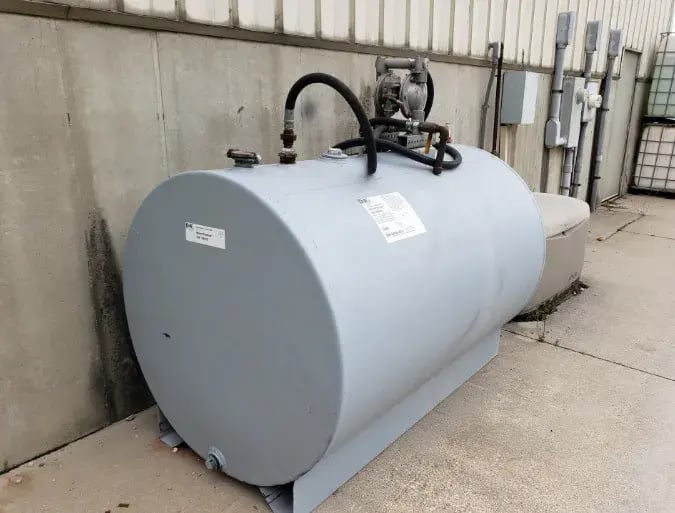
This part is a walk-through with the plan's inventory list in one hand. The auditor counts what's on site and compares it to what the plan says. Every container of 55 gallons or more counts toward your total, and the count uses the container's capacity, not how full it is today. Bulk tanks, drums, totes, generator base tanks, mobile refuelers, and oil-filled equipment like transformers all count. So do vegetable oils and animal fats. Propane doesn't, and motive power containers on vehicles are exempt.
The auditor also checks the facility diagram. The rule requires a diagram showing each fixed oil container, storage areas for mobile containers, transfer stations, and connecting piping, plus the oil type and capacity of each fixed container. A diagram drawn five years ago often misses the generator added last spring or the totes that migrated to another corner of the yard. We wrote guides on how to inventory your oil tanks, drums, and equipment and how to draw an SPCC facility diagram.
Accuracy here drives the rest of the audit. Total capacity decides whether you need a plan, whether you can self-certify, and whether state requirements for larger facilities come into play, so one missed 1,000-gallon tank can change your plan category.
What Does an Auditor Look For in Containment, Tanks, and Transfer Areas?
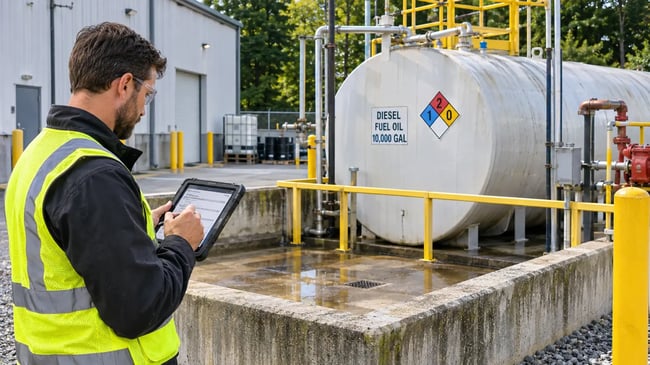
The physical walk-through is where most auditors spend their time. They're checking whether the equipment matches the plan and whether it's in condition to do its job. The table shows the main areas and the kind of gap that tends to turn up.
| Area |
What the auditor examines |
Typical gap |
| Dikes and berms |
Capacity for the largest container plus rain, cracks, penetrations, drain valve position |
Capacity never calculated, or equipment stored inside the dike has eaten into it |
| Bulk tanks |
Shell, seams, supports, foundations, staining, integrity test records |
No integrity test on file, or no one qualified signed it |
| Overfill protection |
Alarms, gauges, pump cutoffs, and evidence the devices get tested |
Device is installed but has never been tested |
| Piping and valves |
Flanges, valve glands, supports, catch pans, out-of-service connections |
Corroded supports or uncapped connections on unused lines |
| Loading and unloading |
Containment or response capability at truck unloading, drive-off prevention |
No written delivery procedure, drains left open |
Auditors also check security, meaning access control, locked valves, and lighting. Rainwater gets its own scrutiny. The rule lets you drain uncontaminated rainwater from a dike only after you've inspected it, with the drain valve kept sealed closed and the opening and resealing done under supervision and recorded. Auditors ask to see those records and look at the dike floor for sheen. We cover the routine in our guide to draining rainwater from a containment dike. For sizing, see evaluating secondary containment, and for tank testing, integrity testing for bulk oil containers.
Which SPCC Inspection, Testing, and Training Records Get Reviewed?
Paperwork is where an otherwise tidy site can fall apart. The rule requires written inspection and testing procedures, and it requires you to keep signed records of those inspections and tests with the plan for three years. Records kept under your normal business practices can satisfy this, so a maintenance system or a logbook works as long as the entries are signed and tied to the right equipment. Our guide to SPCC recordkeeping lists what to keep and where, and a monthly SPCC inspection checklist gives you a starting format.
Auditors usually sample. They pick a month, ask for the record, and compare it to the walk. If an inspection says no leaks and there's staining under the pump, that mismatch gets noted. Identical entries repeated month after month suggest the form was filled out from a desk.
Training gets the same treatment. The rule calls for training oil-handling personnel on equipment operation, discharge procedures, applicable pollution laws, and the plan's contents. It also calls for a designated person accountable for discharge prevention and a discharge prevention briefing at least once a year. The auditor wants to see who attended, what was covered, and when. We lay out the content in SPCC training for oil-handling employees, and RMA's online training library is available if you'd rather not build the sessions yourself.
How Do State Registrations and Spill History Fit Into an Oil Storage Audit?
An SPCC audit in New Jersey looks past the federal rule, because the state layer is stricter than most. NJDEP's Discharges of Petroleum and Other Hazardous Substances rules at N.J.A.C. 7:1E require facilities classed as major facilities to prepare and submit Discharge Prevention, Containment, and Countermeasure (DPCC) and Discharge Cleanup and Removal (DCR) plans. Whether you count as a major facility depends on your total storage capacity and what you store, so check the rule against your own inventory. Our article on whether you need both an SPCC plan and a DPCC plan explains how the two programs differ.
Underground tanks fall under NJDEP's UST rules at N.J.A.C. 7:14B, which include registration and NJDEP-certified contractors for installation and closure. Some facilities also have Community Right to Know filings, and local fire officials enforce the Uniform Fire Code on fuel storage. The auditor notes whether the registrations and permits your site should hold are in the file.
Spill history gets the closest look. Under the federal rule, a single discharge of more than 1,000 gallons, or two discharges of more than 42 gallons each within twelve months, triggers a submission to the EPA Regional Administrator within 60 days, with a copy to the state. We explain the details in when a spill must be reported to EPA. Separately, New Jersey law generally requires discharges to be reported to the NJDEP hotline, 1-877-WARNDEP (1-877-927-6337), right away. The auditor compares your spill log to what you reported, and an unreported past discharge is among the most serious findings an audit can produce. The Spill Act puts cleanup liability on responsible parties and applies broadly, so if an audit turns up an unreported release, talk with an environmental attorney before deciding how to proceed.
How Do SPCC Audit Findings Get Prioritized?
A good audit report doesn't hand you a flat list of forty items. It ranks them with two questions. How likely is oil to reach soil or water if nothing changes? And how exposed are you if an inspector walks in next week? The table shows a common way to sort findings, though every auditor has their own scheme.
| Priority |
What lands here |
Typical response |
| Fix first |
Active or likely releases: a leaking tank, no containment under a bulk tank, no overfill protection, an unreported discharge, no plan where one is required |
Address right away. Call the NJDEP hotline for an ongoing release and consider legal counsel for unreported ones |
| Fix next |
Plan defects: a lapsed five-year review, missing or invalid certification, an inventory and diagram that don't match the site, changes never amended |
Correct on a defined schedule, which often means rebuilding the plan |
| Fix on a schedule |
Records and training gaps: missing inspection logs, no annual briefing, rainwater drainage not logged |
Start documenting correctly now and assign an owner for each task |
| Housekeeping |
Faded labels, empty spill kits |
Fold into routine maintenance |
Penalty exposure is part of the ranking too. Federal civil penalties are set per violation and adjusted for inflation under 40 CFR Part 19, so check current figures. Our overview of top SPCC plan violations and fines shows what inspectors cite most, and we've written about EPA's expedited settlement offers for facilities that receive a notice.
If the audit shows you missed months of inspections, you can't recreate them. Backdating a log turns a recordkeeping gap into a credibility problem, so start recording accurately now. Whether to disclose findings to a regulator is a separate question, and EPA's Audit Policy has timing conditions that start when you discover a violation, which is a good point to involve an environmental attorney.
How Much Does an SPCC Compliance Audit Cost, and What Happens Afterward?
RMA's environmental audits generally run $3,000 to $7,500. Where an audit lands in that range depends on the number of sites, the number of containers, how organized your documentation is, and whether the audit stays on oil storage or also covers programs like stormwater and hazardous waste. RMA's environmental audit pricing calculator gives a ballpark, and our article on what to expect when a consultant conducts an audit describes the process.
After the audit you'll have a ranked list. Your own staff can close many findings, like a missing inspection log or an untested overfill alarm. When the plan itself is the problem, the fix is usually a rebuild. RMA generally doesn't patch a plan someone else wrote, because we can't stand behind a document we didn't build. A new plan for a typical facility runs from $2,500 to $15,000, depending on total storage capacity, the number and type of containers, whether secondary containment needs evaluating, and whether the plan needs a PE's certification. Our post on why PE-certified plans cost more explains the spread. If you have a single generator tank and a plan that's a couple of years old, a self-review may be all you need, and we'll tell you so. The calculator below shows RMA's fee for SPCC plan work if the audit points to a rebuild.
How Can RMA Help With Your SPCC Compliance Audit?
RMA is a family-run firm based in New Jersey, and we work with EPA Region 2 and NJDEP rules every day. For an SPCC compliance audit, we review your plan, walk the site, check your records, and give you a ranked written report in plain language. Senior staff do the work, and we don't use AI for deliverables. If the audit shows your plan needs to be rebuilt, we'll build it so that a licensed Professional Engineer reviews and approves it where certification is required, and we'll tell you up front if a simpler route fits your site better.
There's no pressure and no obligation. You can call 888-RMA-0230 or fill out the form on our website, and we'll talk through your site and what an audit would cover. When you're ready, you can contact RMA, and we'll take it from there.