Paper Mills Are on DEP's List Outright, While Box, Bag, and Converting Plants Come Down to Their SIC Code and What's Sitting Outside
Pennsylvania has a long papermaking history, and the state has plenty of box plants, bag converters, and other packaging operations. If you run one, you've probably wondered whether the rain that lands on your loading dock, your roll stock, or your trash compactor puts you under a DEP stormwater permit. For a paper mill, the answer is usually yes. For a packaging plant, it depends on a four-digit code and on what's sitting outside.
This article covers which paper and packaging operations are on PA DEP's list, how to check your SIC code, which outdoor exposures decide the outcome, and how those exposures sort a plant into PAG-03 (the state's general stormwater permit for industrial facilities) or a No Exposure Certification. We'll also cover when a mill ends up on an individual permit instead. If you'd rather have someone look at your site, you can reach out to RMA. We work with Pennsylvania facilities all the time, and we'll tell you if you don't need us.
Table of Contents
TL;DR
Usually yes for paper mills, and it depends for packaging plants. Pulp, paper, and paperboard mills are on PA DEP's industrial stormwater list and typically use PAG-03 or, if they discharge process wastewater, an individual NPDES permit. Box, bag, and converting plants (SIC 265 and 267) are treated as lighter manufacturing, so what's stored outside decides whether they need PAG-03 or can file a No Exposure Certification. Check your primary SIC code, then walk the site for bales, roll stock, chemicals, dust, dumpsters, and fueling, and confirm your stream's classification and any local sewer rules.
Which Paper and Packaging Plants Are on PA DEP's Stormwater Permit List?
Pennsylvania DEP runs the federal NPDES program (the National Pollutant Discharge Elimination System) for water discharges in the state, and industrial stormwater falls under it. Many covered facilities use PAG-03, DEP's general permit for stormwater from industrial activity. DEP reissued PAG-03 effective March 24, 2023, and the current term runs through March 23, 2028. Whether your plant is covered starts with its SIC code, the four-digit Standard Industrial Classification number that describes what the facility does for a living. PAG-03 sorts those codes into sector appendices, and paper and allied products land in Appendix E.
Here's how the paper and packaging codes break out. The ranges are shorthand, so check your exact four-digit number against DEP's PAG-03 instructions.
| SIC code |
What it covers |
How it's treated |
| 2611 |
Pulp mills |
Federal industrial category that covers SIC 26 across the board. PAG-03 Appendix E. |
| 2621 |
Paper mills |
Same as 2611. |
| 2631 |
Paperboard mills |
Same as 2611. |
| 2652-2657 |
Paperboard containers and boxes, such as corrugated boxes and folding cartons |
Carved out of the federal heavier-industry category and treated as lighter manufacturing. DEP still lists it in Appendix E. |
| 2671-2679 |
Converted paper and paperboard products, except containers and boxes, such as bags, laminated packaging paper, and die-cut products |
Same as 2652-2657. |
The first three rows are heavier industry. Federal rules (40 CFR 122.26(b)(14)) cover SIC 26 across the board except for 265 and 267, which the same rule lists with lighter manufacturing, alongside food plants and printers. DEP still puts those codes in Appendix E, so a box plant that takes PAG-03 coverage follows the same appendix as a paper mill. The difference is at the front door. A lighter-manufacturing plant is in the program when industrial materials or activities are exposed to rain, snow, or runoff, and a plant with a listed code and nothing exposed usually files a No Exposure Certification instead of nothing at all. Our No Exposure vs. PAG-03 comparison covers that split.
DEP goes by the primary SIC code, which is the activity that generates the most revenue at the site. If only a secondary code is listed, coverage generally isn't required unless DEP decides the stormwater carries pollutants. That sorts out a lot of packaging plants, since a facility that converts paper and also runs a printing or plastics line has to decide which one pays the bills. Plastic packaging falls under a different appendix, and a site that's mostly warehouse space is covered in our post on Pennsylvania warehouses.
How Do You Check Your SIC Code for a Pennsylvania Paper or Packaging Plant?
Start with paperwork you already have. Insurance policies, loan documents, and state business filings often carry a six-digit NAICS number (the North American Industry Classification System), not an SIC code. NAICS replaced SIC for most federal agencies in 1997, but DEP's stormwater rules still run on SIC, and the PAG-03 Notice of Intent (NOI, the application form) asks for it. Paper manufacturing sits under NAICS 322, which is the right neighborhood to look in, but the two systems don't line up one to one. Use a NAICS-to-SIC crosswalk, then read the SIC description to see whether it matches what your plant does.
Then check the result against Table 1 of DEP's PAG-03 NOI instructions (form 3800-PM-BCW0083a), which lists each SIC code and the appendix it falls under. If your code isn't listed but your operation looks a lot like one that is, don't stop there. DEP can specify an appendix for activities similar to a listed code. Our guides on finding your SIC code and the SIC code test DEP applies go through the lookup step by step.
A plant that runs several lines can carry more than one code, and DEP's test is the one that earns the most revenue. A site with several tenants works differently, because each activity under a different operator gets its own SIC code, so a converter or packager leasing part of your building is evaluated on its own code.
Which Outdoor Exposures at Paper and Packaging Plants Decide Between PAG-03 and No Exposure?
Exposure means industrial materials or activities that rain, snow, snowmelt, or runoff can touch. EPA's sector fact sheet for paper and allied products lists the usual sources, and DEP's FAQ sets the rules for what counts. Mills and converting plants differ a lot, so we'll take them separately.
Which Exposures Matter Most at Paper and Pulp Mills?
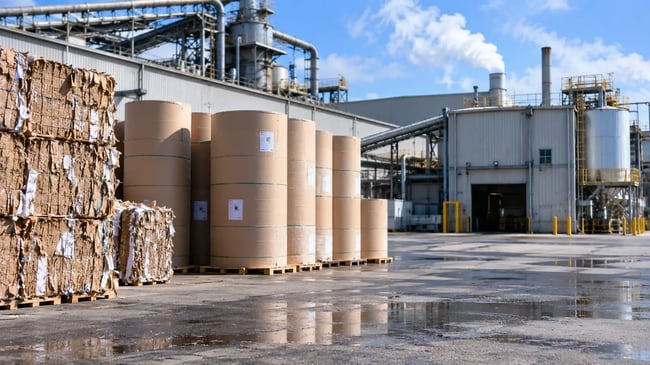
Mills have the longest list. Wood chips, sawdust, and other wood debris left outside shed solids and organic matter, and EPA names total suspended solids and BOD5 (a measure of how much oxygen organic material will use up) as the pollutants from raw material preparation. Pulping, bleaching, and papermaking add chemicals that can reach runoff when stored or transferred outside, including bleaching agents, solvents, starches, latexes, resins, and coatings. Baled waste paper, rollstock, and wooden pallets sit outside at many mills, and spills during loading, fueling, and vehicle maintenance add oil and fuel. Dust from paper trim cyclones is on EPA's list too, since it settles on roofs and yards and washes off in the next storm. At a working mill it's uncommon for everything to be under a roof, which is why mills usually end up under PAG-03 or an individual permit rather than No Exposure.
Which Exposures Matter Most at Box, Bag, and Converting Plants?
A packaging plant has fewer pollutant sources, and its exposure list is shorter and easier to fix. The usual suspects are rollstock or finished product stacked outside, a waste paper compactor or open roll-off, a pallet yard, ink and adhesive totes stored outdoors, dust collectors that discharge near the building, and a forklift fueling spot. DEP's FAQ draws some useful lines. Tightly sealed, undamaged containers and covered, well-maintained dumpsters don't need a shelter, adequately maintained forklifts don't count against you, and uncovered roll-off boxes do. Wooden pallets in good condition that aren't contaminating runoff may be eligible, while broken, stained, or oily ones raise questions. More everyday examples are in our posts on dumpsters, forklifts, and parking lots and storing materials outside.
| Exposure |
Where it shows up |
How it usually counts |
| Baled waste paper, rollstock, or finished product stored outside |
Bale yards, roll stock stacked beside the dock |
Counts as exposure unless it sits inside a real storm-resistant structure. A tarp is a good practice, but ask before counting on it for No Exposure. |
| Logs, wood chips, or pulp storage |
Mill wood yards and chip piles |
Exposure. Points a mill toward PAG-03 or an individual permit. |
| Chemicals, coatings, inks, and adhesives |
Totes, drums, and tanks near the production building |
Tightly sealed, undamaged containers can stay outside. Leaking or damaged ones, and transfer points, can't. |
| Dust and particulates |
Cyclone discharge, roof vents, trim dust settling on the yard |
Exposure when residue settles outdoors and washes off in the next storm. |
| Waste containers |
Compactors and roll-off dumpsters |
Covered, well-maintained dumpsters are fine. Uncovered roll-off boxes don't qualify. |
| Vehicles and fueling |
Forklifts, trailers, a fuel pump |
Adequately maintained material-handling vehicles are fine. Fueling without a roof, canopy, or cover rules out No Exposure. |
When Can a Paper or Packaging Plant File a No Exposure Certification Instead of PAG-03?
A No Exposure Certification (NEC) is DEP's alternative to PAG-03 for a facility in a covered category that keeps all of its industrial materials and activities under a storm-resistant shelter. The federal rule behind it, 40 CFR 122.26(g), defines "no exposure" in just those terms. Filing the form doesn't guarantee approval, and DEP can inspect the facility to check the conditions and make its inspection reports available to the public.
| |
PAG-03 |
No Exposure Certification |
| What it is |
General permit with a plan, inspections, and sampling |
DEP approval based on your certification that nothing industrial is exposed |
| Site requirement |
Covers sites with exposed materials or activities |
Every industrial area must qualify. DEP won't approve part of a site. |
| PPC Plan |
Required and kept current |
Submitted with the application only if the form's questions call for one |
| Sampling |
Semiannual at each outfall, using the appendix parameters |
The application asks existing facilities for stormwater quality information, with no ongoing sampling schedule afterward |
| Reporting |
eDMRs and annual reports |
No eDMRs or annual reports |
| Term |
Current PAG-03 runs through March 23, 2028 |
Generally five years, with a renewal application due at least 180 days before expiration |
| Fees |
Application fee plus an annual fee |
Filing fee with the application and no annual fee. DEP's FAQ lists $500 every five years. |
The eligibility rules are strict. It's all or nothing, so a plant can't certify the production building and leave the compactor out. Facilities that discharge to High Quality or Exceptional Value waters aren't eligible. If conditions change and the plant stops qualifying, it has to notify DEP immediately and submit an NOI or a permit application. The forms are NEC form 3800-PM-BCW0083e and the PAG-03 NOI, form 3800-PM-BCW0083b, which go in together. Our posts on whether your facility can qualify for No Exposure and what No Exposure looks like in practice walk through DEP's checklist.
For a box or bag plant, the path to No Exposure is usually physical. Move the compactor under a roof, bring pallets and rollstock inside, cover the fueling spot, and keep chemical containers sealed. Some plants make those changes and some decide PAG-03 is easier to live with. Either is reasonable, but don't certify something you can't back up, since DEP can walk the site to check.
What Does PAG-03 Require From a Paper or Packaging Plant in Pennsylvania?
PAG-03 is a package of obligations. You need a PPC Plan (Preparedness, Prevention, and Contingency Plan), which is DEP's site plan for preventing pollution and responding to spills, along with routine inspections, stormwater sampling every six months at each outfall (the spot where stormwater leaves your site), electronic reporting through DEP's eDMR system, annual reports, and employee training. Our overview of what PAG-03 is and our guide to the PPC Plan cover each piece.
Appendix E sets the sampling parameters for paper and allied products, and the 2023 reissue added total nitrogen and total phosphorus to every appendix. Check the current permit for the exact parameter list and benchmark values. Benchmarks aren't discharge limits, but if the same pollutant exceeds its benchmark at the same outfall in two consecutive monitoring periods, you owe DEP a corrective action plan within 90 days. The NOI lists your primary SIC code, any secondary codes, and the appendices that apply, so a plant with a second listed activity can end up following more than one. Our guide to the PAG-03 appendices shows how that works.
Plan the training early, since the person who samples and inspects usually has another full-time job on the plant floor. Our online training library is one place to start.
When Does a Paper Mill Need an Individual NPDES Permit, and What Else Can Change the Answer?
A mill that already has, or is required to get, an individual NPDES permit for non-stormwater discharges can't use PAG-03 for its stormwater, because the stormwater is folded into the individual permit. So a mill that sends process wastewater to a stream under its own permit usually handles stormwater inside that permit. Packaging plants usually don't run that kind of discharge, which makes them much more likely to land on PAG-03 or No Exposure. Our post on PAG-03 vs. an individual permit explains how DEP decides.
Your receiving stream matters too. Discharges to High Quality (HQ) or Exceptional Value (EV) waters aren't authorized under PAG-03, and DEP can't approve a No Exposure Certification for them either. Those sites need an individual permit application that includes an antidegradation module. Many older mills were built beside streams, so check your stream's classification before you plan around PAG-03. Our post on High Quality and Exceptional Value streams shows how to check.
A plant whose code isn't listed isn't automatically in the clear. DEP can require permit coverage under the Clean Streams Law when stormwater carries pollutants, and a facility in that position can't use No Exposure. Local rules can add another layer. If your site's runoff goes to a combined sewer that flows to a treatment plant, the sewer authority may govern it in place of a DEP stormwater permit, and townships, cities, and sewer authorities can have their own rules and fees, so confirm your situation locally. Our guide to whether your facility needs a PAG-03 permit covers the basics.
How Does RMA Help Paper and Packaging Plants With Stormwater Permits in Pennsylvania?
We help Pennsylvania paper and packaging facilities work out which path they're on: confirming the SIC code, walking the site for exposures, deciding whether No Exposure is realistic, and then preparing the application, PPC Plan, and sampling program for whichever path applies. We also tell people when they don't need us. If your primary code isn't on the list and nothing is leaving the site, a short conversation may be all you need.
You can call us, email us, or fill out the form on our website, with no pressure and no obligation. Contact RMA and tell us what your plant makes and what's stored outside. You can also browse our Pennsylvania NPDES and stormwater resources, the general NPDES resource library, and our full list of Pennsylvania NPDES articles.