Every New Jersey Industrial Stormwater Permit in One Table, From the 5G2 to Industry-Specific, No Exposure, and Individual Permits
If rain falls on a yard, a loading area, or a pile of material at your business and runs off toward a storm drain, New Jersey's Department of Environmental Protection (NJDEP) can regulate where that water goes and what it carries. The state doesn't hand every industrial facility the same permit. It has one basic general permit, a set of industry-specific general permits, an exclusion for facilities with no exposure at all, and individual permits for sites that don't fit anywhere else. Which one applies to you depends on what you do, whether your materials and activities are exposed to rain, and where your water ends up.
Below, we put every option in one table, then walk through how each permit works, when sampling comes into play, and where the no exposure exclusion and individual permits fit. We're based in New Jersey and help facilities with these permits, so if you'd rather talk through your own situation, reach out to RMA and we'll point you to the right permit, even if the answer is that you don't need one.
Table of Contents
TL;DR
New Jersey has four paths for industrial stormwater. The 5G2 is the basic general permit for facilities that keep materials out of the rain. Industry-specific general permits cover concrete, asphalt, mining and quarrying, sand and gravel, scrap metal, vehicle recycling, and wood and leaf recycling. A no exposure exclusion applies to facilities that operate entirely inside a permanent building, and individual permits cover everything else. The 5G2 doesn't require sampling, while sampling under the other permits depends on the permit itself, so check your authorization.
Which Industrial Stormwater Permits Does New Jersey Offer?
New Jersey regulates rain at industrial facilities through the New Jersey Pollutant Discharge Elimination System, or NJPDES, the state's version of the federal NPDES program. NJDEP runs it. If your facility's industry is on NJDEP's regulated list, which is built on SIC codes (the classification codes that describe what a business does), then stormwater that touches your materials or activities and leaves the site generally needs a permit or an exclusion. Your SIC code is the first thing NJDEP looks at, and a short screening of your site tells you whether you're in scope at all.
Once you are, NJDEP offers four paths: the Basic Industrial Stormwater General Permit (the 5G2), a group of industry-specific general permits, an exclusion for facilities with what NJDEP calls Permanent No Exposure, and an individual permit written for one site. We explain why New Jersey splits things up this way in a separate post. Most of these paths require a written stormwater pollution prevention plan. NJDEP calls it an SPPP, people sometimes call it an SP3 or just a stormwater plan, and we'll call it a SWPPP here. Our SPPP guide has the New Jersey version in plain English.
Two limits on this article. Where your water drains matters, because a site that sends runoff to a sewer instead of a storm drain may fall under a local sewerage authority's rules instead of, or alongside, an NJPDES stormwater permit, which we cover in our post on combined sewers. And construction is a separate track. NJDEP covers construction that disturbs one or more acres under a construction general permit issued through the Soil Conservation Districts, and that isn't what the table below covers.
New Jersey Industrial Stormwater Permits Compared in One Table
Here's every New Jersey industrial stormwater option on one page. Treat it as a map, not a final answer. NJDEP posts the current permit document for each category on its stormwater program pages, and the version named in your authorization is the one you follow.
| Permit |
Who it's for |
Key requirements |
Sampling? |
5G2
Basic Industrial Stormwater General Permit |
Regulated facilities that have eliminated, or can eliminate within six months of authorization, all exposure of industrial materials and activities to stormwater |
SWPPP, practices that keep materials out of the rain, annual inspection and annual certification on NJDEP's form |
No. NJDEP describes it as built on practices, not monitoring |
CPM
Concrete Products Manufacturing |
Ready-mix concrete, block and brick, and other concrete products manufacturers |
SWPPP and the annual items the permit lists. Covers stormwater to surface water and groundwater |
Monitoring is part of the permit. Confirm parameters and frequency in your authorization |
R4
Hot Mix Asphalt Producers |
Facilities that manufacture hot mix asphalt (SIC 2951, NAICS 324121) |
SWPPP with the contents NJDEP lists for this permit, annual certification on NJDEP's form. Covers surface water and groundwater |
Set by the permit. Confirm in your authorization |
R13
Mining and Quarrying Activity |
Mining and quarrying operations. No longer eligible for the 5G2 or the 5G3 construction permit |
SWPPP with R13 contents. Covers stormwater and certain process wastewater to surface water, and stormwater only to groundwater |
Set by the permit. Confirm in your authorization |
RSG
Sand and Gravel Activity |
Sand and gravel mining and quarrying operations with no discharge to surface water |
SWPPP. Covers stormwater discharges to groundwater. Renewed permit effective January 1, 2026 |
Set by the permit. Confirm in your authorization |
SM2
Scrap Metal Processing and Recycling |
Scrap metal recyclers, with or without used vehicle part recycling. The older SM permit has expired |
SWPPP, drainage control plan, spill and fluid handling practices |
Yes. NJDEP's October 2025 compliance advisory calls for quarterly sampling |
RVR
Vehicle Recycling |
Facilities that dismantle motor vehicles and sell used parts. Not facilities that also process scrap |
SWPPP, annual inspection, annual report, annual certification |
Not listed in NJDEP's 2025 advisory. Check your permit |
WRC
Wood Waste Recycling and Leaf Composting |
Receiving and processing clean wood waste, and composting leaves, grass clippings, and wood chips |
SWPPP, annual inspection, annual report form. Renewed permit effective January 1, 2026 |
Set by the permit. Confirm in your authorization |
No exposure
Permanent No Exposure Certification |
Facilities with all industrial materials and activities inside a permanent, fully roofed and walled building on a permanent foundation |
Certification on NJDEP's form every five years, NJDEP inspection access, not transferable to a new operator |
None |
| Individual NJPDES stormwater permit |
Facilities that can't eliminate exposure and don't qualify for a general permit |
Site-specific conditions built around a SWPPP with drainage control |
Often yes, and usually more extensive than under a general permit |
A few notes on reading it. The 5G2 is the default for facilities that can keep materials out of the rain, and the industry-specific permits take over when your industry has its own, which is why a concrete plant or a quarry doesn't end up on the 5G2. Fees and renewal dates differ by category. NJDEP sets fees in N.J.A.C. 7:14A-3.1, so check the current schedule before you budget.
How Does the 5G2 Basic Industrial Stormwater Permit Work?
The 5G2 is the permit most New Jersey industrial facilities end up on. NJDEP's 5G2 page lists a final master general permit effective February 1, 2023, and the permit's whole approach is to keep industrial materials and activities away from rain and snowmelt. You can do that by covering them or by moving them indoors. If you haven't eliminated exposure yet, the permit gives you six months from authorization to do it, and if you can't, you're headed toward an individual permit instead.
In practice, a 5G2 facility writes a SWPPP, puts the practices in it into place, inspects the site, and certifies to NJDEP once a year on the 5G2 certification form that the annual inspection happened and the plan was evaluated. The certification is easy to overlook, so put it on a calendar. Getting coverage starts with a Request for Authorization (RFA) through NJDEP's online system, which we walk through step by step in our RFA guide. For the full picture of what the permit asks for, our 5G2 explainer covers it, and this post on the annual certification covers the yearly piece.
Which Industry-Specific New Jersey Stormwater Permit Fits Your Operation?
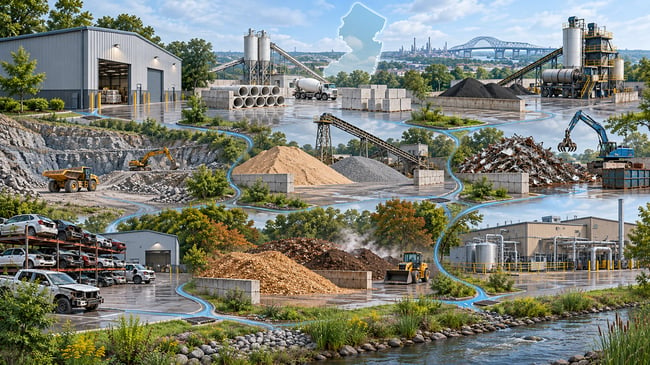
If your industry has its own general permit, that permit usually replaces the 5G2 for you. These permits are statewide, they're written for one type of operation, and NJDEP describes some of them as carrying monitoring, benchmarks, or effluent limits. The practical job is matching what you do to the right one, which is what this comparison of concrete, asphalt, and quarry permits is built for.
Concrete, Asphalt, Mining, and Sand and Gravel
The Concrete Products Manufacturing (CPM) permit covers stormwater from facilities that make ready-mix concrete, block and brick, and other concrete products, and it applies to both surface water and groundwater discharges. Truck washout and other process water are a separate question from stormwater, so they need their own attention. The Hot Mix Asphalt Producers (R4) permit covers facilities that make hot mix asphalt, identified by SIC 2951 and NAICS 324121. We've written up each one: the CPM permit and the R4 permit.
Mining and quarrying split into two permits, and the line between them is where your stormwater goes. The Mining and Quarrying (R13) permit authorizes stormwater and certain process wastewater to surface water, and stormwater only to groundwater. The Sand and Gravel (RSG) permit authorizes stormwater discharges to groundwater for sand and gravel operations that have no discharge to surface water, and NJDEP's renewed RSG took effect January 1, 2026. NJDEP has also removed mining and quarrying from eligibility under the 5G2 and the 5G3 construction permit, so a quarry can't fall back on either. Our post on choosing between the R13 and the RSG walks through the decision.
Scrap Metal, Vehicle Recycling, and Wood and Leaf Recycling
The Scrap Metal (SM2) permit covers scrap metal recyclers, including yards that also recycle used vehicle parts. The original SM permit has expired and is no longer available. The Vehicle Recycling (RVR) permit is narrower. It fits facilities that dismantle motor vehicles and sell used parts, and not facilities that also process scrap. NJDEP's October 2025 advisory on both permits applies to operations that have, or should have, one of them, and our post on scrap yards and auto recyclers covers the details, along with our SM2 guide.
The Wood Waste Recycling and Leaf Composting (WRC) permit covers receiving, storing, processing, and transferring clean wood waste, along with composting leaves, grass clippings, and wood chips, and NJDEP's renewed version took effect January 1, 2026. It covers stormwater only. The right to operate a recycling yard comes from a separate NJDEP recycling approval, which is something we also help with through our New Jersey recycling approvals service. Start with our WRC starting guide if that's your operation.
When Do New Jersey Stormwater Permits Require Sampling?
Sampling is the biggest variable across these permits, and it's where facilities get caught off guard. Under the 5G2, there's no sampling. NJDEP's own presentations describe the permit as built on practices that keep materials out of stormwater, with no monitoring, and we cover that question in more detail. The no exposure exclusion has none either.
Beyond that, it depends on the permit. SM2 permit holders are expected to sample their stormwater discharge quarterly, according to NJDEP's October 2025 compliance advisory. For the CPM, R4, R13, RSG, WRC, and RVR permits, and for individual permits, the sampling requirements live in the permit and your authorization, so read those before you assume anything. NJDEP's program materials describe analysis by a certified laboratory and reporting results on discharge monitoring reports (DMRs), so a sampling requirement also means lab costs and recurring reports.
When sampling does apply, we recommend your own team collect the samples. They know the site, and storm timing makes it impractical for any outside consultant to be standing at your outfall when the rain starts. We don't take samples ourselves. We train your people to do it correctly, which is why we wrote this post on taking your own samples, and our online training library has courses your team can take on their own schedule.
What Is the New Jersey No Exposure Exclusion for Stormwater?
Some facilities don't need a permit at all. NJDEP's rules let an operating entity whose discharges are entirely stormwater skip the NJPDES permit if it has achieved Permanent No Exposure, which means all industrial materials are stored and all industrial activities are performed inside a permanent, fully roofed and walled building or structure on a permanent foundation. Dumpsters and similar rigid containers, vehicles in good repair that handle materials, and pipe that isn't leaking or deteriorated are allowed outside the building.
That's a higher bar than the 5G2, which lets you cover materials as well as move them indoors. The exclusion applies to the whole facility, not to individual outfalls or drainage areas. You file a certification on NJDEP's form, and you resubmit it once every five years. NJDEP can inspect, the exclusion doesn't transfer to a new operator, and if exposure comes back, you need a permit. Fully indoor operations are the ones that fit here, and sometimes the answer to "do I need a permit" is that you don't. Our guide on checking a site for permanent no exposure shows how to walk your property and decide.
When Does a Facility Need an Individual NJPDES Stormwater Permit?
An individual NJPDES stormwater permit is written for one facility. NJDEP issues them to facilities that can't eliminate exposure of pollutants to stormwater and don't qualify for a general permit. They're built around a SWPPP that includes drainage control, they can require monitoring of discharges, and in some cases they set effluent limits. Because individual permits are customized, they usually cost more and carry more extensive sampling and monitoring than a general permit, and NJDEP can also require a facility that would otherwise be eligible for a general permit to get an individual one because of its contribution to water pollution.
Individual industrial permits use NJDEP's RF application. If you're weighing whether to change how you operate to avoid this path, covering or relocating materials is what the 5G2 asks for. Our post on the individual NJPDES industrial permit covers when it's the right path, and this one on changes that move you between permits covers what happens when your operations shift.
How Can RMA Help You Choose a New Jersey Stormwater Permit?
If you've read this far and still aren't sure which row you're in, a short conversation usually settles it. We help New Jersey facilities work out which permit fits, put together the SWPPP, walk through the paperwork to get coverage, and keep up with the annual items afterward. We train your team to take their own samples, and we offer ongoing support after you're permitted, whether you want us hands-on or in the background. If you clearly fit the no exposure exclusion, or you can handle the 5G2 yourself, we'll tell you that too.
One boundary. If you're building or expanding a facility, the construction-phase approvals, such as 5G3 coverage and soil erosion and sediment control certification, are a different specialty and not something we prepare. Most facilities handle those with their engineer, contractor, or a soil erosion specialist, and we're glad to point you toward the right people. Once the site is running, the operational permits and plans in this article are where we come in.
There's no pressure and no obligation. You can call, email, or fill out the form on our website, and you can contact RMA to talk through your site with someone on our senior team.