If you've ever gotten a notice from your town about storm drains, dumpster lids, or illicit connections, or heard someone say your municipality is "Tier A" or "Tier B," you've run into the town's own stormwater permit. Every permitted municipality in New Jersey needs a permit from NJDEP (the New Jersey Department of Environmental Protection) for the storm drain system it owns and runs, and that permit pushes a long list of duties down to the town. A few of those duties end up at the property line of local businesses.
Below we cover what Tier A and Tier B mean (and why the Tier B label is mostly history), what the town's permit requires, how it can touch industrial and commercial properties, and how it differs from any stormwater permit your own facility may need. If you'd like a second set of eyes on how your town's rules fit with your facility, you can reach out to RMA any time.
Table of Contents
TL;DR
Your town's stormwater permit belongs to the town, not to you, but it requires the town to adopt and enforce rules that can reach your property, like bans on dumping into storm drains, dumpster and storage rules, and upkeep of private stormwater basins. New Jersey used to split towns into Tier A and Tier B, but NJDEP moved every Tier B town to Tier A, so one permit now sets the baseline for all of them. It doesn't replace any NJDEP industrial stormwater permit your facility needs, and your NJDEP permit doesn't excuse you from local ordinances either. Check your town's stormwater webpage and municipal code to see what applies to you.
What Are Tier A and Tier B MS4 Permits in New Jersey?
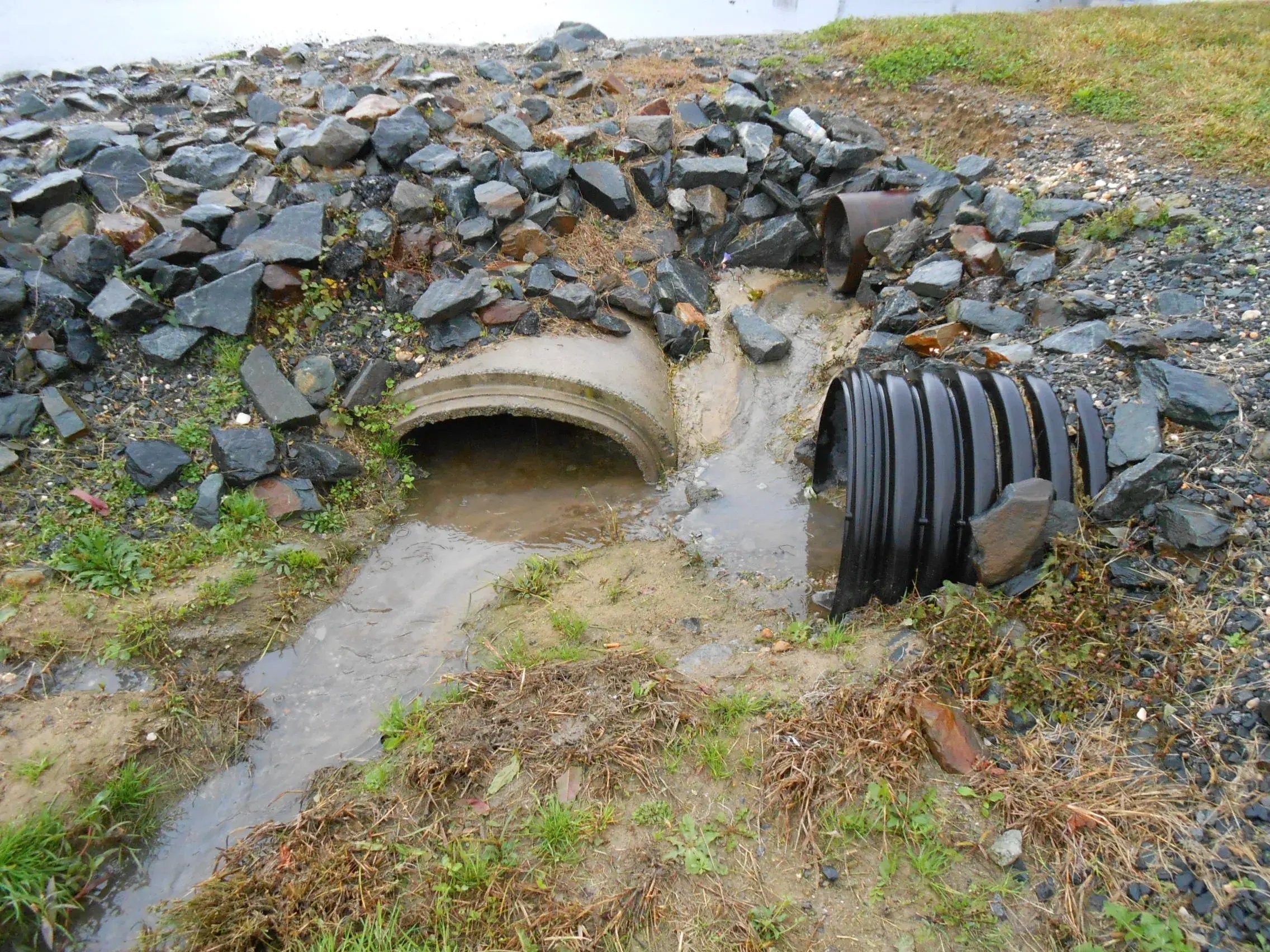
MS4 stands for municipal separate storm sewer system. It's the network of street inlets, catch basins, pipes, ditches, and outfalls that a town owns and operates to carry rain runoff to local streams, rivers, and bays. Most of that system isn't connected to the sanitary sewer, so what goes down a storm drain generally reaches a waterway without any treatment. Because of that, federal and state water pollution law treats the town as a discharger and requires it to hold an NJPDES permit. NJPDES stands for the New Jersey Pollutant Discharge Elimination System, the state's version of the federal NPDES program, and we explain why NJDEP cares about rain at businesses in a separate article.
NJDEP set up its municipal stormwater program in 2004 and sorted towns into two groups. Tier A covered the denser, more developed municipalities and tracked the federal small MS4 rules, with a long list of required measures. Tier B was a state-only permit for smaller towns, and it asked for far less. For years that meant two neighboring towns could have very different stormwater duties, depending on which letter they'd been assigned.
That split is gone. In 2022 NJDEP notified Tier B municipalities that it was reassigning them to Tier A, and the renewed Tier A permit took effect on January 1, 2023. Former Tier B towns have been phasing in the added requirements on a schedule, which is why you may still hear the old labels at a council meeting or from a neighbor. If someone tells you your town is Tier B, the practical answer today is that it's covered by the same Tier A permit as the rest of the state's permitted municipalities.
Is a Town's MS4 Permit the Same as a Business's Stormwater Permit?
No. They're separate permits held by separate parties. The town's MS4 permit governs discharges from the town's storm sewer system. A facility's NJPDES industrial stormwater permit, such as the Basic Industrial Stormwater General Permit (known as the 5G2) or one of the industry-specific general permits, governs runoff from your site. Whether your facility needs one depends on your industry code, whether materials and activities are exposed to rain, and where your water goes. We walk through that in Does My New Jersey Business Need a Stormwater Permit? and explain the most common permit in What Is the 5G2?
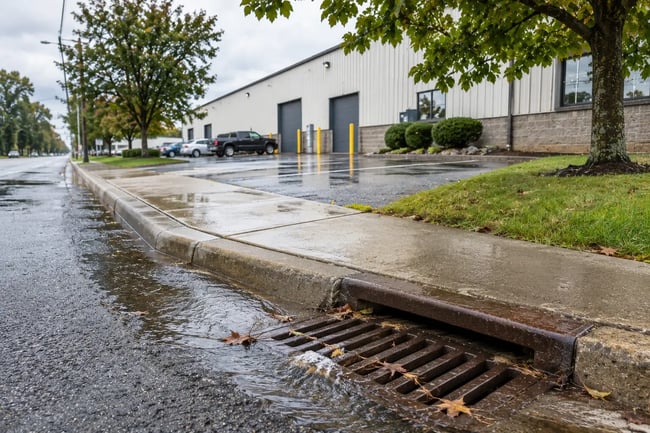
Where the two permits meet is the pipe. If your lot drains into a town inlet, your runoff becomes part of what the town's system carries to the waterway. That's why the town pays attention to what's in it, and why the town's permit makes it responsible for catching illegal discharges into its drains. Those little "drains to river" markers you see on inlets exist for the same reason, and we cover what the markers mean for businesses.
Two mix-ups come up often. First, holding a 5G2 or another NJDEP industrial permit doesn't exempt you from local ordinances like dumpster or storage rules, and a facility with no exposure still can't send wash water or process wastewater into a storm drain. Second, a stormwater utility fee from your town is a billing matter and not an NJDEP permit. We explain that difference in Does a Town Stormwater Utility Change My NJDEP Stormwater Permit?
What Does the Tier A MS4 Permit Require Towns to Do?
The permit works through a written municipal stormwater plan the town maintains and through ordinances the town adopts. A town can't meet it with good intentions. It has to adopt rules, check that they're followed, and keep records. The table below groups the main duties in plain terms and shows where each one can reach a business. Details and deadlines vary by town and by whether it was an original Tier A town or a former Tier B one, so treat this as the general shape and not a substitute for the permit itself.
| What the town does |
What it looks like in practice |
Where a business may feel it |
| Adopts community-wide ordinances |
Rules on illicit connections, improper waste disposal, litter, pet waste, wildlife feeding, yard waste, outdoor refuse containers, and salt storage |
Dumpster lids, outdoor storage areas, and what you're allowed to send to a storm drain |
| Maps the system and inspects outfalls |
Outfalls are inspected on a rotation, and dry-weather flow is treated as a sign something is entering the system that shouldn't be |
An inspector tracing an unexpected flow back to a nearby property |
| Investigates complaints and illicit connections |
Reports from residents or staff get looked into, and illicit connections have to be eliminated |
A notice asking you to stop a discharge or fix a connection |
| Oversees private stormwater facilities |
A program to make sure privately owned basins and similar facilities are inspected and maintained |
Maintenance records and upkeep for a detention basin on your site |
| Reviews new development |
The municipal engineer reviews stormwater designs for projects that come before the planning or zoning board |
Site plan approval for a new or expanded facility |
| Cleans up its own operations |
Public works yards, fueling, vehicle washing, material storage, street sweeping, and inlet cleaning |
Mostly the town's own business, but it shows what the town is expected to hold others to |
| Trains staff and informs the public |
A designated stormwater coordinator, employee training, and a stormwater page on the town website |
A place to look up your town's rules and a person to ask |
How Can a Town's Stormwater Rules Reach Industrial and Commercial Properties?
The ordinances are where the town's permit turns into obligations for private property owners. The wording differs from town to town, but the topics are similar across New Jersey because municipalities are working from the same permit. Here are the ones businesses run into most.
Illicit Connections and Dumping Into Storm Drains
Nearly every town prohibits connecting anything other than stormwater to its storm drain system. Process wastewater, noncontact cooling water, washwater, and floor drain connections are the usual examples. When a town finds flow at an outfall during dry weather, its next step is to trace it upstream, and the trail can end at a commercial lot. Everyday habits are where this goes wrong, like hosing a loading dock or washing a truck outside, and we cover both in hosing down a loading dock into a storm drain and washing trucks and equipment outside.
Dumpsters, Outdoor Storage, and Salt
Town ordinances commonly require outdoor dumpsters and refuse containers to be covered or kept closed, and many include rules for how road salt and other deicing material are stored on private property. These are easy to overlook because they have nothing to do with an NJDEP permit, yet a town can enforce them on its own. If you're already working to keep materials out of the rain for your own SWPPP, you're probably most of the way there.
Private Storm Drain Inlets and Stormwater Basins
When a commercial owner repaves, repairs, or reconstructs a lot, a town ordinance may require storm drain inlets on the property to be retrofitted so they keep trash and large debris out of the system. Separately, the permit requires towns to make sure privately owned stormwater facilities such as detention basins are inspected and maintained. If your site has one, expect the town to ask for inspection or maintenance records. Complaints also trigger attention, since towns have to look into the reports they receive. A neighbor's call about oily or muddy runoff can bring someone out, and we describe what discolored runoff can mean if you've seen it leaving your lot.
How Does Municipal Stormwater Review Affect a New or Expanding Facility?
Building or expanding triggers the town's development review. The municipal engineer looks at the stormwater design for projects that go before the planning or zoning board, and the town's stormwater control ordinance covers non-residential development as well as residential. The state's Stormwater Management Rules, N.J.A.C. 7:8, set the baseline for major development, and towns can sometimes add requirements of their own. If your site is in a redevelopment area, the same question comes up in a slightly different form, which we discuss in Our New Jersey Facility Is in a Redevelopment Area.
The construction phase carries its own approvals. Depending on the project, that can include soil erosion and sediment control certification through the local Soil Conservation District and coverage under NJDEP's 5G3 construction stormwater general permit. RMA doesn't prepare or manage those construction-phase approvals or the stormwater design behind them. Most owners work with their site engineer, contractor, or a soil erosion specialist on that piece, and we're glad to help you figure out what the construction phase is likely to need and point you toward the right people.
Once the building is up and running, a different set of requirements takes over, and that's the side of things we handle. A new or expanded facility often needs the right NJPDES industrial stormwater permit or a no exposure exclusion, a stormwater pollution prevention plan (sometimes called an SPPP, an SP3, or just a stormwater plan, though we'll stick with SWPPP), regular inspections, and annual certification. We explain the plan itself in What Is an SPPP? It's also worth knowing that a facility doesn't always need a permit at all. Plenty of indoor operations don't, and our post on businesses that are all indoors covers what still applies to them.
How Do I Find Out What My Town's Stormwater Rules Say?
Start with your town's website. Tier A towns are expected to keep a stormwater page, and it's usually where you'll find the municipal stormwater plan, contact information for the town's stormwater program coordinator, and notices about ordinances. Next, search the municipal code, which most New Jersey towns post online, for chapters on stormwater control, illicit connections, refuse and dumpsters, and storm drain inlets. If something's unclear, call the public works department or the municipal engineer's office. They field these questions regularly, and a quick call can tell you whether a rule applies to a lot like yours.
Two other things can change the answer. Where you sit in the state matters, since Pinelands, Highlands, and Meadowlands properties can have regional rules layered on top, and we cover that in why location matters for stormwater. And where your drains lead matters too. In some older cities, drains feed a combined sewer or a sewerage authority instead of a separate storm sewer, which changes who sets the rules. Our article on combined sewers in New Jersey cities explains it, and it's worth confirming with your town before assuming either way. If your property has a private basin, dig out the site plan approval too, because maintenance conditions are often written into it.
How Can RMA Help With Municipal and NJDEP Stormwater Questions?
If you've read your town's ordinances and they only ask for covered dumpsters and no washwater in the storm drain, you probably don't need us. A phone call to the town and a few changes around the yard may cover it. When the picture is bigger, we can help. Maybe you're not sure whether your facility needs an NJDEP industrial stormwater permit, your SWPPP is out of date, or you're planning an expansion and want to understand which operational permits and plans will follow. We're a small, family-run firm, senior staff do the work, and we're upfront that we don't do engineering design, treatment system construction, or construction-phase approvals.
There's no pressure and no obligation. You can call us, email us, or fill out the form on our website, and you can contact RMA about municipal stormwater questions whenever it suits you. If you'd rather keep reading first, our NPDES and stormwater resources collect everything we've published on the topic in one place.