How Generators and Heating Oil Tanks Add Up Across a Multi-Tenant Property, Who Holds the Plan, and Where a Simple Tier I Plan Fits
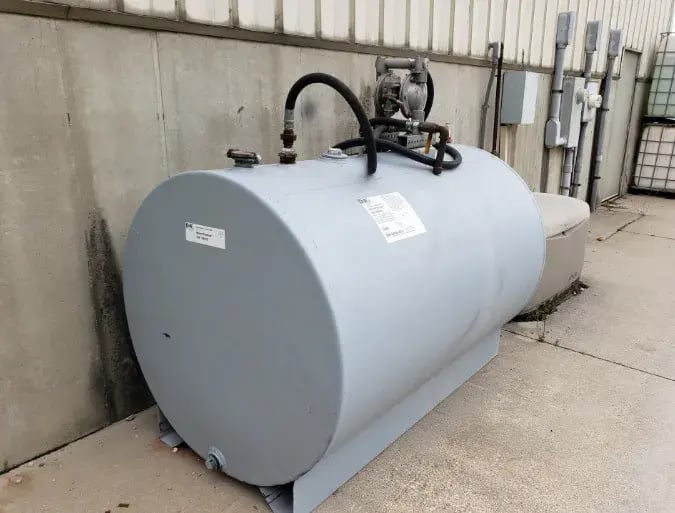
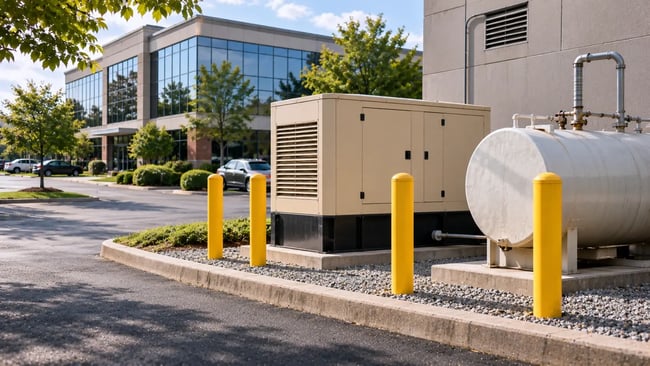
Most property managers don't think of an office park as an oil storage site. It's offices, parking lots, and a landscaping crew. Then someone walks the mechanical rooms and finds a diesel generator with a belly tank, a day tank in the building, a heating oil tank nobody has touched in years, and a few drums in the maintenance shed. Spread those across several buildings and a property can cross the federal threshold for an oil spill plan without anyone deciding it should.
The short answer is yes, if the property stores more than 1,320 gallons of oil aboveground and a spill could reasonably reach a waterway, which in New Jersey it usually can. The rule behind that is the Spill Prevention, Control, and Countermeasure rule, known as SPCC, and EPA Region 2 enforces it in New Jersey. This article covers how to count oil across a multi-building property, whether the owner or the tenant holds the plan, and why a self-certified Tier I plan often fits. If you'd rather talk it through for your own property, you can reach out to RMA anytime.
Table of Contents
TL;DR
Yes. A New Jersey office park or commercial property needs a federal oil spill plan once its oil containers of 55 gallons or more add up to more than 1,320 gallons aboveground and a spill could reasonably reach a waterway. Generators, day tanks, heating oil tanks, elevator reservoirs, and drums all count, and the total is based on tank capacity across the property, not what's in the tanks today. The property owner usually holds the plan for shared equipment, a tenant holds it for equipment it controls, and the lease should say which. Many properties stay under 10,000 gallons and can use a self-certified Tier I plan, as long as no single tank is over 5,000 gallons and the spill history is clean.
Do Office Parks and Commercial Properties Need an Oil Spill Plan Under SPCC?
Two things have to be true. The property has to hold more than 1,320 gallons of oil aboveground in total, counting only containers of 55 gallons or more, and a spill there has to be reasonably expected to reach a waterway or its shoreline. Both tests come from the federal oil spill rule, 40 CFR Part 112, and the rule puts the duty on the owner or operator of the facility. Oil covers many materials beyond fuel. Diesel, heating oil, hydraulic oil, lube oil, used oil, and vegetable oils like fryer oil all count, while propane and natural gas don't. Our guide to what counts as oil goes through the list.
The waterway test trips people up because it's judged on geography, not on what you've built to hold a spill. Catch basins and storm drains usually carry oil toward a stream, so a paved lot is more often a path to water than a barrier. Our article on the reasonable expectation test explains why "we're not near water" rarely holds up. For an office park, the question that usually decides things is the first one: how much oil is on the property in total.
If your only oil is one generator, our office building and warehouse generator article covers that case in detail. This article is about the bigger picture: several buildings, several tenants, shared equipment, and the question of who holds the plan.
What Oil Is Stored at a Typical Office Park or Commercial Property?
Most of it sits in places a property manager walks past every day. The biggest items are usually the emergency generator and its fuel tanks, which can include a sub-base or belly tank under the unit, a smaller day tank inside the building, and sometimes a separate aboveground tank. Boilers add heating oil tanks, often in basements or mechanical rooms and often older than anyone on the current staff.
The smaller sources add up. Hydraulic elevators carry oil reservoirs in the machine room, and our article on elevators, transformers, and other hidden oil covers how those get counted. A maintenance shed might hold drums of motor oil, hydraulic oil, and used oil. Tenants bring their own: a restaurant in a retail center stores fryer oil, a light-industrial tenant keeps hydraulic and lube oil for equipment, and a data tenant may run its own generator. Transformers the property owns count, but one owned and controlled by the utility is generally treated separately.
How Is Oil Storage Capacity Counted Across a Multi-Building Property?
The rule counts capacity, not contents. A 500-gallon tank that's usually a quarter full counts as 500 gallons. Every aboveground container of 55 gallons or more inside the facility boundary goes into one running total, and containers under 55 gallons are left out. The 1,320-gallon rule and our oil inventory walkthrough show the step-by-step version.
The harder part on a commercial site is deciding where one facility ends and the next begins. The rule's definition says boundaries depend on site-specific factors, and that contiguous or non-contiguous buildings, parcels, and leases under the same owner or operator may be considered separate facilities. EPA's guidance points to things like who owns or operates the equipment, whether the functions are similar, how close the buildings are, and whether they share drainage. It also says boundaries can't be drawn only to avoid the rule. EPA's own example is two contiguous 700-gallon areas under one owner with similar functions and staff, which would likely be one facility sitting above the threshold. For an office park under one owner with shared utilities and a shared generator, treating the property as one facility is usually the safest starting point.
Here's an illustrative count for a made-up four-building office park. No single item crosses 1,320 gallons, and the property still needs a plan.
| Source at the property |
Capacity (gallons) |
Counts toward 1,320? |
| Generator sub-base tank |
750 |
Yes |
| Generator day tank |
100 |
Yes |
| Heating oil tank in the boiler room |
500 |
Yes |
| Two hydraulic elevator reservoirs, 150 gallons each |
300 |
Yes |
| Three 55-gallon drums in the maintenance shed |
165 |
Yes |
| One 30-gallon used oil container |
30 |
No, under 55 gallons |
| Propane tank for the clubhouse grill |
Any |
No, propane isn't oil |
| Counted total |
1,815 |
Over the threshold |
Property Owner or Tenant: Who's Responsible for the Oil Spill Plan?
The rule assigns the plan to the owner or operator of the facility, and on a multi-tenant property both of those can be true of different people. EPA's guidance on leased property says that if you use tanks already on a property, the lease should state who is responsible for them, and that you should talk to the property owner if it doesn't. Where more than one owner or operator shares a site, EPA looks at day-to-day control, training, inspections, and cleanup responsibility. In plain terms, responsibility tends to follow whoever controls the equipment.
| Situation |
Who usually holds the plan |
Why |
| Landlord-owned generator or boiler tank serving common areas |
Property owner |
The owner controls, fuels, and maintains it. |
| Generator or tank installed and run by one tenant for its own space |
That tenant |
The tenant has day-to-day control, though the landlord should know it's there and have the arrangement in writing. |
| Generator shared by several tenants and fueled through the landlord's vendor |
Usually the property owner |
The owner arranges deliveries and maintenance, and costs may be passed through under the lease if it allows. |
| Drums, fryer oil, or shop oil kept inside a leased unit |
The tenant |
The tenant handles it, and the landlord should ask for an inventory. |
| Utility-owned transformer |
The utility |
EPA generally leaves it out of the host's capacity count, but the host should coordinate with the utility. |
A single-tenant net lease is the most confusing setup, since the tenant runs everything but the owner still holds title. New Jersey's Spill Act can reach property owners as well as the party that caused a discharge, whatever the lease says between the two of them. A fuel delivery spills shows how responsibility splits when a delivery goes wrong, and a a landlord, lender, or insurer asks for your plan explains what to send back.
What Should a Lease Say About Oil Spill Plan Responsibility?
The lease or a side agreement should name who prepares and holds the plan, who does the monthly inspections, who trains the people who handle oil, who calls in a spill, and who pays for containment repairs and deliveries. It should also require a tenant to tell the owner before it brings in a generator, a tank, or a drum storage area, because one tenant's equipment can push the whole facility over the threshold. Questions about allocating liability between owner and tenant belong with an environmental attorney. We can tell you what the plan needs to cover, not how to divide risk in a lease.
Does a Tier I SPCC Plan Fit a Commercial Property?
Often, yes. A facility that meets the qualified facility criteria can self-certify its plan instead of having an engineer certify it, and the simplest version is the Tier I plan. Most office parks with a generator, a heating oil tank, and a handful of drums sit well under the limits, and the qualified facility article walks through the full test.
| Tier I requirement |
Limit |
| Total aboveground oil capacity |
10,000 gallons or less |
| Largest single container |
5,000 gallons or less |
| Discharge history, past three years |
No single discharge over 1,000 gallons, and no two discharges over 42 gallons each within any twelve months |
| Who signs |
The owner or operator, no Professional Engineer needed |
Our example property qualifies easily at 1,815 gallons with no large tank. EPA publishes a free Tier I template, and our walkthrough of EPA's Tier I template shows where people go wrong, which is usually missing containers or claiming containment that isn't there. The template is built for simple sites. If a property needs a deviation from the standard requirements, or containment can't be built the way the rule expects, an engineer's judgment is typically required and the plan moves to a PE-certified one. When that happens, the key is that a licensed Professional Engineer visits, reviews, and certifies the plan, and our Tier I, Tier II, or PE-certified guide compares the paths. Self-certified or not, the owner or operator still has to carry out what the plan says, and the plan needs a review every five years.
On cost, RMA's SPCC plans run from $2,500 to $15,000, and a property with a generator, a heating oil tank, and some drums usually lands toward the low end. Having RMA build the plan is optional, since the template is free if you have the time to do it well. Our SPCC plan costs and what a Tier I plan costs pieces break down what drives the price, and if you'd like a ballpark for your own property, the pricing calculator below walks through it.
What Do New Jersey's Rules Add for Commercial Properties?
Three things sit on top of the federal rule. First, the Spill Act requires immediate reporting of a discharge to NJDEP, and that applies to every property, with or without a plan. The NJDEP hotline is 1-877-WARNDEP (1-877-927-6337). Second, New Jersey requires discharge prevention and cleanup plans, called DPCC and DCR plans, for “major facilities” under N.J.A.C. 7:1E. A property is a major facility at 20,000 gallons of non-petroleum hazardous substances or 200,000 gallons of hazardous substances of all kinds, including petroleum. A typical office park is nowhere near that, but a large campus with big tanks or chemical storage should check the rule against its own inventory. See our SPCC plan and a DPCC plan article for the comparison.
Third, buried tanks fall under New Jersey's underground tank program, N.J.A.C. 7:14B, which covers some nonresidential heating oil tanks and requires NJDEP-certified contractors for installation and closure. Whether a buried tank counts toward the federal total depends on which rules cover it, and our articles on buried tanks count toward SPCC and heating oil tank article explain how. The Uniform Fire Code adds tank and generator requirements enforced by your local fire official, and our fire code and SPCC overlap article covers the overlap.
Installing a new generator or tank on a property involves construction and fire permits, and RMA doesn't prepare those. Your contractor, engineer, and local officials handle that side. What RMA helps with is the operational side that follows: a new or expanded facility needs its plan in place before it starts operating, and we can help you figure out what the construction phase needs and point you to the right professionals. Adding a generator covers the plan side.
How Should a Property Manager Handle Oil Spill Plan Compliance?
Start with a walk of the whole property, building by building, writing down every container of 55 gallons or more and its capacity. Include mechanical rooms, the maintenance shed, and any tenant spaces you can get into. Then decide the facility boundary and who the operator is for each piece of equipment, check the leases against that list, and add up the total. If it's under 1,320 gallons, keep the count on file, since it changes whenever a tenant moves in or a tank gets replaced.
If it's over, pick the plan type that fits, get the plan written, and put the routine in place: monthly inspections using a monthly inspection checklist, annual training for the people who handle oil through our online training library, and the five-year review. Sales and financing bring the question up too, so if you're buying or selling a property with oil tanks, or a lender or insurer has asked for your plan, expect a deadline.
How Can RMA Help With an Oil Spill Plan for Your Property?
We're based in New Jersey and work with property owners and managers on exactly this. We can walk your property, count the oil, and tell you whether you need a plan at all. If you do, we'll tell you which type fits and what it should cost, and if you'd rather use EPA's free template, we'll say so. Where the rule calls for an engineer, we make sure a licensed PE reviews and certifies the plan.
There's no obligation. You can call us at 888-RMA-0230, email us, or fill out the form on our website, and we'll get back to you. If you'd like to see how our process works first, our SPCC pricing calculator and our SPCC plans in New Jersey article are good places to start, and what an SPCC plan is is the plain-language primer.