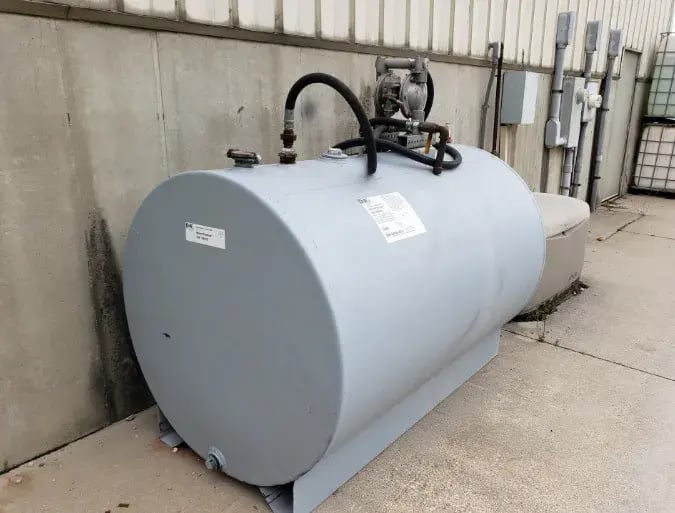
60 Plain-English Answers on SPCC Applicability, Oil Counting, Plan Tiers, Containment, Inspections, PE Certification, New Jersey Tank Rules, and Enforcement
If your New Jersey facility stores diesel, hydraulic oil, used oil, or fuel for a generator, someone will eventually ask whether you have an SPCC plan. The question usually comes from an EPA inspector, an insurer, a landlord, or a customer's vendor form, and it rarely arrives in words the person receiving it already understands. SPCC stands for Spill Prevention, Control, and Countermeasure, and it's EPA's federal oil spill prevention rule under 40 CFR Part 112. New Jersey adds its own layer on top, with the Spill Act, discharge prevention plans for larger facilities, underground tank rules, and a fire code enforced by your local fire official.
We put this page together from the questions facility managers ask us most, and each answer stands on its own, so you can jump straight to the one you need. The sections cover who needs a plan, how to count oil, which plan tier applies, containment and tank rules, inspections and records, amendments, how New Jersey rules overlap with the federal rule, cost, and enforcement. Where a deeper article exists, we link to it. If you'd rather talk your situation through with a person, you can reach out to RMA at any point.
Table of Contents
TL;DR
A New Jersey facility needs a federal SPCC plan when it stores more than 1,320 gallons of oil aboveground, counting containers of 55 gallons or more by capacity, and could reasonably be expected to reach navigable waters. Facilities with 10,000 gallons or less and a clean three-year spill history can usually self-certify, and larger or more complex sites need a licensed Professional Engineer. New Jersey adds the Spill Act, discharge prevention plans for major facilities, underground tank rules, and fire code requirements. This page answers 60 common questions on each of those pieces.
Who Needs an SPCC Plan in New Jersey?
What is an SPCC plan?
An SPCC plan is a written oil spill prevention plan that EPA requires under 40 CFR Part 112, part of the Clean Water Act. It describes what oil your facility stores, where it sits, how it's contained, how you inspect it, who's trained, and what you do if oil gets out. The plan stays at your facility, usually isn't filed with EPA, and has to be available when an inspector asks for it. Our overview of what an SPCC plan is walks through the full picture.
Who needs an SPCC plan in New Jersey?
A non-transportation facility needs one when it stores more than 1,320 gallons of oil aboveground, counting only containers of 55 gallons or more, and could reasonably be expected to discharge oil to navigable waters or adjoining shorelines. More than 42,000 gallons of completely buried oil storage that isn't covered by underground tank rules also triggers it. Most facilities find out by adding up every tank, drum, and piece of oil-filled equipment, and our guide on how to determine whether your New Jersey facility needs an SPCC plan shows how.
Do I need an SPCC plan if I store less than 1,320 gallons?
Not under the federal rule, as long as your total aboveground oil in containers of 55 gallons or more is 1,320 gallons or less. New Jersey's rules still apply to you, though. The Spill Act requires you to report discharges and puts cleanup responsibility on the party responsible, and local fire officials enforce tank storage requirements under the Uniform Fire Code. A small facility with no plan still needs to know its numbers, so check whether your oil storage adds up to a federal spill plan before assuming you're under.
What does "reasonable expectation of a discharge" mean?
It's the second half of the SPCC test. Even above 1,320 gallons, a facility is excluded only if its location alone means oil couldn't reach navigable waters or adjoining shorelines. That call has to rest on geography, such as distance to water, land contour, and drainage. It can't rely on dikes, equipment, or other manmade structures that might stop a spill. Our post on the reasonable expectation of discharge test explains why the exclusion is hard to document.
Does being far from water get my facility out of SPCC?
Rarely. Storm drains, ditches, swales, and streams that lead toward larger waterways all count as pathways in the analysis, and New Jersey's dense network of waterways and drainage makes a clean "no" tough to support. The exclusion has to hold up when an inspector asks you to explain it, using location facts alone. Read why being far from water rarely gets a New Jersey facility out of SPCC for examples.
What counts as oil under the SPCC rule?
Oil covers petroleum products such as diesel, gasoline, motor oil, hydraulic fluid, lube oil, transformer oil, and used oil. It also covers non-petroleum oils, including vegetable oils, animal fats, and synthetic oils. Propane and natural gas aren't oil. Fryer oil and cooking oil count, which catches kitchens and food plants off guard, so our guide to what counts as oil at a New Jersey business lists the common materials on both sides.
Which containers and facilities does the SPCC rule exempt?
The rule excludes containers under 55 gallons, motive power containers such as vehicle fuel tanks, permanently closed containers, hot-mix asphalt, pesticide application equipment, milk and milk product containers, and heating oil used solely at a single-family residence. Facilities used only for wastewater treatment also have an exclusion. An exempt container can still matter under New Jersey rules, and our article on SPCC exemptions in New Jersey covers where the overlap shows up.
Does a backup generator trigger an SPCC plan?
A generator can, and it often does in combination with other oil. A generator's belly tank or day tank counts at its full capacity, and that number gets added to your drums, bulk tanks, and equipment. Offices, hospitals, schools, warehouses, and data centers usually land over the threshold once the generator joins the tally. Read how a backup generator affects your need for an oil spill plan, or the version for an office building or warehouse with a generator.
When does a new facility need its SPCC plan?
Before it begins operations. A facility that becomes operational and could reasonably be expected to discharge oil has to prepare and implement its plan before oil goes into service. Construction-phase approvals, tank installation permits, and UST installation by NJDEP-certified contractors run through your engineer, contractor, and local officials, and RMA doesn't handle that part. We help with the operational side: the SPCC plan, spill procedures, inspections, and training, and we can point you toward the right construction people.
How Do You Count Oil Storage for SPCC?
How do I add up my facility's oil storage?
Count the full shell capacity of every aboveground oil container of 55 gallons or more, no matter how full it is. Add bulk tanks, drums, totes, day tanks, used oil containers, and oil-filled equipment together. The rule counts capacity, not contents, so a half-empty 500-gallon tank is still 500 gallons. Start with a walk-through and a written inventory, and use our guide on how to inventory oil tanks, drums, and equipment to keep the list organized. The 1,320-gallon rule article covers the math in more detail.
| Counts toward 1,320 gallons |
Doesn't count |
| Bulk tanks, generator belly tanks, and day tanks |
Containers under 55 gallons |
| 55-gallon drums and 275-gallon totes |
Permanently closed containers |
| Used oil tanks and drums |
Motive power containers (vehicle fuel tanks) |
| Transformers, hydraulic reservoirs, and other oil-filled equipment of 55 gallons or more |
Propane and natural gas |
| Vegetable oil and animal fat containers |
Hot-mix asphalt containers |
| Bunkered and partially buried tanks |
Single-family residential heating oil tanks |
Do 55-gallon drums count toward the SPCC threshold?
Yes. Each full-size drum counts at its 55-gallon capacity whether it's full or empty. Twenty-four drums equal exactly 1,320 gallons, which is not over the line, and a twenty-fifth drum puts you at 1,375. A shop with a few drums of motor oil, hydraulic fluid, and used oil adds up faster than the drum count suggests, especially once a bulk tank joins them. Our post on how many oil drums a New Jersey shop can have breaks down totes and drum areas too.
Do empty containers count toward the total?
Yes, unless they're permanently closed. The rule counts capacity, so an empty 1,000-gallon tank still adds 1,000 gallons. To drop out of the count, a container has to be permanently closed: emptied of oil and sludge, disconnected from piping, valves closed and locked, and marked as permanently closed. A tank you might use again next season isn't closed. If you're shutting oil storage down on purpose, our post on going idle or closing a New Jersey facility explains what the plan needs to say.
Does propane count as oil for SPCC?
No. Propane is a gas, not an oil, so propane tanks don't count toward the 1,320-gallon threshold and don't need to be in your SPCC plan. The same is true of natural gas. Other fuels that aren't oil can still raise New Jersey fire code or hazardous substance questions, even though they don't count here. Our article on propane and other fuels that aren't oil sorts the common ones.
Does vegetable oil or cooking oil count toward SPCC?
Yes. The rule covers animal fats and vegetable oils along with petroleum, so fryer oil, shortening, tallow, and used cooking oil containers count at full capacity. Food plants and commercial kitchens are the facilities that tend to miss this. A bulk tote of cooking oil and a used grease tank can push a site over 1,320 gallons without a drop of diesel. See whether vegetable oil needs an SPCC plan at a New Jersey food plant for the details.
Does used oil count toward the SPCC threshold?
Yes. Used oil tanks and drums at garages, fleet shops, and manufacturers count at their full capacity, and they need the same containment and inspection as your clean oil. People often leave used oil out of their tally because it's headed for disposal, but it's sitting in a container on your property in the meantime. Our guide on how used oil counts toward federal spill rules at New Jersey businesses covers the details.
Does oil-filled equipment like a transformer or hydraulic system count?
Yes, when the equipment holds 55 gallons or more. Transformers, hydraulic presses, elevator reservoirs, and compressors all count at the oil capacity of the unit. Qualifying oil-filled operational equipment can use an alternative to general secondary containment, which is a documented monitoring program plus an oil spill contingency plan. It isn't a shortcut, and it only works with a clean spill history. See hidden oil at New Jersey businesses and the contingency plan option for oil-filled equipment.
Do underground tanks count toward SPCC?
Completely buried tanks that meet federal underground tank requirements, or New Jersey's under N.J.A.C. 7:14B, are excluded from SPCC. A buried tank that isn't covered by those rules counts toward a separate 42,000-gallon buried threshold. Bunkered, partially buried, and vault tanks are treated as aboveground and count toward the 1,320-gallon total. Which bucket a tank falls into depends on how it's regulated, and our post on when buried tanks count toward SPCC and when they don't explains how to tell.
Do heating oil tanks count toward SPCC?
Only a heating oil tank used solely at a single-family residence is excluded. Heating oil tanks at businesses, churches, schools, multi-family buildings, and other commercial or institutional properties count at full capacity. New Jersey has its own tank rules on top of that, and nonresidential tanks over 2,000 gallons fall under the state underground tank program when buried. Read when heating oil tanks bring federal spill rules to New Jersey businesses for a worked example.
Which SPCC Plan Tier Applies, and Who Can Certify It?
What are the types of SPCC plans?
There are three paths: a Tier I qualified facility plan built on EPA's template, a Tier II self-certified plan, and a full plan certified by a licensed Professional Engineer. Which one fits comes down to your total aboveground storage, your largest container, and your spill history. Our post on Tier I, Tier II, or PE-certified plans in New Jersey walks through the decision.
| Plan type |
Aggregate aboveground oil |
Largest single container |
Spill history (3 years) |
Who certifies |
| Tier I |
10,000 gallons or less |
5,000 gallons or less |
Clean |
Owner or operator, using EPA's template |
| Tier II |
10,000 gallons or less |
Can exceed 5,000 gallons |
Clean |
Owner or operator, with a PE for any alternatives |
| PE-certified |
Any amount |
Any size |
Any history |
Licensed Professional Engineer |
What is a qualified facility?
A qualified facility is one that can self-certify its SPCC plan instead of hiring a PE. It needs 10,000 gallons or less of total aboveground oil storage and a clean spill history for the three years before self-certification. Tier I and Tier II are the two flavors. A facility that fails either test needs a PE-certified plan. Our article asking whether your New Jersey facility is a qualified facility has the full criteria.
What spill history disqualifies me from self-certifying?
In the three years before you self-certify, you can't have had a single discharge over 1,000 gallons or two discharges each over 42 gallons within any 12-month period. These are discharges that reached navigable waters or adjoining shorelines, and natural disasters, acts of war, and terrorism are excluded. A reportable discharge in that window can end eligibility. Read our post on when a New Jersey oil spill must be reported to EPA for how the same numbers drive reporting.
Can I write my own SPCC plan?
If you're a qualified facility, yes. A Tier I facility can complete EPA's Appendix G template, and a Tier II facility can write a full self-certified plan. You're certifying that you know the rule, have visited the site, and will fully implement the plan, so the plan has to match what's really on the ground. See our walkthroughs on how to write your own SPCC plan and how to complete EPA's SPCC template before you start.
When does a Professional Engineer have to certify my SPCC plan?
A PE has to certify when you don't qualify to self-certify, which means more than 10,000 gallons of aboveground storage or a reportable spill history. A PE is also required for certain choices even in a Tier II plan: environmental equivalence, impracticability determinations that replace secondary containment, and technical amendments to a PE-certified plan. Our post on self-certifying versus hiring an engineer in New Jersey lays out the dividing lines.
What does a PE do when certifying an SPCC plan?
The PE attests that they're familiar with Part 112, have visited or examined the facility, prepared the plan consistent with good engineering practice, established inspection and testing procedures, and found the plan adequate. Certification doesn't take the responsibility for carrying out the plan off the owner. The engineer's review is where weak containment and gaps in testing get caught. See what a professional engineer does when certifying an SPCC plan in New Jersey.
Does my SPCC plan engineer need a New Jersey license?
The federal rule requires a licensed Professional Engineer and doesn't say which state's license. New Jersey engineering licensure law may also bear on engineering work done in the state, so confirm with whoever you hire before you commit. We'd rather you ask that question up front than learn about it during an inspection. Our post on whether an SPCC plan needs a New Jersey-licensed engineer covers what to ask.
Who can write and certify an SPCC plan in New Jersey?
You can, if you qualify, or you can hire a consultant, an engineering firm, or an online service. What matters is that a PE reviews and approves the plan where one is required. Some firms have a PE on staff and others work with a trusted outside PE, so ask who is certifying, how they'll visit the site, and who answers questions later. Our comparison of every option for writing and certifying an SPCC plan in New Jersey lines up the trade-offs.
Can ChatGPT or an online service write my SPCC plan?
A plan has to describe your actual tanks, containment, drainage, and procedures, and a chatbot can't see your site. Generic output tends to read well and get the facts wrong. RMA doesn't use AI to produce client deliverables, and we say so openly. Online services can work for simple facilities with good documentation, but ask who visits the site and who certifies. Read whether ChatGPT can write an SPCC plan and whether you can get an SPCC plan online.
What if the engineer who certified my SPCC plan retired or disappeared?
Your plan doesn't become invalid on its own, but any technical changes since the original certification need a current PE's review. A new licensed engineer can review the plan, certify what needs certifying, and bring it current, usually with a site visit. Don't wait for an inspector to find the gap. Our post on what to do when the PE who certified your plan retired or disappeared lays out the steps.
What Are the SPCC Secondary Containment and Tank Requirements?
How big does SPCC secondary containment need to be?
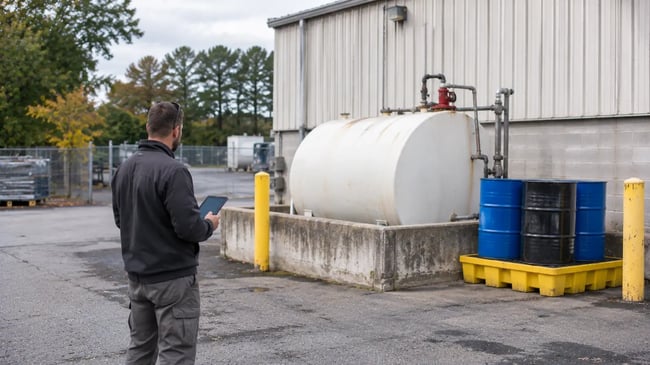
For bulk storage, containment has to hold the full capacity of the largest single container plus enough freeboard for rain. Loading areas need to hold at least the largest single compartment of the tank truck that uses them. The containment also has to be impervious enough to hold oil until it's cleaned up. Our post on how big your SPCC oil spill containment needs to be works through sizing for common setups.
How much freeboard does SPCC containment need for rain?
The federal rule doesn't give a number. EPA guidance points to the precipitation from a 25-year, 24-hour storm, and many older plans use a 110 percent rule of thumb that may fall short in a large storm. Rainfall depth varies across the state, so the right number depends on your county and your containment footprint. See our guide on how to evaluate secondary containment for your SPCC plan.
What is New Jersey's six-inch rain rule for containment?
Under N.J.A.C. 7:1E-2.6, secondary containment at major facilities has to include extra capacity for six inches of rainwater wherever rain could collect in it, on top of the largest tank or container. Loading areas get the same allowance on top of the largest compartment. It applies to facilities covered by New Jersey's DPCC rules, and where both programs apply, size to the stricter number.
| Example: 5,000-gallon tank, 500 square foot dike floor |
Containment needed |
| Largest tank only |
5,000 gallons |
| 110 percent rule of thumb |
5,500 gallons |
| New Jersey six-inch rule |
About 6,870 gallons (1,870 gallons of rain) |
Real dikes also need room for the volume that other equipment displaces, so treat these figures as the floor.
Do drums and totes need secondary containment?
Yes. Mobile and portable containers have to be positioned to prevent a discharge and need containment sized for the largest container or compartment, with limited exceptions such as mobile refuelers. New Jersey's rules for major facilities also call for containment at tote and drum storage areas. Spill pallets, containment lockers, berms, and indoor storage all work when they're sized correctly. See secondary containment for drums and totes at New Jersey facilities.
Does a double-walled tank count as secondary containment?
Sometimes, but not automatically. A second wall can catch oil from a leak in the inner shell, but it doesn't do anything for overfills, piping leaks, or spills during delivery, and an engineer should confirm how your particular tank handles precipitation and testing. Inspectors expect the reasoning to be written down in the plan. Our article asking whether double-walled tanks count as secondary containment covers what the second wall does and doesn't cover.
Do aboveground oil tanks need integrity testing?
Yes. Aboveground bulk containers have to be inspected or tested on a regular schedule and after material repairs. Acceptable methods include visual inspection, hydrostatic testing, ultrasonic testing, radiographic testing, and acoustic emissions testing, and you have to inspect the supports and foundations as well. The rule leaves the schedule to good engineering practice and industry standards, and you keep comparison records. Read about integrity testing for bulk oil containers at New Jersey facilities.
What overfill prevention does the SPCC rule require?
Each bulk container needs at least one safeguard, such as a high-level alarm, a high-level pump cutoff, direct communication between the person filling and the pump operator, or a fast-response level-sensing system. Any level-sensing devices must be tested regularly. Many tank spills come from overfills during delivery, not from failed walls. See overfill prevention for oil tanks at New Jersey facilities for alarms, gauges, and delivery procedures.
Can I drain rainwater out of my containment dike?
Yes, with conditions. You can drain uncontaminated rainwater from a diked area only if the drain valve is normally kept sealed closed, the water is inspected first, the valve is opened and resealed under responsible supervision, and you keep records of each drainage event. If there's any sheen or oil in the water, it doesn't go out the valve. Our post on draining rainwater from your containment dike includes a documentation approach that holds up in an inspection.
What are the SPCC rules for fuel delivery and unloading areas?
Tank truck unloading areas need containment or quick drainage sized for at least the largest single compartment of a truck, and you need interlocks, warning devices, or wheel chocks to keep a truck from driving off while still connected. Drivers and staff should inspect the truck's lowermost drains and outlets before departure. See fuel delivery areas and the unloading requirements that get overlooked.
How Do SPCC Inspections, Training, and Recordkeeping Work?
How often do I have to inspect my SPCC-regulated tanks and containers?
The rule requires inspections and tests under written procedures and doesn't set one frequency for every facility. Monthly visual inspections are the common practice, and whatever your plan commits to is what an inspector will hold you to. Write a schedule you'll really keep. Our monthly SPCC inspection checklist for New Jersey facilities is a good starting point, and the New Jersey SPCC compliance calendar lays out the full year.
What SPCC records do I have to keep, and for how long?
Keep the written inspection and test procedures and the signed records of each inspection and test with your plan for three years. Usual business records can satisfy this. Most facilities also keep drainage logs, training sign-in sheets, the signed five-year review statement, and amendment records in the same binder or folder. See SPCC recordkeeping at New Jersey facilities for what to keep and where.
Who needs SPCC training, and how often?
Oil-handling employees need training on equipment operation and maintenance, discharge procedures, the applicable laws, and the contents of your plan. You also have to name a person accountable for discharge prevention and hold discharge prevention briefings at least once a year. Document who attended and what you covered. Read our guide to SPCC training for New Jersey oil-handling employees, use the annual discharge prevention briefing agenda, or browse RMA's online environmental training library.
What goes into SPCC spill response procedures?
The plan has to let someone reporting a spill supply the facility location and phone number, the date and time, the material, quantity, source, affected areas, cause, response actions, and who's been contacted. Procedures should be organized so staff can use them in an emergency, and they should name the equipment on hand, such as spill kits and sorbents. See how to write SPCC inspection and spill response procedures and what to stock in spill kits.
Does my SPCC plan need a facility diagram?
Yes. The plan needs a facility diagram showing the location and contents of each container, transfer stations, connecting pipes, and the spots where a spill would travel. Many facilities build one from aerial imagery or site plans. A hand sketch can work at small sites, but it stops being enough once the layout gets complicated. See how to draw an SPCC facility diagram for a New Jersey site, and what goes into an SPCC plan for the other sections.
When Does an SPCC Plan Need an Amendment or Five-Year Review?
Does an SPCC plan expire?
No, an SPCC plan doesn't have an expiration date. The rule requires you to review and evaluate it at least once every five years, document the review, and sign a statement saying whether you'll amend the plan as a result. The five years run from your last required review. Our post on how long a New Jersey SPCC plan is good for explains the review rule and what the signed statement looks like.
What happens if my SPCC plan is overdue for its five-year review?
An overdue review is a common inspection finding, and the fix is to do the review now, document it, and amend whatever it turns up. The older the plan, the more likely it no longer matches the site, and then the review turns into a rewrite. When RMA sees an outdated plan someone else wrote, we usually rebuild it so we can stand behind it. Read how exposed an overdue New Jersey SPCC plan leaves you.
What changes require an SPCC plan amendment?
Any change in design, construction, operation, or maintenance that materially affects the potential for a discharge. That includes adding or removing containers, replacing tanks, changing piping, altering secondary containment, changing products, and revising procedures. Prepare the amendment within six months of the change and implement it as soon as possible, no later than six months after it's prepared. A PE certifies technical amendments unless a qualified facility self-certifies. See replacing an old tank, expanding a facility, and adding a backup generator.
What happens if my facility goes over 10,000 gallons of oil storage?
You lose qualified facility status, and self-certification ends. A Tier I facility that adds a container over 5,000 gallons or goes over 10,000 gallons total has to move to the next level within six months of preparing the amendment. A Tier II facility that crosses 10,000 gallons needs a full plan certified by a PE. Plan for it before you install new storage. Our post on crossing 10,000 gallons of oil storage explains the sequence.
What happens to my SPCC plan when I buy, sell, idle, or close a facility?
The obligation follows the facility's oil and its operator. A buyer who takes over a site with oil storage needs a plan that fits their operation, and a seller who leaves oil behind can't assume the plan went away. A facility that goes idle or closes still has to deal with the oil left on site. See buying or selling a facility with oil tanks and what happens to your SPCC obligations when a facility goes idle or closes.
How Do SPCC Rules Overlap With New Jersey DPCC, Tank, and Spill Rules?
Does New Jersey require a separate spill plan on top of SPCC?
For major facilities, yes. New Jersey's Spill Act rules at N.J.A.C. 7:1E require a discharge prevention, containment and countermeasure plan (DPCC) and a discharge cleanup and removal plan (DCR), submitted to NJDEP for approval. One plan can't replace the other, though they draw on the same site data. A facility can need only SPCC, both, or only DPCC and DCR, such as a chemical warehouse with no oil. Read our post on whether you need both an SPCC plan and a DPCC plan.
What is a "major facility" under New Jersey's rules?
A major facility has a total storage capacity of at least 20,000 gallons of hazardous substances other than petroleum, or at least 200,000 gallons of all hazardous substances including petroleum. Storage counts the design capacity of tanks and containers over five gallons, and a tank only drops out when it meets the rule's definition of out of service. The list of hazardous substances grew in June 2025 when NJDEP added more than 200 PFAS compounds. Check N.J.A.C. 7:1E against your own inventory, since the answer depends on what you store.
Who enforces SPCC in New Jersey?
EPA Region 2 enforces the federal SPCC rule in New Jersey. NJDEP enforces the Spill Act, the discharge prevention rules at N.J.A.C. 7:1E, and the underground tank program at N.J.A.C. 7:14B, and local fire officials enforce the Uniform Fire Code on tank storage. A facility can hear from all three over the same set of tanks. Read who enforces SPCC plans and how fire code and SPCC overlap in New Jersey.
Who do I call when oil spills at my New Jersey facility?
Call 911 first for a fire, an injury, or any danger to people. Then call the NJDEP hotline at 1-877-WARNDEP (1-877-927-6337) right away, since New Jersey law requires most discharges to be reported immediately. If oil reaches a waterway or leaves a sheen, call the National Response Center at 1-800-424-8802 as well. Small-discharge exceptions exist in N.J.A.C. 7:1E-5, so ask before assuming a spill is too small to report. Read the sheen rule explained for the federal side.
When do I have to send a written spill report to EPA?
The SPCC rule requires a written report within 60 days after a single discharge of more than 1,000 gallons, or two discharges of more than 42 gallons each within any 12-month period, when the oil reaches navigable waters or adjoining shorelines. It goes to the EPA Regional Administrator (Region 2 for New Jersey) with a copy to NJDEP. A reportable discharge can also end your eligibility to self-certify. See when a New Jersey oil spill must be reported to EPA.
Do New Jersey's underground tank rules apply to my tanks?
They apply to regulated underground storage tanks under N.J.A.C. 7:14B, which include state registration and operating requirements. Residential heating oil tanks and nonresidential heating oil tanks of 2,000 gallons or less used on site are exempt from that program, but nonresidential tanks over 2,000 gallons are regulated. Installation, closure, and testing generally require NJDEP-certified professionals, and cleanup of a regulated tank usually goes through a Licensed Site Remediation Professional (LSRP). See heating oil tanks at New Jersey businesses and underground tanks and SPCC.
Who's responsible for a spill at my New Jersey facility?
Under the Spill Act, liability is strict and can be joint and several, which means the party responsible for the discharge, and often the property owner or operator, can end up on the hook for cleanup costs regardless of fault. Spills during fuel deliveries raise questions about the driver, the supplier, and the facility. This isn't legal advice, and an environmental attorney is the right call for liability and enforcement questions. See who's responsible for a fuel delivery spill and when oil storage goes beyond SPCC into Facility Response Plans.
What Does an SPCC Plan Cost in New Jersey?
How much does an SPCC plan cost in New Jersey?
RMA's SPCC plans generally run from $2,500 to $15,000, depending on total storage, the number and type of containers, the number of buildings and areas on site, and whether PE certification is needed. A small Tier I facility using EPA's free template spends mostly staff time, containment fixes, and any outside help it chooses. Read SPCC plan costs explained and our breakdown of what a Tier I SPCC plan costs in New Jersey.
Why do PE-certified SPCC plans cost more?
A PE-certified plan comes with a site visit, an engineering review of containment, tank integrity, and procedures, and a licensed professional putting their seal and liability behind the result. Bigger sites also have more containers and more containment to evaluate. Costs rise with total capacity, container count, secondary containment complexity, and whether the facility has to be evaluated for impracticability. See why PE-certified SPCC plans cost more in New Jersey.
How can I save money on an SPCC plan?
Start with a complete inventory, a good site diagram, and organized records, since a consultant's time goes up when they have to find the basics. Qualified facilities can use EPA's template and save the consulting fee. The cheapest proposal can also leave gaps that cost more at inspection. Read how a small business can save money on an SPCC plan in New Jersey and the red flags in an SPCC plan proposal. RMA's SPCC pricing calculator is below, and it gives a ballpark based on your own facility.
What Happens in SPCC Enforcement and Inspections?
What are the penalties for SPCC violations?
Federal penalties are adjusted for inflation every year under 40 CFR Part 19. In the January 2025 table, EPA administrative penalties for Clean Water Act section 311 violations ran up to $23,647 per violation, and civil judicial penalties for failing to carry out SPCC requirements reached $59,114 per day of violation. Check the current table, since the numbers move. Our post on the top SPCC plan violations and fines lists the usual findings, and RMA's violation cost calculator gives a rough exposure.
What is an EPA expedited settlement agreement for SPCC violations?
It's a fast-track penalty offer EPA may extend when the violations found fit its checklist. You can't apply for one, and EPA decides whether to offer it. Signing generally means correcting the listed violations, documenting the fixes, paying the penalty, and giving up hearing rights, and the resulting order is public. It settles only the listed violations, not New Jersey requirements. Read EPA expedited settlement agreements for SPCC violations at New Jersey facilities.
Why is my customer, landlord, or insurer asking for my SPCC plan?
They want proof you manage spill risk, since a spill can become their liability too. Send them a copy of the plan or a summary page showing that it exists, who certified it, and when it was last reviewed. If you don't have a plan, don't make one up on short notice. Work out whether you need one first. Our post on what it means when a customer, landlord, or insurer asks for your SPCC plan explains what to send back.
How Can RMA Help With Your New Jersey SPCC Plan?
RMA is a family-run environmental consulting firm based in New Jersey, and SPCC plans are a core part of our work. If you're not sure whether your facility needs a plan, we'll tell you straight, including when you don't need us. If you do need one, we help you count your oil, work out which plan tier fits, evaluate containment, and put together a plan, inspection routine, and training program your staff will keep up. Our senior people do the actual work, and we publish our pricing and process so you know what to expect. To see how we work and what it costs, start with our SPCC plan process and the SPCC resource library.
There's no pressure and no obligation. You can call us at 888-RMA-0230, email, or fill out the form on our website, and we'll talk through your tanks, your spill history, and what an inspector would look for. When you're ready, contact RMA about your New Jersey SPCC plan. If there's construction involved, such as new tanks or a new containment dike, that piece goes through your engineer and contractor, and we can point you toward the right people while we handle the operational plan.